Preparing for Your First Trichologist Appointment: What to Know

You don’t need to arrive with all the answers, just useful observations. Preparing for your first trichologist appointment can feel daunting when you’re unsure which changes matter or what the assessment involves. You don’t need to diagnose the cause yourself. Notes about when thinning or shedding began, where you’ve noticed it and any changes in your hair or scalp can make the conversation more useful.

A clinical assessment can add detail that memory and a quick glance in the mirror may miss. At Hair Health Australia’s Hair Health Check in Redfern, Sydney, a microscopic Trichoscopy scan assesses active hair follicles and helps diagnose the type of hair loss. The check is free, with no obligation, and takes ONLY 30 MINS. Specialists explain the findings and tailor treatment plans to your individual diagnostic results.

This guide covers what to note before your appointment, what to expect during an assessment and questions that can help you understand your next steps. You’ll be better prepared to discuss your concerns and leave with clearer information about your options.

Key Takeaways

  • When preparing for your first trichologist appointment, note when changes began and what you’ve observed, without trying to diagnose the cause yourself.
  • Microscopic Trichoscopy assesses active hair follicles and helps identify the type of hair loss.
  • Use the assessment to understand the diagnosis, the reasoning behind recommendations and how proposed next steps relate to your results.
  • A simple checklist of your hair-change timeline, relevant history and questions can help you feel organised. Records and product details are useful context, not requirements.
  • Hair Health Australia’s Sydney Hair Health Check is free, with no obligation, and takes ONLY 30 MINS.

Preparing for your first trichologist appointment: start with what you have noticed

Noticing more hair in your brush, a wider-looking part or a change in your hairline can feel unsettling. You don’t need to arrive with a theory about why it’s happening. Start by describing what you’ve observed, when it began and whether it has changed. These details help frame the conversation without turning your notes into a self-diagnosis.

Hair changes can involve shedding, density, the hairline or the condition of your scalp. One observation alone doesn’t identify a cause, and patterns vary between people. If you’re curious about the field, What is Trichology? offers background on its focus on hair and scalp health. For your appointment, everyday descriptions are enough: “my part looks wider in photos” or “I’ve noticed more hair coming away when I wash it”.

What changes should you write down before the appointment?

Jot down a few observations while they’re fresh. You’re building a useful record, not preparing a clinical report. Include what you’ve noticed, even if you’re unsure whether it’s relevant. The assessment can help put those details into context.

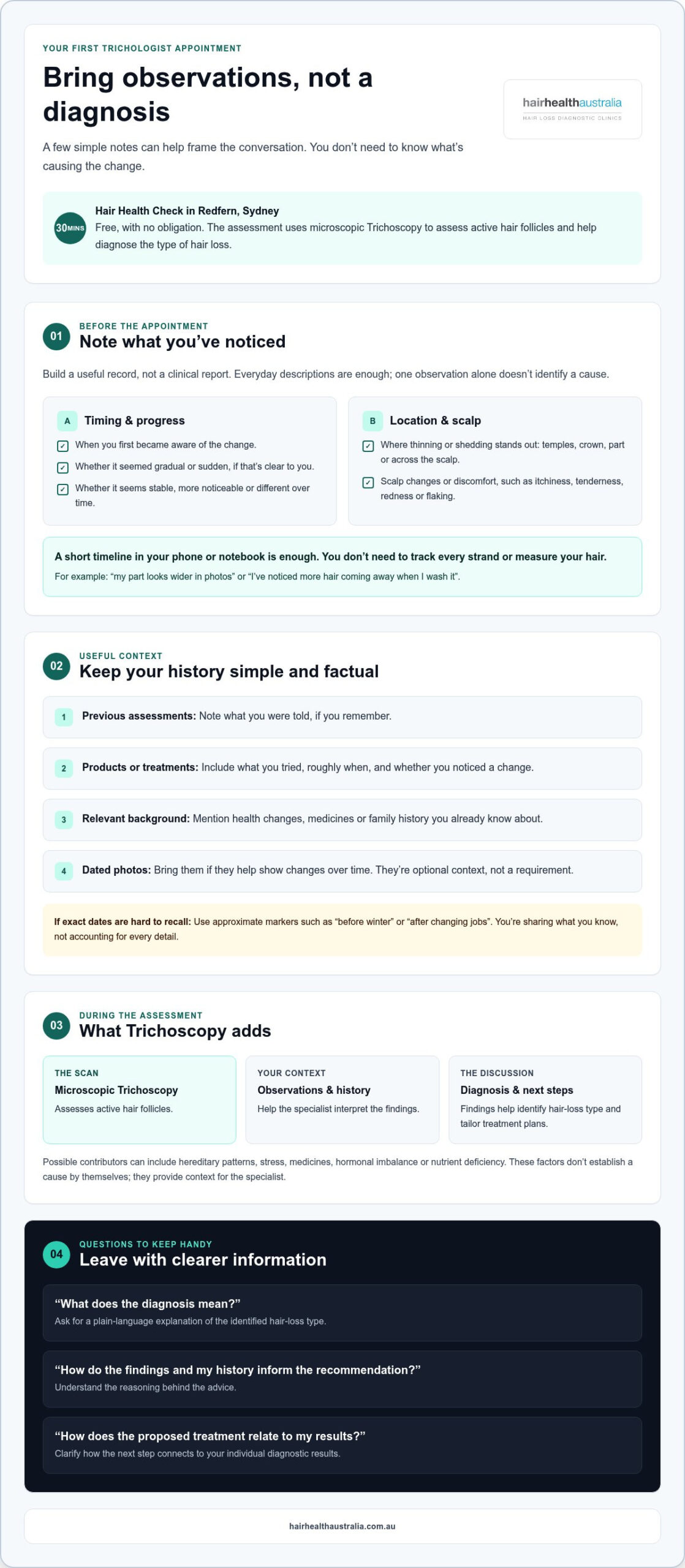
  • Timing: Note when you first became aware of the change. Describe it as gradual or sudden if that’s clear to you.
  • Location: Record where thinning or shedding stands out, such as around the temples, crown, part or across the scalp.
  • Scalp observations: Mention visible changes or discomfort, such as itchiness, tenderness, redness or flaking. Describe what you experience rather than trying to label a condition.
  • Progress: Note whether the change seems stable, more noticeable or different in certain areas over time.

A dated record can make a first assessment more focused by showing when changes began and how they developed, rather than relying on memory alone. A short timeline in your phone or notebook is enough. You don’t need to track every strand or measure your hair.

How can you describe your hair-loss history clearly?

When preparing for your first trichologist appointment, keep your history simple and factual. A few dates or brief notes can help organise what you remember, especially if changes have happened over an extended period.

  • List any previous assessments and what you were told, if you remember.
  • Note products or treatments you’ve tried, roughly when you used them and whether you noticed a change.
  • Include relevant health changes, medicines or family history that you already know about.
  • Bring dated photos if they help show changes over time. They’re optional context, not a requirement.

If you can’t recall exact dates, use approximate markers such as “before winter” or “after changing jobs”. The aim is to share what you know, not account for every detail. Your notes give the specialist a clearer starting picture, while the assessment helps interpret the pattern and guide a discussion about next steps.

What happens at a first trichologist appointment and what can it clarify?

A first appointment is an opportunity to move from noticing a change to understanding what type of hair loss may be involved. At Hair Health Australia’s Hair Health Check, microscopic Trichoscopy is used as part of the assessment. This scan assesses active hair follicles and helps diagnose hair-loss type. Your observations and history add context, and the findings inform a discussion about suitable next steps.

What can a microscopic Trichoscopy scan show?

The Trichoscopy scan assesses active hair follicles. It forms part of the Hair Health Check’s full clinical diagnosis of hair-loss type. The scan gives the specialist follicle information to consider alongside what you’ve noticed about density or shedding.

During Hair Health Australia’s Hair Health Check, microscopic Trichoscopy assesses active hair follicles and helps diagnose the type of hair loss.

Thinning or shedding can look similar to you while having different explanations. A scan adds a closer view to the clinical assessment, within its scope of assessing active follicles and helping identify hair-loss type. The findings are used to tailor treatment plans, rather than assuming the same approach suits everyone.

Why does the appointment focus on your individual history?

Scan findings are considered alongside your personal history. Possible contributors to hair changes include hereditary patterns, stress, medicines, hormonal imbalance or nutrient deficiency. These factors don’t establish a cause by themselves, and a timeline or family history can’t prove what is happening. They do give the specialist useful context for interpreting the findings and discussing your situation without relying on a general assumption.

Preparing for your first trichologist appointment can also help you make the most of the explanation. Share relevant details you already know, then ask how they relate to the diagnosed hair-loss type. Specialists explain the diagnosis and educate clients about how recommended treatment works. Treatment plans are tailored to individual diagnostic results.

  • Ask what the diagnosis means: Request a plain-language explanation of the identified hair-loss type.
  • Understand the reasoning: Ask how the scan findings and your history inform the recommendation.
  • Clarify the next step: Make sure you understand how a proposed treatment is intended to work for your individual results.

Clear answers can replace some uncertainty with a more grounded understanding. If you’re looking for a Sydney assessment that uses microscopic Trichoscopy, the Hair Health Check provides a focused way to discuss your findings and individual next steps.

How to assess appointment advice: diagnosis, explanation and next steps

A useful appointment should leave you clearer about what was assessed, what the findings mean and how any recommendation relates to your situation. A product suggestion on its own doesn’t explain the type of hair loss or why an option may suit you. Hair Health Australia’s Hair Health Check uses microscopic Trichoscopy to assess active follicles and support a clinical diagnosis of hair-loss type. The value is in connecting the assessment to an understandable explanation and an individual next step.

Use this simple comparison to organise what you hear during the discussion:

Stage What to understand
Observation What changes you’ve noticed and what the assessment examines.
Diagnosis The hair-loss type identified through the clinical assessment.
Explanation How the findings relate to your individual situation and the reasoning behind the advice.
Proposed next step What treatment or follow-up is recommended, and how it connects to the diagnosis.

What makes an explanation useful and specific?

A clear explanation names the diagnosed hair-loss type and describes the relevant assessment findings in plain language. If a recommendation is made, ask how it follows from those findings rather than accepting a product suggestion without context. You can also ask what the proposed treatment is intended to address, how it relates to your results and what follow-up involves.

You don’t need technical terms to get a clear explanation. Straightforward questions can help you understand the decision-making:

  • What hair-loss type did the assessment identify?
  • Which findings informed that conclusion?
  • How does the recommendation relate to my results?
  • What should I understand about the recommended next steps?

If an answer isn’t clear, ask for it to be explained another way. Understanding the reasoning matters as much as hearing a recommendation.

How should you think about a recommended treatment plan?

A treatment plan should make sense in light of your diagnosis, rather than feel like a one-size-fits-all prescription. Hair Health Australia customises hair regrowth treatment plans for men and women based on diagnostic results, with specialist follow-up. Preparing for your first trichologist appointment includes thinking about what you need to understand before deciding on next steps.

Ask how the proposed plan connects to your assessed hair-loss type, what each recommendation is intended to do and how progress or follow-up will be discussed. Treatment plans are individual, so ask how the recommendation relates to your results. If you’d like to understand how assessment informs tailored recommendations, explore the Hair Health Check.
Preparing for Your First Trichologist Appointment: What to Know

A practical checklist for the day of your first trichologist appointment

Preparing for your first trichologist appointment doesn’t require a folder of paperwork or a perfect account of every hair change. A short, organised summary can help you explain what’s been happening and follow the discussion. Bring what you already have, and treat records and product details as helpful context, not requirements.

Hair Health Australia’s microscopic hair assessment uses Trichoscopy to assess active hair follicles and help diagnose hair-loss type. Use the checklist below to gather information that may put your individual findings in context.

What information is useful to bring along?

Keep your notes brief and easy to refer to. Include details you can readily share instead of spending time trying to reconstruct information you don’t remember.

  • A timeline: When you first noticed a change, whether it seemed gradual or sudden, and what has changed since.
  • Your observations: Where you’ve noticed thinning or shedding, along with any scalp changes or discomfort.
  • Relevant history: Health changes, medicines or family history you already know about and think may be relevant.
  • Previous hair-loss products or treatments: What you tried and any changes you noticed. Product names or packaging details can help if they’re readily available.
  • Existing records: Previous assessment results, health records or dated photos, if they help explain your history. These are optional, not a requirement.

Before you leave, follow any appointment-specific instructions you’ve received. Don’t assume there are standard washing or styling rules. Use the guidance provided for your appointment.

Which questions can help you leave with clarity?

Write down a few questions in advance so you can return to them during the conversation. You can also note the answers in your own words, making it easier to reflect on the information afterwards.

  • What type of hair loss was identified?
  • What does the scan show, and which findings support the explanation?
  • How is a recommended treatment intended to work, and what happens next?

If a treatment is discussed, ask how its suitability relates to your results and what specialist follow-up involves. The aim is to understand the recommendation and the reasoning behind it, not to leave with a one-size-fits-all answer. It’s reasonable to ask for a plain-language explanation or to clarify a point you’re unsure about.

With your notes and questions ready, you can focus on understanding the assessment rather than trying to recall every detail on the spot. Hair Health Australia’s Hair Health Check is free, with no obligation, and takes ONLY 30 MINS.

Your next step in Sydney: Hair Health Australia’s free Hair Health Check

If you’re ready to move from personal observations to a clearer clinical assessment, Hair Health Australia’s Hair Health Check offers a straightforward next step in Sydney. The check is free, with no obligation, and takes ONLY 30 MINS. It’s an opportunity to have your hair assessed and understand what the findings may mean for your individual situation, without needing to arrive with a diagnosis or treatment decision already made.

What is included in the Hair Health Check?

The Hair Health Check includes a microscopic Trichoscopy scan and a full clinical diagnosis of hair-loss type. Trichoscopy assesses active hair follicles and helps identify the type of hair loss. It adds information to the clinical assessment beyond what you may have noticed in the mirror or remember over time.

The scan assesses active hair follicles and helps diagnose hair-loss type. Specialists explain the diagnosis and provide education about the findings. This gives you a clearer basis for discussing what may be appropriate next, with the conversation focused on your results rather than a general recommendation.

The diagnosis clarifies the type of hair loss identified and provides a starting point for considering individual options. Any treatment plan is tailored to your diagnostic results, so recommendations are connected to your assessment rather than assumed in advance.

How can you take the next step in Sydney?

The clinic is located in Redfern, Sydney. If you’ve been preparing for your first trichologist appointment, bring the timeline and questions you’ve gathered to help guide the discussion. You don’t need every detail or record. The aim is to get a clearer understanding of your hair-loss type and the information behind your next steps.

During the check, specialists explain the diagnosis and tailor treatment plans to individual results. Ask how any recommendation relates to the assessment, what it is intended to address and what follow-up support involves. Take the time to understand the explanation before deciding what feels right for you. The check has no obligation, so you can get information without committing to a treatment plan.

Hair Health Australia’s free Hair Health Check uses microscopic Trichoscopy to assess active follicles and help diagnose hair-loss type. It takes ONLY 30 MINS.

Take the next step with a clearer perspective

Preparing for your first trichologist appointment is about giving yourself a better starting point for understanding what’s happening. You don’t need to have every answer before you go. A few notes can give you a clearer basis for asking questions, considering your options and deciding what feels appropriate for you.

If you’re ready to take that step, Hair Health Australia’s Hair Health Check is available in Redfern, Sydney. The free, no-obligation check takes ONLY 30 MINS and uses a microscopic Trichoscopy scan to assess active hair follicles and help diagnose hair-loss type. Specialists explain the findings and tailor treatment plans to individual results, so you can consider your next step with a clearer understanding.

Book your free Hair Health Check or call 1800 908 898 or (02) 93190051 to arrange an assessment in Redfern, Sydney.

Frequently Asked Questions

Is a trichologist appointment worth it if I have only just noticed thinning?

An assessment can be worthwhile even if thinning has only just become noticeable. Preparing for your first trichologist appointment can help you describe the change clearly, while an individual assessment may clarify the hair-loss type instead of leaving you to rely on a guess. Hair Health Australia’s Sydney Hair Health Check uses microscopic Trichoscopy to assess active follicles and provide a full clinical diagnosis. It’s free, with no obligation, and takes ONLY 30 MINS.

What should I bring to my first trichologist appointment?

A short written timeline is a useful starting point. Note when you noticed a change, where it appears and whether it seems different now. You can add relevant health history, medicines, previous hair-loss products or treatments, and any changes you noticed. Existing dated photos or records may help explain your experience, but you don’t need to create a complete file. Follow any appointment-specific instructions you’ve received.

Should I wash my hair before a trichologist appointment?

Follow any appointment-specific instructions you’ve received rather than assuming you need to wash or style your hair a particular way. Preparation advice can differ between clinics, so instructions from another appointment may not apply here. If you haven’t received specific guidance, you can still prepare by noting your hair changes and questions. Hair Health Australia’s check uses microscopic Trichoscopy to assess active hair follicles and help diagnose hair-loss type.

What happens during Hair Health Australia’s Hair Health Check?

The check includes a microscopic Trichoscopy scan and a full clinical diagnosis of hair-loss type. The scan assesses active hair follicles, and specialists explain the findings and how a recommended treatment works. The Hair Health Check is free, with no obligation, and takes ONLY 30 MINS. Hair Health Australia’s clinic is in Redfern, Sydney, making it a local option for an individual assessment.

Is Hair Health Australia’s Hair Health Check free?

Yes. Hair Health Australia’s Hair Health Check is free, with no obligation. It includes a microscopic Trichoscopy scan to assess active hair follicles and a full clinical diagnosis of hair-loss type, and takes ONLY 30 MINS. If treatment is discussed, plans are tailored to individual diagnostic results. The check helps you understand your assessment and doesn’t require you to commit to a treatment plan.

What questions should I ask at my first trichologist appointment?

Ask what hair-loss type the assessment identified, which findings informed that diagnosis and how a recommended treatment is intended to work. You might also ask what specialist follow-up and education are part of your individual plan. Writing questions down beforehand can help you stay focused, and noting the answers in your own words gives you something to reflect on later. Aim to leave understanding the reasoning behind your next steps.
Sydney Hair Restoration: What to Expect & How to Choose

The most useful hair restoration consultation may be the one that doesn’t rush you towards treatment. If you’re booking a hair restoration consultation Sydney appointment, it’s reasonable to want clear answers about what may be causing your hair changes and whether the advice is right for you. A considered discussion starts with your concerns and circumstances, not a one-size-fits-all recommendation.

It’s understandable to feel unsure about what happens during an appointment, what information to bring or how to compare providers. You should have time to explain what you’ve noticed, ask questions and understand the limits of the assessment, without feeling pressured to decide on the spot.

This guide explains what a consultation may cover, how to prepare and what to look for in an individualised assessment. You’ll also find questions to ask about possible next steps, so you can leave with a clearer picture of your options and take time to decide what suits you.

Key Takeaways

  • A hair restoration consultation Sydney appointment should begin with your hair or scalp concerns, not a rushed recommendation.
  • Learn what a consultation may involve and which details about your hair-loss timeline can help guide the discussion.
  • Compare providers by how clearly they explain their assessment, uncertainty, follow-up and time for questions.
  • Use a short pre-appointment checklist to organise your concerns without trying to diagnose the cause yourself.
  • Before deciding on next steps, clarify the goals, expected timeframes, limitations and review points relevant to you.

Hair restoration consultation in Sydney: when is an assessment worth considering?

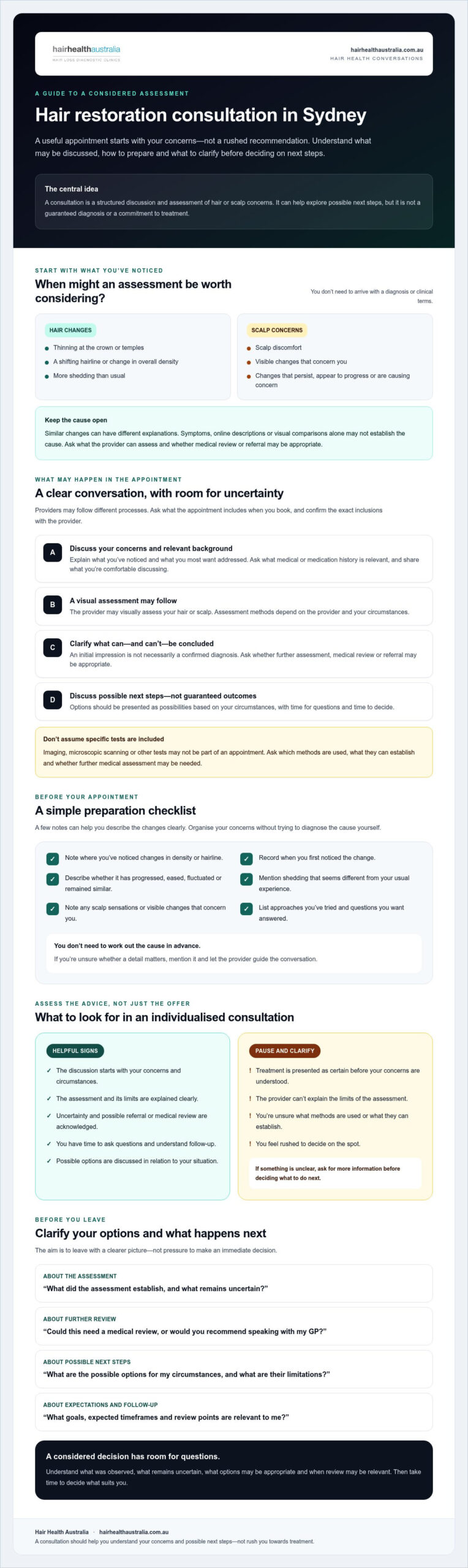
Hair changes can happen gradually, making it difficult to tell whether you’re seeing normal variation or a change worth discussing. You might notice thinning at the crown or temples, more shedding than usual, a shifting hairline or a change in overall density. Scalp discomfort or visible changes are also worth mentioning.

A hair restoration consultation is a structured discussion and assessment of your hair or scalp concerns. It can help explore possible next steps, but it isn’t a guaranteed diagnosis or a commitment to treatment.

That distinction matters. A hair restoration consultation Sydney appointment should first make space to understand what you’ve noticed. Similar changes can have different explanations, and symptoms alone may not establish the cause. For example, gradual changes can be associated with Pattern hair loss, but an online description or visual comparison can’t confirm that this is what’s happening in your case.

What concerns can you raise at a hair restoration consultation?

Describe the change in your own words. You don’t need clinical terms or a theory about what’s causing it. These details can help make the discussion more specific:

  • Where you’ve noticed a change in density or hairline
  • Whether shedding seems different from your usual experience
  • When you first noticed the change, and whether it has progressed, eased or fluctuated
  • Any scalp sensations or visible changes that concern you

The assessment should take your circumstances into account rather than assume one cause. Hair Health Australia’s hair health check offers a way to discuss concerns and possible next steps. What may be suitable depends on the individual assessment.

When should you seek advice rather than self-diagnose?

Consider seeking advice if hair changes persist, appear to progress or are causing concern. You don’t need to wait until the change feels severe, and you don’t need to arrive with a diagnosis. Ask what the provider can assess and whether your situation may call for medical review or referral.

You could ask, “Could this need a medical review, or would you recommend speaking with my GP?” This helps clarify the limits of the assessment. If a provider can’t explain those limits or presents treatment as certain before understanding your concerns, pause and ask for more information before deciding what to do next.

What should happen during a Sydney hair restoration consultation?

Providers don’t all follow the same process, so ask what your appointment includes when you book. A consultation may start with a discussion of your concerns and relevant background, followed by a visual assessment of your hair or scalp. The aim is to understand what you’ve noticed, explain what can and can’t be assessed, and consider whether any next steps are appropriate.

Assessment methods depend on the provider and your circumstances. Don’t assume imaging, microscopic scanning or specific tests are included. Mayo Clinic’s overview of diagnosing hair loss describes how a doctor may use different approaches to investigate hair loss. Ask which methods your provider uses, what they can establish and whether further medical assessment may be needed.

If you’d like to discuss your concerns and possible next steps, you can explore the hair health check. Confirm the appointment’s exact inclusions and process with the provider.

What information should you bring to the appointment?

A few notes can help you describe the changes clearly. Record when you first noticed them and how they’ve developed, including whether thinning has remained similar or become more noticeable. Bring your questions, note any approaches you’ve tried and identify the concerns you most want addressed.

You don’t need to work out the cause in advance. Ask what medical or medication history is relevant to the assessment, and share what you’re comfortable discussing. If you’re unsure whether a detail matters, mention it and let the provider guide the conversation.

How should findings and possible next steps be explained?

Clear advice distinguishes what was observed from what remains uncertain. An initial impression isn’t necessarily a confirmed diagnosis. The provider should explain whether the assessment is enough to discuss options or whether further assessment, medical review or referral may be appropriate.

Treatment options should be presented as possibilities based on your circumstances, not as guaranteed outcomes. Before you leave, make sure you understand:

  • What the assessment did and didn’t establish
  • Why a particular next step may be relevant to you
  • What further review may be needed before deciding
  • Who to contact if questions come up afterwards

A hair restoration consultation Sydney appointment should leave you better informed, not obliged to commit. Take time to consider the explanation and ask for clarification if anything is unclear.

How to compare hair restoration consultations and assess the advice

A useful comparison goes beyond the treatment proposed. Consider how the provider reaches a recommendation, explains uncertainty and gives you room to make a considered decision. A thorough hair restoration consultation Sydney experience should help you understand the reasoning, rather than leave you relying on broad claims.

What to compare A considered approach A reason to pause
Assessment The provider explains what they’ll assess and how it relates to your concerns. A recommendation is made without a clear explanation of its basis.
Uncertainty Observations, limitations and any need for further review are discussed openly. Vague claims are presented as certain findings.
Follow-up You’re told what follow-up may involve and who to contact with questions. It’s unclear what happens after the appointment or who is responsible.
Questions You have time to ask questions and consider the answers. You’re hurried or pressed to decide immediately.

Check who will assess you, their qualifications and their role. If the person is a registered health practitioner, you can check their details and registration type on the Australian Health Practitioner Regulation Agency (AHPRA) public register. Ask whether the assessment is within their scope and whether another type of practitioner or medical review may be appropriate.

Questions to ask before choosing a consultation

Before booking, ask who will conduct the assessment and what it includes. Find out whether additional steps may be suggested, how findings will be explained, and what costs or follow-up may apply before you decide on treatment. The American Society of Plastic Surgeons outlines considerations for a hair transplant surgery consultation. This information relates to surgical care and shouldn’t be taken as a description of services offered by every provider.

For broader provider-selection criteria, you can also read Choosing a Non-Surgical Hair Loss Clinic in Sydney. Compare the advice you receive with your concerns and the clarity of the explanation, not just how confident the wording sounds.

What are warning signs of a poor consultation experience?

Guaranteed outcomes, pressure to commit straight away and unclear explanations are reasons to pause. Ask what a recommendation is based on and what it can realistically establish. If you’re still uncertain, take time to consider the advice or seek a second opinion before proceeding.

Sydney Hair Restoration: What to Expect & How to Choose

How to prepare for a hair restoration consultation in Sydney

A little preparation can help you make good use of your appointment. You don’t need to diagnose the cause or prepare a detailed medical history. Focus on describing what you’ve noticed and the questions you need answered. Before a hair restoration consultation Sydney appointment, contact the clinic to confirm its current Sydney location, accessibility, appointment format and what, if anything, you should bring.

Useful preparation is simple: note your main concern, when it began, how it has changed, what you’ve tried and the questions you want answered.

  • Write down the change you’re concerned about, such as thinning in a particular area or increased shedding.
  • Note when you first noticed it and whether it has stayed the same, progressed or fluctuated.
  • List previous approaches you’ve tried and the questions or concerns you want to raise.
  • Check the appointment details with the clinic, including where to go, access arrangements, format and what to bring.

If you’re ready to discuss your concerns and explore possible next steps, arrange a hair health check. Confirm the appointment process and inclusions with the clinic before attending.

Questions to take into the appointment

Written questions can help keep the discussion focused, especially if it covers unfamiliar information. Consider asking:

  • What can this assessment establish, and what can’t it determine?
  • Which options might suit the findings, and what limitations or uncertainties should I understand?
  • Will I receive information about the findings or proposed next steps in writing?
  • When should I expect follow-up information, and who can I contact if I have more questions?

You can also ask which medical or medication history is relevant. Share information that seems connected, and let the provider guide you on what’s needed for their assessment.

How to make a considered decision afterwards

You don’t have to agree to a plan during the appointment. Take time to review any written information, note what remains unclear and consider whether the proposed next step addresses your concerns. Ask for clarification before proceeding if you need it.

If you’re comparing providers, look beyond promotional claims. Consider whether each explanation is clear, individualised and honest about uncertainty, and whether the follow-up arrangements make sense. Base your decision on the assessment and your priorities, not a sense of urgency.

Your next steps after a Sydney hair restoration consultation

An appointment doesn’t have to end with a treatment decision. Depending on what was discussed, a reasonable next step could be further assessment, a proposed programme, medical review or referral, or taking time to monitor your concern. It may also be appropriate to make no immediate change if there isn’t enough information to recommend one.

Before proceeding, make sure you understand the purpose of the recommendation and how it relates to your assessment. Ask what outcome the proposed approach aims to support, what limitations or uncertainties apply, how progress would be reviewed and when that review would happen. Check any relevant costs and what follow-up is included rather than making assumptions.

What should a clear treatment recommendation include?

A useful recommendation explains its reasoning in plain language. You should be able to connect the proposed next step to what was observed and understand what it can realistically address. Ask how progress would be reviewed and what might prompt a change in plan. Hair Health Australia provides personalised, non-surgical hair loss treatment programmes for men and women. Suitability and recommendations depend on individual assessment. Confirm the hair health check’s inclusions and appointment process directly with the clinic.

When might another opinion or medical review be useful?

Unanswered questions are a reasonable reason to seek clarification before deciding. If the explanation still doesn’t make sense, or you’re unsure whether the recommendation fits your circumstances, you can consider another opinion. You might also ask whether your hair changes or other symptoms warrant review by a GP or another health professional. This doesn’t mean every hair concern needs specialist referral. The appropriate next step depends on the situation.

A hair restoration consultation Sydney appointment should leave you understanding your options, not feeling pressured to act. Take the time you need to weigh the advice and decide whether the next step feels appropriate for you.

If you’d like to discuss your concerns and explore possible next steps, take the first step with a hair health check.

Take your next step with clarity

A hair restoration consultation Sydney appointment is a chance to understand your concerns and discuss suitable next steps, not an obligation to begin treatment. Look for an individual assessment, clear explanations of what’s known and uncertain, and realistic expectations. Before deciding, make sure you understand the proposed goals, limitations and how progress would be reviewed.

Preparing a brief timeline and a few questions can help you use the appointment well. You’re entitled to take time afterwards, ask for clarification or seek another opinion if you’re unsure.

Hair Health Australia offers tailored hair loss programmes for men and women, with a focus on personalised, non-surgical care. Any recommendation depends on individual assessment, so confirm what the hair health check includes and which next steps may be appropriate for you.

Book or enquire about a hair health check to start a considered conversation about your concerns. You can move forward at your own pace, with clearer information to guide your decision.

Frequently Asked Questions

What happens at a hair restoration consultation in Sydney?

A hair restoration consultation Sydney appointment typically involves discussing your concerns and relevant background, followed by an assessment of your hair or scalp and a conversation about possible next steps. The process varies between providers, so ask what the appointment includes before booking. An assessment may help explore your concerns, but it doesn’t guarantee a diagnosis or treatment outcome. You should have time to ask questions and understand any recommended follow-up.

How do I prepare for a hair restoration consultation?

Note your main concern, when you first noticed the change and how it has developed. Write down your questions, previous approaches you’ve tried and any details you’re unsure are relevant. You don’t need to diagnose yourself. Before attending in Sydney, confirm the appointment location, format, accessibility and what to bring with the provider. You can also ask which medical or medication history may be useful to discuss.

Can a consultation identify the cause of my hair loss?

A consultation may help explore possible causes, but an initial assessment may not confirm what’s behind your hair changes. Different causes can look similar, and assessment methods vary between providers. Ask what the findings establish, what remains uncertain and whether further assessment or medical review may be appropriate. Don’t treat an initial impression as a confirmed diagnosis, particularly if the provider hasn’t explained how they reached it.

How do I know whether a hair restoration clinic is trustworthy?

Look for clear, individualised explanations, realistic expectations and time to consider advice without pressure. Ask who will assess you, their qualifications and role, what the assessment involves and how follow-up works. If the person is a registered health practitioner, you can check their details on the Australian Health Practitioner Regulation Agency public register. Guaranteed outcomes, vague claims or pressure to decide immediately are reasons to pause and seek clarification.

Do I need a referral for a hair restoration consultation in Sydney?

Referral requirements depend on the provider and type of appointment, so check directly before booking. Ask whether you can book an assessment yourself or need a referral from your GP, and whether that changes if medical review is recommended. If your GP is already involved in your care, ask whether they think a referral or further medical assessment is suitable for your circumstances.

Will a hair restoration consultation commit me to treatment?

No. Attending a consultation doesn’t mean you have to accept a recommendation or begin treatment. The appointment is an opportunity to discuss your concerns, understand what the assessment suggests and ask about possible next steps. Take time to review any information afterwards. If the recommendation, expected outcomes or limitations aren’t clear, ask questions before deciding. You can also seek another opinion if you remain unsure.

What should I ask about the cost of a hair consultation?

Ask whether there’s a consultation fee and what it covers before booking. Check whether additional assessment, tests, written information or follow-up could involve separate costs, and when those would be discussed. If a treatment programme is proposed, request a clear explanation of its costs before agreeing to proceed. Fees and inclusions vary between providers, so confirm the current details directly rather than relying on assumptions.

Male diffuse thinning treatment: understand the cause before choosing a solution

Could choosing a male diffuse thinning treatment before understanding the cause lead you down the wrong path? Noticing less density across your scalp can be unsettling, especially when it’s unclear whether the change has been gradual or sudden. Online advice can add to the confusion, with different claims about results, side effects and long-term commitment.

The right next step is to understand what may be driving the thinning. Diffuse hair loss can have different causes, and the pattern, timing and changes in your health or routine can all help guide an assessment. A treatment that may suit one cause might not be appropriate for another.

This article explains why individual assessment matters, what information to bring to a hair health appointment and what questions to ask a professional in Sydney. You’ll also learn how to compare treatment pathways, including non-surgical options, with realistic expectations. Hair Health Australia provides personalised male hair-loss treatment in Sydney, but no approach can promise regrowth or a particular result. A clear discussion of your concerns, possible options and potential risks can help you make an informed decision.

Key Takeaways

  • Compare changes in density across your scalp with older photos to help describe the pattern and when you first noticed it.
  • Genetic pattern hair loss and temporary shedding are among the possible causes, so a similar appearance doesn’t confirm the reason.
  • Bring notes about your thinning timeline, symptoms and relevant health changes to an assessment.
  • Discuss how each male diffuse thinning treatment option relates to the suspected cause, including its limitations and potential risks.
  • Use your appointment in Sydney to ask what assessment involves, what options may suit you and what expectations are realistic.

What male diffuse thinning looks like, and why the pattern matters

Thinning across the scalp can feel different from watching the hairline recede. You may notice less coverage over a wider area, rather than a clear change at the temples. The pattern can offer useful clues, but appearance alone can’t identify the cause or show which male diffuse thinning treatment may be suitable.

Pattern vs cause

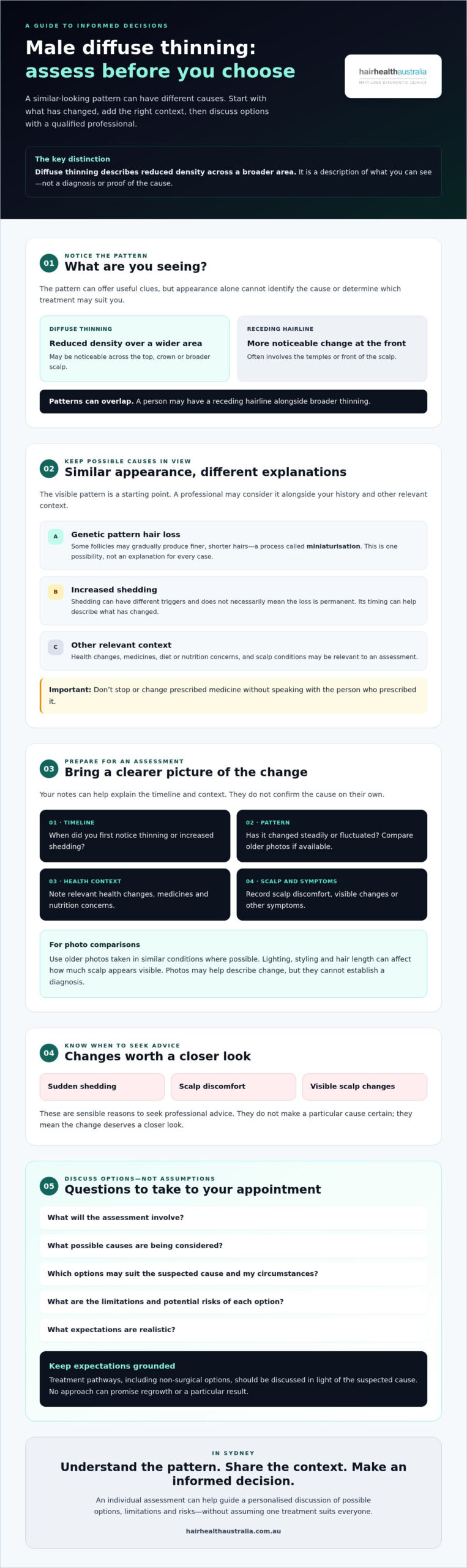
Diffuse thinning describes reduced hair density across a broader scalp area. It’s a way of describing what you can see, not a diagnosis. The underlying cause needs to be considered separately.

How diffuse thinning differs from a receding hairline

A receding hairline usually involves more noticeable change around the temples or front of the scalp. With diffuse thinning, reduced density may be easier to spot across the top or crown, or over a wider area. Individual patterns vary, and the two can overlap: a person may have a receding hairline alongside broader thinning. For background on one common form of patterned loss, see Pattern hair loss. A guide to men’s hair-loss patterns can offer a closer comparison.

What changes should prompt closer attention?

Note when you first noticed the change and whether it has continued steadily or fluctuated. You could also record whether you’ve seen more hair shedding than usual, and when it began. These details help describe what’s happening, but can’t confirm the reason on their own.

Sudden shedding, scalp discomfort or visible changes to the scalp are sensible reasons to seek professional advice. This doesn’t mean a particular cause is certain; it means the change deserves a closer look. A professional can consider the pattern alongside your history and other relevant context before discussing next steps. In Sydney, a hair health check can provide an opportunity to discuss your individual pattern and possible options.

Why male diffuse thinning can have more than one cause

A similar spread of reduced density can develop through different processes. Genetic pattern hair loss may gradually affect follicle growth, while increased shedding can make hair look thinner over a shorter period. Health changes, medicines, nutrition and scalp conditions may also be relevant context for a professional assessment. The visible pattern is a starting point, not enough information to select a treatment.

Appearance alone cannot confirm the cause of diffuse thinning. That distinction matters because a male diffuse thinning treatment should be considered in light of the suspected cause, your health history and individual circumstances, rather than chosen from appearance alone.

Gradual thinning and hair follicle miniaturisation

With genetic pattern hair loss, some follicles can gradually produce finer, shorter hairs. This process is called miniaturisation. As the hairs become less substantial, overall coverage may reduce, sometimes without a clearly defined bald patch. Genetic hair loss is one possibility, not an explanation for every case of diffuse thinning.

Slow changes can be hard to recognise from day to day. Hair length, styling and lighting can also affect how much scalp appears visible. Consistent photos taken in similar conditions may help you describe changes over time, but they can’t establish a diagnosis.

Shedding, health changes and other possible contributors

Increased shedding can have different triggers and doesn’t necessarily mean the loss is permanent. A qualified health professional can consider whether the timing might relate to changes in your health, medicines, diet or scalp, among other factors. Don’t stop or alter prescribed medicine without speaking with the person who prescribed it.

Before an appointment, note when shedding or thinning began and list relevant health changes, medicines and nutrition concerns. Share any scalp symptoms or visible changes, too. These details provide context, but don’t prove a cause. Any specific cause, need for tests or likely recovery timeframe depends on individual assessment and should be discussed with a qualified professional.

If you’re unsure what your pattern may indicate, a hair health check can be a starting point for discussing your concerns and possible next steps. Assessment can help guide a personalised approach, without assuming that one treatment will suit everyone.

How to assess male diffuse thinning before choosing treatment

Choosing a treatment before the cause is reasonably understood can lead to a poor fit. A male diffuse thinning treatment should be considered in context: the pattern, how it has changed, your health history and any scalp symptoms all matter. A professional may review your history and scalp findings, but the assessment process can vary. Ask what each step can and can’t establish.

What information to prepare before an appointment

A few clear notes can make the conversation more useful. Use this framework to organise what you’ve noticed:

  1. Pattern: Note where density seems reduced, such as across the top, crown or a wider area. Mention whether the hairline has changed as well.
  2. Timeline: Record when thinning or shedding began and whether it has continued steadily, appeared suddenly or fluctuated. Photos taken in similar conditions may help you compare changes over time.
  3. Symptoms: Write down any scalp discomfort or visible changes, and when they occur.
  4. Health context: Bring a current list of medicines and supplements, and note relevant health or nutrition changes. Don’t stop prescribed medicine without advice from the prescriber.

Prepare questions, too: What possible causes fit my pattern? What remains uncertain? Which options may be suitable, and what risks, limitations or follow-up should I understand?

What an individualised assessment should clarify

Ask how your history and observed pattern inform the working explanation, and which findings support it. A scalp image, scan or single test shouldn’t be assumed to identify every possible cause. If the picture is unclear, ask whether further medical advice or assessment is appropriate before deciding on treatment.

Assessment methods differ, so check what a provider uses and what the results can tell you. For more background on one technique, consult a guide to microscopic hair analysis, while keeping in mind that a single method doesn’t replace consideration of your wider history. Specialised services such as rootedscalpclinic.co.uk illustrate how personalised scalp analysis can also be paired with cosmetic solutions to achieve fuller-looking hair.

The aim isn’t to force a quick answer. It’s to understand what is known, what needs further review and why a particular option is being discussed. In Sydney, a hair health check can be a starting point for discussing your individual pattern and possible next steps.

Male diffuse thinning treatment: understand the cause before choosing a solution

Male diffuse thinning treatment options: compare them by cause and suitability

There isn’t one treatment pathway for every pattern of diffuse thinning. Options depend on the suspected cause, your health circumstances and what an appropriate professional considers suitable. Use this comparison to prepare questions, not to self-diagnose or choose treatment without advice.

Treatment category Intended context Discussion points Limitations
Clinician-guided treatment for genetic pattern loss When assessment supports a pattern consistent with genetic hair loss Ask about suitability, potential side effects, precautions, monitoring and ongoing commitment. May not address other causes of shedding; response and suitability vary between individuals.
Management of an identified health or nutritional contributor When history or professional assessment suggests a relevant factor to investigate or address Discuss what evidence supports the suspected contributor and whether medical follow-up is appropriate. Changing supplements or medicines without advice may be unsuitable; improvement cannot be assumed.
Care for a scalp condition When scalp symptoms or findings need professional review Ask what the findings suggest and whether a qualified health professional should assess them. A visible scalp change alone doesn’t confirm a specific condition or treatment.
Observation and review When the cause or pattern remains uncertain and monitoring is recommended Agree what changes to track and when to seek further advice. Monitoring doesn’t establish a diagnosis or guarantee that thinning will resolve.

Questions to ask about clinician-guided options

For any proposed male diffuse thinning treatment, ask why it fits your assessed pattern and what alternatives have been considered. Discuss possible side effects, contraindications, follow-up and ongoing commitment before deciding. Specific medicines, precautions and availability should be checked against current Australian guidance with an appropriate health professional. Don’t self-prescribe or change prescribed treatment based on online advice.

Be cautious of one-size-fits-all promises

An option considered for genetic pattern loss may not address shedding linked to another factor. Be wary of guarantees, dramatic timelines or testimonials presented as evidence of what will happen for you. A more useful conversation explains the reasoning, uncertainties and realistic limits of each option. For broader context, consult a clinical hair-treatment guide or an Australian hair-regrowth reference, and check that information against current professional advice.

Hair Health Australia offers personalised, non-surgical hair-loss treatment programmes in Sydney. To discuss your individual pattern and possible next steps, arrange a hair health check. Assessment can help inform a plan, but no particular result can be promised.

Your next steps for male diffuse thinning treatment in Sydney

If you’re weighing up what to do next, you don’t need to arrive with a diagnosis or a preferred treatment. The useful first step is to understand what the thinning may relate to and what information could guide a suitable discussion. An assessment may be worth considering if the change concerns you, is continuing or is accompanied by symptoms. If you’re unsure, you can still ask what kind of advice is appropriate.

Questions to ask before starting a treatment programme

Use an appointment to understand the reasoning behind any proposed plan, not just its name. These questions can help you make a considered decision:

  • What pattern or possible cause is this programme intended to address? Ask how your history and observed changes inform that explanation.
  • What information is needed to personalise recommendations? Find out whether you should bring notes about timing, health changes, medicines or supplements.
  • What are the limitations and potential risks? Ask what the approach may not address, what concerns to watch for and when to seek further advice.
  • How will progress be reviewed? Clarify what follow-up involves, what changes will be considered and who to contact if you have concerns.

You can also ask what remains uncertain. A clear explanation should distinguish between what is known about your situation and what would need further professional input. Take time to consider the answers before committing to a plan.

How to take the next step with Hair Health Australia

Hair Health Australia provides personalised, non-surgical male hair-loss treatment in Sydney. A hair health check can be a starting point to discuss your individual pattern and possible next steps. It’s reasonable to ask what information is needed, what the check can help explore and whether further medical advice may be appropriate. No single approach suits everyone, and a discussion should not be taken as a promise of regrowth or a particular result.

If you’re ready to explore your options, complete a hair health check. It can help open a conversation about whether a personalised male diffuse thinning treatment pathway may be relevant to your circumstances. From there, decisions can be made with realistic expectations, based on your needs rather than a one-size-fits-all claim.

Make your next step an informed one

Diffuse thinning describes a change in hair density, not the reason behind it. Because similar patterns can have different causes, the most useful next step is to discuss your timeline, symptoms and relevant health context with a professional before choosing a male diffuse thinning treatment.

In Sydney, Hair Health Australia offers personalised, non-surgical male hair-loss treatment programmes. A hair health check can help you discuss your individual pattern and explore possible next steps. Ask what an option is intended to address, what its limitations may be and how progress would be reviewed. No treatment can guarantee regrowth or a particular outcome, so clear information and realistic expectations matter.

Ready to start that conversation? Complete a hair health check to discuss your next steps with Hair Health Australia. You can take things one informed decision at a time.

Frequently Asked Questions

What causes diffuse thinning in men?

Diffuse thinning in men can have several possible contributors, including genetic hair loss, increased shedding, health changes, medicines or scalp conditions. The visible pattern alone can’t confirm which explanation applies. A professional can consider when the change began, your health history and scalp findings before discussing options. Bring a current list of medicines and supplements, and don’t start or stop prescribed medicines based only on online information. Ask an appropriate health professional for advice about your circumstances.

Can diffuse thinning in men grow back?

Whether hair density improves depends on the cause, how long the change has been present and how you respond to an appropriate plan. Some shedding may be temporary, while other forms of hair loss may need ongoing management. No treatment can guarantee regrowth for every person. Ask a qualified professional what outcomes are realistic in your case, what limitations to expect and how progress would be reviewed. If the cause is unclear, discuss that before choosing an approach.

Is diffuse thinning the same as male pattern baldness?

No. Diffuse thinning describes reduced density across a broader area, while male pattern hair loss often follows recognisable patterns. However, patterns can overlap, and different causes may look similar. A label or photograph can’t confirm what’s causing your thinning. If the change is new, progressing quickly or accompanied by scalp symptoms, seek professional advice. Describe when you first noticed it and how it has changed, rather than relying on appearance alone to choose a treatment.

How is diffuse thinning diagnosed?

Assessment usually begins with questions about when thinning started, how it has changed, your health history and relevant medicines. A professional may also examine your hair and scalp, and consider further checks if appropriate. The process depends on your circumstances and the provider, so ask what an appointment includes and what its findings can establish. No single visual check should be treated as a guaranteed way to identify every possible cause.

What is the best treatment for male diffuse thinning?

There’s no single best option for everyone. A suitable male diffuse thinning treatment depends on the likely cause, your health context, preferences and potential risks. Ask a qualified professional why an option may suit your situation, what limitations or side effects to consider, and how its suitability will be reviewed. Be cautious of guaranteed results or recommendations made without considering your circumstances. Treatment choices should follow an individual discussion, not a one-size-fits-all claim.

When should I seek professional advice about diffuse thinning?

Consider seeking advice if thinning persists, changes, causes concern or is difficult to explain, particularly if it begins suddenly or occurs with scalp symptoms or other health changes. This doesn’t automatically mean the cause is serious, but a discussion may help clarify what to consider next. In Sydney, Hair Health Australia’s hair health check can help you explore your individual pattern and possible next steps. Ask what the check can clarify and whether further medical advice may be appropriate.

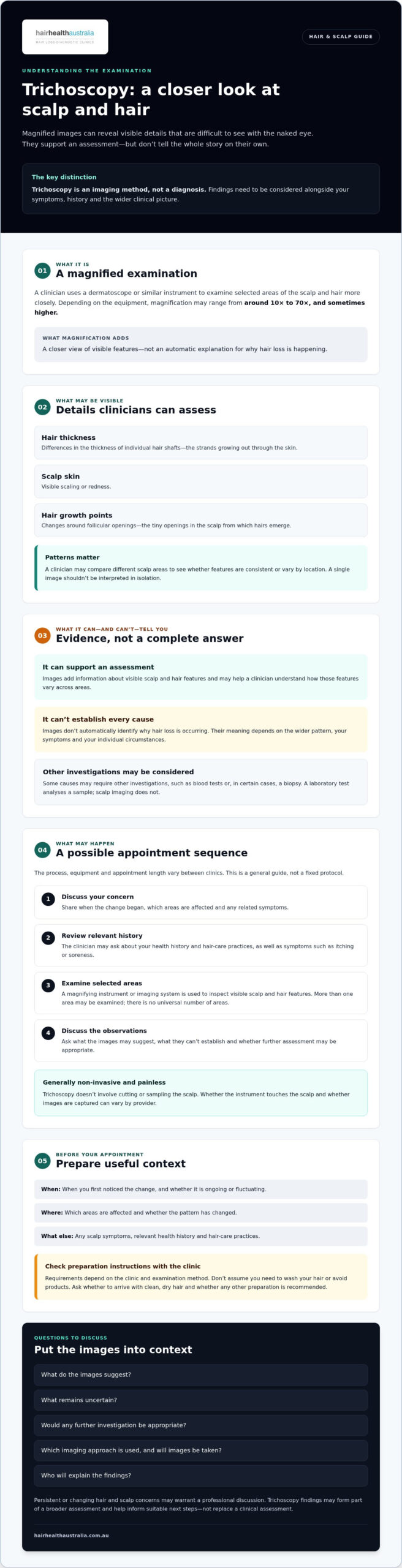
What Is a Trichoscopy Exam? A Clear Guide to Scalp Imaging

Could a close-up view of your scalp tell the whole story behind hair loss? Not on its own. If you’re wondering what is a trichoscopy exam, it’s a non-invasive way for a clinician to examine your scalp and hair under magnification. The images can reveal details that are difficult to see with the naked eye, but their meaning depends on the wider pattern and your individual circumstances.

It’s understandable to feel unsure about what happens during a scalp examination or whether magnified images can provide a definite diagnosis. Trichoscopy is generally painless and doesn’t involve cutting or sampling the scalp. However, it has limits: some causes of hair loss may require other investigations, such as blood tests or, in certain cases, a biopsy.

This guide explains what the examination involves, what clinicians may look for and what the findings can and can’t confirm. You’ll also learn how to prepare and what to discuss with a clinician. If you’re considering a hair health check in Sydney, trichoscopy findings may form part of a broader assessment and help inform suitable next steps, rather than being treated as a diagnosis on their own.

Key Takeaways

  • Learn what is a trichoscopy exam and how magnified scalp and hair images can support an assessment.
  • Understand what may happen during the examination, while recognising that clinic procedures can vary.
  • See which visible features imaging may help assess, and why it can’t establish every cause of hair loss on its own.
  • Prepare useful details about your symptoms and hair history, and check any preparation instructions with the clinic.
  • Know when persistent or changing hair and scalp concerns may warrant a professional discussion, and what to ask about next steps.

What Is a Trichoscopy Exam, and What Does It Examine?

Trichoscopy is a magnified examination of the scalp and hair. A clinician uses a dermatoscope or similar instrument to view details that may be difficult to see with the naked eye. Depending on the equipment, magnification can range from around 10 times to 70 times, and sometimes higher. The images help the clinician assess visible features, but their meaning depends on your symptoms, history and the wider clinical picture.

If you’re asking what is a trichoscopy exam, the key distinction is that it’s an imaging method, not a diagnosis. An ordinary visual check gives an overall view of the scalp and hair, while trichoscopy provides a closer look at selected areas. A laboratory test is different: it analyses a sample, such as blood, and can help investigate issues that scalp images can’t establish. For background on the method, see Trichoscopy.

What features can trichoscopy make easier to see?

Magnified images may show features of the scalp skin and hair shafts, including differences in hair thickness, visible scaling or redness, and changes around hair growth points. A hair shaft is the strand that grows out through the skin. A follicular opening is the tiny opening in the scalp from which a hair emerges. These observations don’t identify every cause of hair loss by themselves.

A clinician may compare images from different scalp areas to see whether features are consistent or vary from one location to another. That pattern can add useful evidence, but a single image shouldn’t be interpreted in isolation.

Is trichoscopy the same as a hair loss diagnosis?

No. Images can support an assessment, but they don’t automatically reveal why hair loss is happening. The clinician may consider how long the concern has been present, whether it’s changing, any scalp symptoms, your health and hair history, and findings from a broader examination. If needed, other investigations may help assess possible causes that imaging can’t confirm.

Think of trichoscopy as one potential part of a clinical assessment, not a substitute for one. Ask the clinician what the images suggest, what remains uncertain and whether further investigation is appropriate. This puts the visual findings into context and can clarify possible next steps.

What Happens During a Trichoscopy Exam?

A trichoscopy appointment usually begins with a conversation, followed by a closer look at selected areas of the scalp and hair. The sequence, equipment and appointment length vary between clinics, so check with the provider about their process. DermNet NZ explains how this examination of the scalp and hair can help clinicians assess visible features more closely.

What may happen before the scalp images are taken?

The clinician may ask when you first noticed a change, whether it’s ongoing or fluctuating, and which areas are affected. They may also ask about symptoms such as itching or soreness, your health history and relevant hair-care practices. These details help put visible findings in context.

Preparation instructions depend on the clinic and examination method. Don’t assume you need to wash your hair or avoid products beforehand. Ask whether to arrive with clean, dry hair and whether any other preparation is recommended.

How are the scalp and hair examined?

A magnifying instrument or imaging system may be used to view selected scalp areas. The clinician might examine more than one area, depending on your concern, but there’s no universal number or fixed protocol. Some providers capture images; others assess features directly. Whether the instrument touches the scalp and how long the examination takes can also vary. Ask what to expect if you’re unsure.

A typical sequence may look like this, but confirm the details with your practitioner:

  1. Discuss your concern: Share when the change began, where it’s happening and any related symptoms.
  2. Review relevant history: Answer questions about your health and hair-care routine.
  3. Examine selected areas: The clinician uses magnification to inspect visible scalp and hair features.
  4. Discuss observations: Ask what the images may suggest, what they can’t establish and whether further assessment is needed.

The examination is generally non-invasive, but the method and experience aren’t identical at every clinic. Before attending, ask which imaging approach is used, whether images are taken and who will explain the findings.

If you’re in Sydney and seeking a broader discussion about hair concerns, Hair Health Australia’s hair health check may be a relevant next step. Confirm directly whether it includes trichoscopy and which examination methods are used.

What Can a Trichoscopy Exam Show, and What Can It Not Confirm?

Magnified images can reveal visible differences in the scalp and hair, helping a clinician compare patterns across areas. A pattern is evidence to interpret, not proof of a particular condition. In other words, what is a trichoscopy exam can help answer is what features are visible, not necessarily what caused them.

How might trichoscopy contribute to assessing hair loss?

Differences in hair thickness, scalp appearance or follicular openings may contribute to an assessment of conditions such as androgenetic alopecia, alopecia areata or telogen effluvium. These are examples, not conclusions that can be drawn from one feature alone. Signs can overlap, so the clinician considers where they appear and how they fit with your symptoms and history. A review of trichoscopy for diagnosing alopecias describes its role as one source of clinical evidence.

Think of the images as one part of the picture:

What imaging may show What it cannot establish alone
Visible features of the scalp and hair shafts, including differences between examined areas. The full cause of hair loss or whether a particular condition is definitely present.
Patterns that may support a clinician’s consideration of a hair or scalp condition. Underlying medical factors, such as a nutritional deficiency or thyroid problem.
Changes that may prompt closer clinical discussion or further assessment. Whether treatment is suitable, or what the outcome of treatment would be.

When might other tests or assessments be considered?

It depends on the person. A clinician may consider further assessment if your symptoms, history and visible findings don’t provide enough clarity, or if a possible cause can’t be evaluated through scalp images. Blood tests may help investigate certain underlying factors. A scalp biopsy may be considered in some cases where further examination of scalp tissue is needed. Neither is automatically required after trichoscopy.

The appropriate next step depends on clinical judgement, not a fixed pathway. Ask what the images do and don’t suggest, whether other assessment is relevant to your situation, and why. Avoid using online images or a single feature to self-diagnose. Findings need to be interpreted in the context of a broader assessment.

What Is a Trichoscopy Exam? A Clear Guide to Scalp Imaging

How Should You Prepare for a Trichoscopy Exam and Understand the Findings?

Preparation instructions vary between clinics and examination methods, so check directly rather than changing your hair-care routine based on general advice. Ask whether you should arrive with clean, dry hair and whether to avoid styling products. If you’re unsure what is a trichoscopy exam likely to involve at your clinic, ask what method is used and what to expect before you attend.

What information should you bring to an assessment?

A clear account of what you’ve noticed can help the practitioner understand your concern and interpret any images in context. You don’t need to prepare a formal report. A few notes on your phone may be enough.

  • Timeline and pattern: When did the change begin, and which areas are affected? Note whether it seems stable, gradual or changing.
  • Symptoms: Record any scalp discomfort, itching or other changes you’ve noticed, and when they occur.
  • Relevant background: List medicines, health factors, hair-care practices or previous assessments that may be useful to discuss.
  • Your questions: Write down what you want to understand about the examination, the images and possible next steps.

What questions can help you understand the results?

Ask the practitioner to explain their observations in plain language. It’s reasonable to ask what was visible, how it relates to your concern and what the images can’t tell you. If an observation is uncertain, ask what information could help clarify it rather than assuming it confirms a specific cause.

  • Which features did you observe, and how do they relate to my symptoms?
  • Are these findings conclusive, or are there other possible explanations?
  • Would any further assessment be appropriate in my situation, and why?
  • What follow-up do you recommend, and when should I seek another clinical opinion?

A good explanation distinguishes what was observed from what remains uncertain. If you leave without understanding the findings or suggested follow-up, ask for clarification. You can also seek another clinical opinion if you remain concerned or feel your questions haven’t been addressed.

If you’re in Sydney and would like to discuss your hair concerns as part of an assessment, explore a hair health check. Confirm with the clinic whether it includes trichoscopy and which examination methods are used.

When Is a Trichoscopy Exam a Useful Next Step for Hair Concerns?

A professional discussion may be helpful if hair loss persists, changes over time or comes with scalp symptoms that concern you. You don’t need to know the cause before asking for an assessment. Understanding what is a trichoscopy exam is only one part of deciding what may help: a clinician can discuss whether magnified imaging is relevant to your concern and what else might be considered.

Trichoscopy is one potential assessment component, not a guaranteed answer, diagnosis or treatment. Its value lies in interpreting visible features alongside your history and symptoms, then explaining what they do and don’t indicate. If a finding is uncertain, ask what could clarify it and whether follow-up is appropriate.

What should you consider when choosing a hair assessment?

Look for clear information about what the assessment involves, its limitations and how findings will be discussed. Before proceeding, ask who conducts the assessment, who interprets any images and what follow-up is available. Check whether the clinic uses trichoscopy as part of its process. Don’t assume every hair assessment includes it.

How does an assessment fit into a treatment discussion?

An assessment can help frame a conversation about possible next steps, but suitable options depend on the individual concern and the information gathered. A treatment recommendation isn’t automatic, and no imaging result can promise regrowth or establish that a particular programme is right for you. Ask how a suggested option relates to your assessment, what its purpose is and what uncertainties remain.

Hair Health Australia is a Sydney-focused clinic offering personalised, non-surgical hair loss treatment programmes for men and women. Its hair health check provides an opportunity to discuss your concerns and possible next steps. Confirm directly which examination methods are used, including whether trichoscopy is part of the assessment. An assessment and a treatment recommendation are distinct steps.

If you’re ready to discuss ongoing or changing hair concerns, book a hair health check and ask what the assessment includes. A clear conversation can help you understand your options without assuming one image or examination will provide every answer.

Take the Next Step with Clearer Information

Trichoscopy gives a clinician a closer view of scalp and hair features, but the images are only one part of a broader assessment. Understanding what is a trichoscopy exam also means knowing its limits: visible patterns may inform a discussion, but they don’t always identify the cause or determine suitable treatment on their own.

If hair or scalp changes are persistent or concerning, discussing them with a clinician can help clarify what to consider next. Ask what an assessment involves, how findings will be interpreted and whether further investigation may be relevant. Hair Health Australia offers personalised, non-surgical hair loss treatment programmes for men and women in Sydney. A hair health check is an opportunity to discuss your concerns and possible next steps. Confirm directly whether it includes trichoscopy.

Arrange a hair health check to start a conversation about your hair concerns. With clear information and an individual assessment, you can take your next step with greater confidence.

Frequently Asked Questions

What is a trichoscopy exam?

A trichoscopy exam is a magnified examination of the scalp and hair using a dermatoscope or similar imaging instrument. If you’re asking what is a trichoscopy exam, think of it as a closer visual assessment, not a test that automatically identifies the cause of hair loss. A clinician may examine selected areas and interpret visible features alongside your symptoms, health and hair history, and any other relevant assessment.

Is a trichoscopy exam painful or invasive?

A trichoscopy exam is generally painless and non-invasive. It involves viewing the scalp and hair under magnification, rather than cutting or taking a sample of the scalp. The exact method can vary between clinics, including whether the instrument touches your scalp or images are captured. If you’re worried about discomfort or unsure what will happen, ask the clinic to explain its examination approach before you attend.

Can trichoscopy diagnose the cause of hair loss?

Trichoscopy can provide useful visual evidence, but it can’t confirm every cause of hair loss on its own. Images may show features that inform a clinician’s assessment, while factors such as your symptoms, health history and examination findings also matter. Blood tests may be considered to investigate some underlying causes, and a biopsy may be relevant in selected cases. Neither is automatically required; further assessment depends on your circumstances.

How long does a trichoscopy exam take?

A trichoscopy examination may take around 5 to 30 minutes, according to the research information for this article. The time can vary depending on the areas examined, the imaging method and whether the appointment includes discussion of your history or findings. Ask the clinic how long to allow for your appointment, as examination processes differ and an assessment may include more than image-taking.

Do I need to prepare my hair before trichoscopy?

Preparation instructions vary, so check directly with the clinic rather than assuming you should wash or leave your hair unwashed. Some guidance recommends avoiding washing for one to two days and not using styling products, but your provider’s instructions should take priority. Ask whether to arrive with clean, dry hair and whether products such as gel or hairspray could affect the examination method used.

Can trichoscopy tell the difference between types of hair loss?

Trichoscopy may help a clinician assess patterns associated with conditions such as androgenetic alopecia, alopecia areata or telogen effluvium. It doesn’t always distinguish them conclusively: visible signs can overlap, and findings need to be considered alongside your symptoms and history. Avoid diagnosing yourself from an image or one feature. Ask the practitioner what the pattern may suggest, what remains uncertain and whether further assessment is appropriate.

What happens after a trichoscopy exam?

After the examination, the practitioner may explain the visible features, how they relate to your concern and whether follow-up is appropriate. Further tests aren’t automatic, and imaging doesn’t guarantee a diagnosis or treatment plan. Ask what the findings can and can’t establish, and what next steps make sense for you. If you’re in Sydney, Hair Health Australia’s hair health check is an opportunity to discuss hair concerns. Confirm directly which examination methods it includes.