The Emotional Journey of Hair Regrowth: What to Expect

What if a sign of new growth brought relief one day and doubt the next? The emotional journey of hair regrowth can include hope, impatience and worry, sometimes all at once. Hair changes can affect confidence and self-image, while gradual progress can be difficult to judge from day to day.

If the process feels emotionally uneven, that doesn’t mean you’re responding the wrong way. Regrowth isn’t always easy to see or experience as a steady upward path, and there’s no single feeling you’re supposed to have. Set realistic expectations and focus on observations you can describe, rather than judging progress by how you feel on a particular day.

This article explores emotions that can accompany hair loss and regrowth, practical ways to manage uncertainty, and when extra support may help. It also explains how an individual hair health check can give you a clearer picture of your concerns and help you consider next steps with more information and less guesswork.

Key Takeaways

  • The emotional journey of hair regrowth is personal. Recognise how changing hair affects you without comparing your response with anyone else’s.
  • Hope and apprehension can coexist when you seek support, and your feelings don’t have to follow a set sequence.
  • When progress feels hard to judge, choose a consistent, manageable way to notice changes rather than expecting immediate reassurance.
  • If checking, comparing or discussing your hair adds to your distress, set boundaries that feel right for you.
  • A personalised hair health check can help clarify your concerns and inform a discussion about possible next steps.

Why the emotional journey of hair regrowth begins with hair loss

The emotional journey of hair regrowth often starts before you change your routine or appearance. It begins when you notice your hair is different and start working out what that change means to you. You might feel self-conscious, frustrated or sad. You might feel relieved to seek answers, or simply want to understand what’s happening. These are possible responses, not stages you have to pass through.

Hair loss can also create uncertainty about what to do next. Looking for information or support is a reasonable response to a concern that matters to you. It isn’t vanity or an overreaction, and you don’t need to prove your feelings are serious enough before taking them into account.

Why changes in hair can feel personal

Hair can be part of how someone expresses themselves, recognises their appearance or follows familiar grooming routines. A change might stand out in photographs, in a social setting or while styling your hair. For someone else, it may have little effect on identity or confidence. There’s no single meaning attached to hair, and no one else can decide what the change should mean to you.

Some people connect hair with a particular life stage, family resemblance or sense of self. Others are more concerned about the practical disruption to their routine. Identifying what specifically feels difficult can help you explain your concern, whether you’re talking with someone you trust or seeking information. The psychological distress caused by hair loss is discussed in broader overviews of the condition, but each person’s experience remains their own.

Making room for mixed emotions

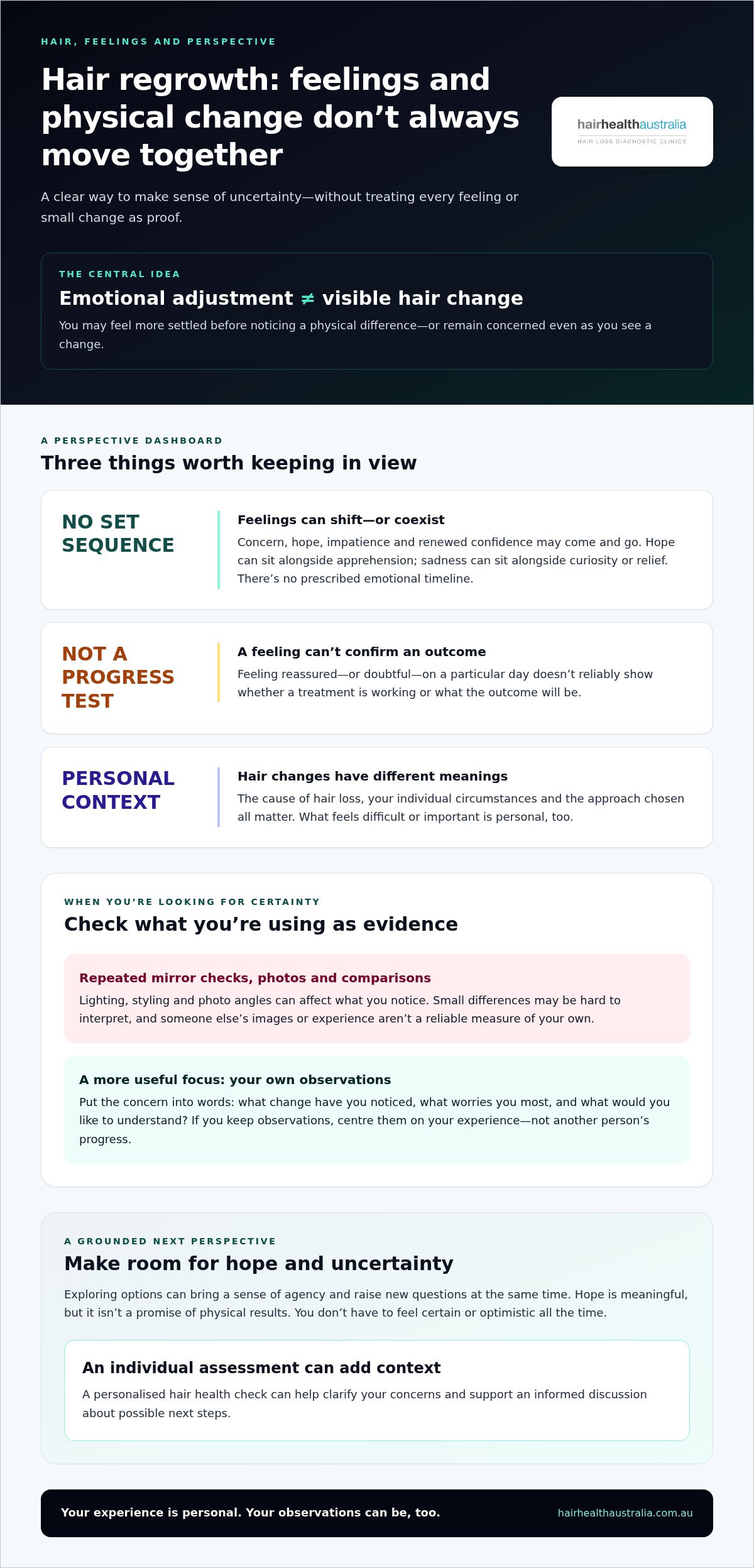
There isn’t a prescribed emotional timeline. You may feel hopeful about exploring options and apprehensive about what treatment might involve. Sadness about the change can sit alongside curiosity or relief at taking a first step. There is no single correct emotional response to hair change; what it means depends on the person, their circumstances and their expectations.

Feelings can shift with circumstances. A photograph or a comment might bring the concern into focus, while a busy week leaves less room to think about it. Neither response proves that you care too much or too little. Notice what you’re feeling without turning it into a judgement about your character or what progress should look like.

If you want a clearer understanding of your situation, a personalised hair health check can help replace guesswork with an individual assessment. Hair Health Australia provides personalised, non-surgical treatment programmes for men and women. Clinical guidance can be one practical next step, while leaving room for your emotional response to unfold in its own way.

What emotions can arise at different points in the hair regrowth journey?

There’s no set emotional sequence to follow. You might move between concern, hope, impatience and renewed confidence, or feel relatively steady while you work out what’s happening. These responses can come and go rather than marking clear stages. The emotional journey of hair regrowth is personal, and feelings don’t reliably indicate whether a treatment is working or what the outcome will be.

Seeking help can bring a sense of agency: you’re gathering information and considering a plan. It can also raise questions about what comes next, whether an approach will suit you and how you’ll feel while waiting. Both reactions can be present at once. Exploring options doesn’t require you to feel certain or optimistic all the time.

From noticing change to seeking answers

Repeatedly checking the mirror, taking photos or comparing your hair with how it looked months ago can seem like a way to find certainty. But lighting, styling and photo angles affect what you notice, so small differences can be hard to interpret. Online comparisons can add to the doubt because other people’s experiences and images aren’t a reliable measure of your own.

Instead, put the concern into words: what change have you noticed, what worries you most, and what would you like to understand? This can make a conversation about your hair more focused. If you choose to keep observations, centre them on your own experience rather than treating someone else’s progress as a benchmark.

Hope, patience and changing expectations

Beginning a plan may feel encouraging because you’ve taken a step towards understanding your hair. That hope is meaningful, but it isn’t a promise of physical results. The cause of hair loss, your individual circumstances and the approach chosen all matter. Avoid treating a particular outcome as certain before receiving individual guidance.

Waiting for visible change can test your patience. Hair can be difficult to assess consistently, and close attention can make every fluctuation feel important. Some days you may feel reassured; on others, you may question whether anything has changed. Neither reaction is a dependable assessment on its own. If uncertainty starts to dominate, a professional discussion can help put your observations in context.

Emotional adjustment and visible hair changes may not move together. You might feel more settled before noticing a physical difference, or remain concerned even as you see a change. There’s no need to make your confidence wait for a particular result. Give yourself room to respond honestly and consider what would help you feel informed and supported now.

If you’re ready to replace guesswork with an individual assessment, a personalised hair health check can help clarify your concerns and support an informed discussion of possible next steps.

How to handle uncertainty when hair regrowth feels slow or unclear

Seeking professional guidance or beginning treatment can offer a sense of direction, but it doesn’t automatically remove worry or self-consciousness. You may still wonder whether you’re seeing a change or feel uneasy about what might happen next. That uncertainty doesn’t mean you’ve made the wrong decision. The emotional journey of hair regrowth can continue alongside practical steps to understand and manage hair loss.

Realistic expectations don’t have to dampen hope. They help you make decisions based on your individual situation, rather than on a promise that progress will be immediate or look a certain way.

Why progress can be difficult to interpret

Hair can look different depending on lighting, styling, how it’s parted and the angle you’re viewing it from. A single photograph or mirror check can create a strong impression without giving a dependable picture of change. If a difference worries you, note what you observed and discuss it with a qualified health professional rather than trying to diagnose the cause yourself.

Separate what you notice from what you fear it means. For example:

  • Observation: “My part looks wider in this particular photo.”
  • Interpretation: “My hair must be getting worse.”

The observation is something you can describe; the interpretation is a conclusion that may need more context. Keeping that distinction in mind can make conversations about your concerns clearer and less driven by a worrying moment.

When expectations need a reset

Your preferred appearance and the goals discussed as part of your care may not be identical. Explain what matters to you, then clarify how any proposed approach relates to your situation. Different causes and individual circumstances mean no single treatment is right for everyone, and the same plan can’t promise the same result for each person.

A treatment plan can support informed care, but it can’t guarantee a particular physical result or emotional outcome. That honest limit doesn’t remove the value of seeking help; it makes room for decisions grounded in what is known about you.

If you’re unsure what your observations mean, a personalised assessment can help clarify your concerns and support a more informed discussion of possible next steps. Hair Health Australia’s hair health check offers an individual starting point, so you don’t have to draw conclusions from day-to-day impressions alone.
The Emotional Journey of Hair Regrowth: What to Expect

Practical ways to care for yourself during hair regrowth

Small, manageable steps can make the process feel less consuming. Try this adaptable sequence when hair concerns take up more attention than you’d like:

  1. Name the concern. Write down what’s bothering you, such as uncertainty about a change or discomfort in a particular situation.
  2. Choose one useful action. Note a question for a clinical conversation, take a break from checking, or speak with someone you trust.
  3. Review how it feels. Notice whether the action gave you more clarity or ease. If it didn’t help, try a different step next time.

This isn’t a test you need to pass. The aim is to find practical ways to care for yourself, not to make every difficult feeling disappear.

Build a steady, realistic progress routine

If you’re repeatedly inspecting your hair, keep observations and questions in one place for a clinical conversation instead. If you use progress photos, take them in similar lighting, with a similar hairstyle and viewing angle. You don’t need to follow a set photo schedule; consistency matters more than frequent checking. If documenting changes starts to increase distress, it’s reasonable to pause.

Keep other parts of your life in view, too. Make space for activities, relationships and routines that help you feel like yourself, whether that means catching up with a friend, enjoying a hobby or getting on with your day without checking your hair. Hair care can matter without becoming the measure of your whole wellbeing.

Talk about hair loss on your own terms

You can choose whether to share your concerns and how much to say. A simple “I’m thinking through some changes to my hair, and I’d appreciate you listening rather than offering advice” can set the tone. You can also say, “I’d rather not discuss my appearance today.” Trusted support may help, but privacy is a valid choice as well.

It’s fine to set boundaries if repeated questions, comparisons or unsolicited suggestions leave you feeling more self-conscious. A brief response followed by a change of subject can be enough. Respecting personal boundaries is one of the key signs of a healthy relationship, allowing you to feel supported without being scrutinised. Choose the kind of support that feels useful to you.

If distress is persistent, overwhelming or affecting daily life, consider speaking with an appropriate health professional. The emotional journey of hair regrowth can involve practical questions as well as personal ones. A hair health check can provide an individual assessment to help clarify your concerns. Arrange a hair health check to discuss your situation and possible next steps.

How a personalised hair health check can make next steps clearer

When hair changes are difficult to interpret, an individual assessment can help turn broad worries into clearer questions. You may be concerned about shedding, changes in density or how your scalp feels. Rather than assuming one cause or one emotional response, a personalised hair health check gives you space to discuss what you’ve noticed and what you want to understand.

What a personalised assessment contributes

A hair health check can replace guesswork with a more informed discussion of your concerns and possible next steps. You don’t need to arrive with a firm diagnosis or a decision about treatment. Explain what has changed, how it’s affecting you and what you hope to learn. Clearer information can make it easier to weigh options without relying on online comparisons or assumptions about someone else’s experience.

Hair Health Australia provides personalised, non-surgical hair-loss treatment programmes for men and women, with a focus on clinically backed approaches and scalp health. The right conversation starts with your individual circumstances. No programme can promise a particular result, and seeking information doesn’t commit you to treatment.

Choosing a next step without rushing

You can take time to understand your options before deciding whether treatment feels right for you. If you’re a woman exploring changes in your hair, reading about female hair-loss treatment may help you identify questions for a professional discussion. Any approach should be considered in light of your own concerns and circumstances, not as a guaranteed route to a specific appearance.

For Sydney readers seeking professional guidance, a hair health check can be a practical starting point. It can help organise what you’ve noticed into a clearer conversation about possible non-surgical care. You’re allowed to ask questions, take time to consider the information and decide what feels appropriate for you.

The emotional journey of hair regrowth can involve uncertainty even when you’re taking thoughtful steps. A personalised assessment can offer clarity about your situation, while leaving the decision about what to do next in your hands. Book your hair health check to discuss your concerns and explore possible next steps.

Choose a next step that feels right for you

You don’t need to have every answer before taking a step. The emotional journey of hair regrowth isn’t a test of patience or positivity, and your feelings don’t have to match anyone else’s. For now, decide what you’d like to understand better and what kind of support would feel useful.

A conversation about your hair can turn uncertainty into clearer questions. Explain what you’ve noticed, what concerns you and what you hope to learn, then take time to consider the information. Seeking guidance doesn’t mean you have to commit to treatment. It gives you the chance to make a more informed choice based on your own situation.

If you’re ready to take that first step, book your hair health check. Move forward at a pace that feels manageable, with clear information and care that respects your individual needs.

Frequently Asked Questions

Is it normal to feel anxious while waiting for hair regrowth?

Feeling anxious while you wait can be an understandable response to uncertainty, but it doesn’t mean something is wrong with you. Notice whether the worry is occasional or starting to affect sleep, concentration or everyday decisions. If you’re unsure what a physical change means, write down what you’ve observed and raise it with a qualified health professional rather than relying on repeated checking for reassurance.

Can hair regrowth improve confidence straight away?

How long does the emotional journey of hair regrowth take?

There’s no standard duration. Your feelings may change with new information, personal circumstances and how much attention hair concerns are taking in daily life. The emotional journey of hair regrowth may not match the pace of physical changes, so avoid setting a deadline for feeling confident or settled. If you keep notes, include how you’re coping as well as questions about your hair, then discuss both with a health professional.

What if my hair does not regrow as much as I hoped?

If the outcome differs from what you hoped for, it’s reasonable to feel disappointed and ask what that means for your care. Avoid deciding from appearance alone that a plan has failed or that you caused the result. Talk through your concerns and goals with a qualified professional. You can then consider what options, if any, fit your needs without assuming a particular result is achievable.

Can I feel hopeful and upset about hair loss at the same time?

Yes. Hope about seeking answers can exist alongside sadness, frustration or concern about what has changed. These feelings don’t cancel each other out, and you don’t need to choose one as the “right” response. If it helps, tell someone you trust, “I’m hopeful about understanding this, but I’m also finding it hard.” You can ask them to listen without trying to fix the situation.

Should I take photos to track hair regrowth?

Photos are optional, and they’re useful only if recording them doesn’t increase your worry. If you choose to take them, keep them private and label them with the date so you’re less reliant on memory. Don’t treat a photo as a diagnosis or a verdict on your progress. Bring images to a clinical discussion if useful, and ask for help interpreting what they do and don’t show.

When should I seek support for the emotional impact of hair loss?

Consider speaking with a GP or mental health professional if distress persists, feels overwhelming or begins to interfere with work, relationships, sleep or activities you usually value. You don’t need to wait until things feel unmanageable. Sydney readers who also want help understanding their hair concerns can arrange an individual hair health check through Hair Health Australia. If you’re at immediate risk of harm, call 000.
How to Check for Hair Miniaturisation: Signs, Limits and Next Steps

What if a widening part or thinner-looking hairline isn’t enough to tell you what’s happening? If you’re searching for how to check for hair miniaturization, you’re not alone: subtle changes can be hard to judge in the mirror, and online photos can make normal variation seem worrying. Shedding, breakage and gradual changes in hair thickness can also be difficult to distinguish by sight alone.

A home check can help you record patterns, but it can’t confirm the cause. Hair miniaturisation involves finer, shorter hairs developing over time, while shedding and breakage have different signs. One look at your scalp, or a handful of loose hairs, won’t give you the full picture.

This guide explains what to look for without turning observations into a self-diagnosis. You’ll learn how to compare photos consistently, distinguish possible miniaturisation from shedding and breakage, and decide when a professional assessment may help. The aim is a useful next step, not a reason to scrutinise every strand.

Key Takeaways

  • Hair miniaturisation can involve finer, shorter hairs, but differences in hair thickness are a clue, not a diagnosis.
  • For how to check for hair miniaturization at home, use consistent lighting and compare the same scalp areas over time rather than relying on one glance.
  • Compare possible miniaturisation with shedding and breakage carefully. The signs can overlap, so treat them as observations.
  • Record when changes began, which areas are affected and any patterns you notice to make a professional discussion more useful.
  • An assessment considers your observations alongside relevant history and examination findings before suitable options are discussed.

What is hair miniaturisation, and what might you notice?

Hair miniaturisation is a gradual change in the hairs a follicle produces, often making them finer and shorter. It’s a visible clue, not a diagnosis. The change can be slow, making it difficult to spot from one day to the next. You might notice that hair looks less substantial in one area, or that more hairs there appear fine compared with nearby strands. These observations can prompt questions, but they can’t confirm why the change is happening.

Hair miniaturisation is associated with androgenetic alopecia, but appearance alone can’t establish that condition or predict what may happen next. Hair thickness naturally varies across the scalp and between people. A pattern of varied hair calibre may be worth discussing in context, rather than treated as proof. This overview of androgenic alopecia and hair miniaturisation provides background on the terminology and its relationship to pattern hair loss.

What changes in a miniaturising hair follicle?

A follicle affected by miniaturisation produces hairs that may become progressively finer and often shorter-growing. In practical terms, some strands in an area can look less robust than neighbouring hairs, even while others remain thicker. The difference may be subtle, particularly if you usually see your hair under changing lighting or styling conditions.

Because the change develops gradually, a single mirror check may tell you little. Hair length, parting, dampness and how your hair sits can all affect how much scalp is visible. An area that seems thinner doesn’t reveal the cause or show whether the pattern will progress. If you’re considering how to check for hair miniaturization, look for changes over time rather than relying on one striking image or comparing your hair with someone else’s.

How can miniaturisation look different from shedding or breakage?

The distinction is useful, but it isn’t always clear by sight. Miniaturisation concerns a change in the thickness and often the length of hairs produced in an area. Increased shedding means more hairs are coming away than you’re used to, while the remaining hairs may still look similar in thickness. Shedding can happen for reasons unrelated to miniaturisation.

Breakage happens along the hair shaft, rather than involving a whole hair being shed from the scalp. It can leave strands at uneven lengths, with shorter pieces among longer hairs. Styling, handling and other factors may contribute, so uneven lengths don’t identify the cause on their own. Shedding and breakage can also occur alongside changes in density, making a visual check uncertain.

In short, reduced density describes how full an area looks; increased shedding describes a change in hairs coming away. Neither observation alone confirms miniaturisation or androgenetic alopecia. A hair health check with Hair Health Australia can help put your observations into context, rather than drawing a conclusion from appearance alone.

How to check for hair miniaturisation at home

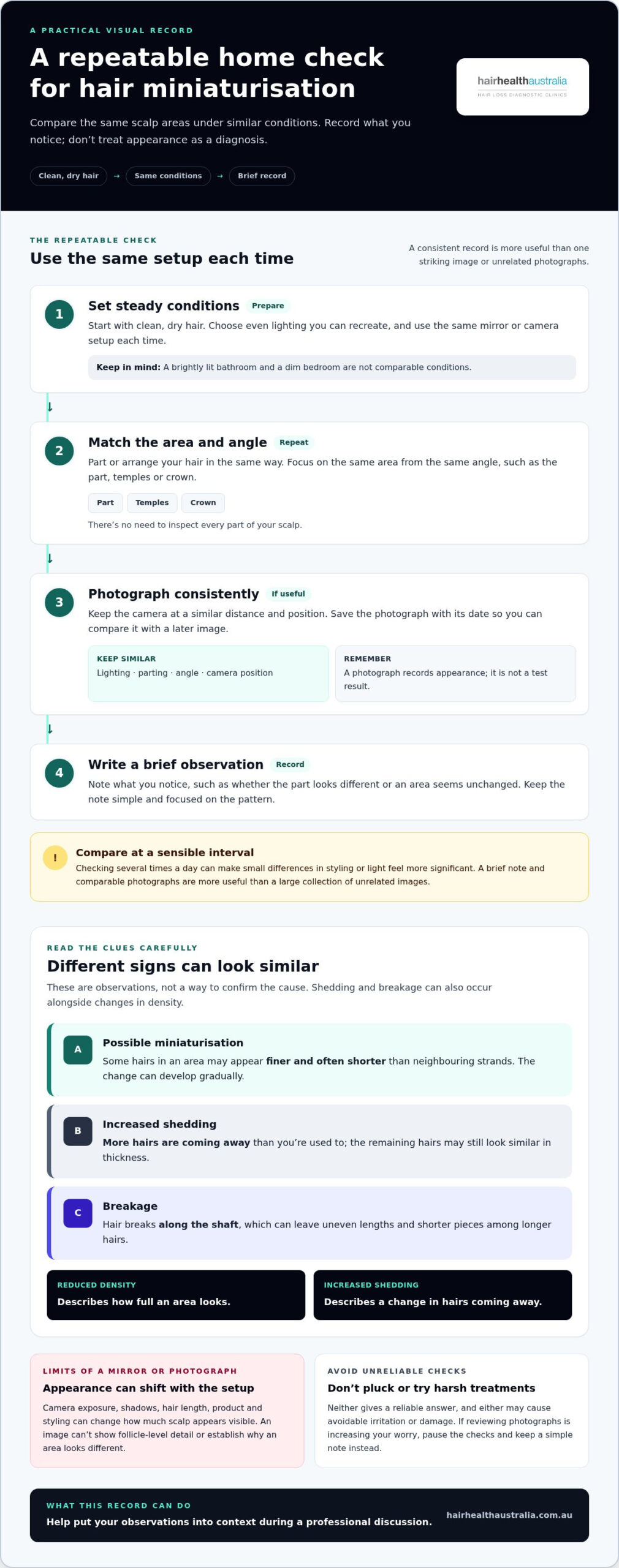
A home check is most useful as a consistent record of what you can see, not as a way to diagnose the cause. If you’re wondering how to check for hair miniaturization, compare the same areas under similar conditions. A change that appears in one photograph but not another may reflect the setup, not a change in your hair.

A repeatable visual check: lighting, areas and photographs

Start with clean, dry hair and choose even lighting you can recreate. Avoid comparing a brightly lit bathroom mirror with a dim bedroom photo. Keep your parting consistent and focus on areas relevant to your concern, such as the part, temples or crown. There’s no need to inspect every part of your scalp.

  1. Choose a place with steady lighting and use the same mirror or camera setup each time.
  2. Part or arrange your hair in the same way, then inspect the same area from the same angle.
  3. If you take a photograph, keep the camera at a similar distance and position. Save it with the date.
  4. Write a brief note about what you notice, such as whether the part looks different or one area seems unchanged.

Compare at a sensible interval rather than checking several times a day. Frequent inspection can make small differences in styling or light feel more significant than they are. A brief note and comparable photographs are more useful than a large collection of unrelated images.

What a mirror or phone photograph cannot tell you

Images have limits. Camera exposure, shadows, hair length, product and styling can all change how much scalp appears visible. A photograph also can’t show follicle-level detail or establish why an area looks different. Treat it as a record of appearance, not a test result, and don’t draw a firm conclusion from a single image.

Don’t pluck hairs to inspect them or try harsh treatments to see whether the appearance changes. Neither gives a reliable answer, and either may cause avoidable irritation or damage. If reviewing photos is increasing your worry, pause the checks and keep a simple note instead. For background on what a formal hair-loss evaluation may involve, see the Mayo Clinic’s information on hair loss diagnosis and treatment.

If your notes or photographs leave you unsure, a hair health check can help put the changes you’ve observed into context. The aim is to discuss the pattern alongside other relevant factors, not to treat a phone photo as a diagnosis.

Miniaturisation, shedding or breakage: compare the clues carefully

Thinning describes a change in how full your hair looks, but doesn’t explain why it’s happening. The clues may relate to finer hairs developing over time, more hairs being shed, damage to the hair shafts, or a combination. Similar visible changes can have different causes, so appearance alone can’t confirm what’s behind them.

Use the comparisons below to organise what you’ve noticed, not to diagnose the cause yourself.

Pattern Possible clue What it may suggest
Miniaturisation A mix of finer and thicker hairs in an area, with coverage that may seem to change gradually Hairs may be changing in calibre over time. This can occur in androgenetic alopecia, but the observation alone doesn’t establish the cause.
Shedding More hairs than usual coming away during washing, brushing or other routine handling This concerns hair release from the scalp, rather than simply a change in the thickness of hairs that remain.
Breakage Shorter strands of uneven lengths among longer hairs The hair shaft may be breaking. This appearance doesn’t identify why it’s happening.

Clues that may point towards finer hair over time

If some hairs in an area seem noticeably finer than others, and the overall coverage appears to change gradually, that’s a useful observation to record. It isn’t proof of miniaturisation: natural variation and other factors can affect how hair looks. There’s no universal visual threshold to apply at home. Focus instead on whether a consistent pattern emerges when you compare the same area under similar conditions.

Clues that may fit shedding or hair-shaft breakage instead

Shedding refers to hairs coming away, while breakage involves damage along the hair shaft. Short, uneven strands could fit breakage, but they don’t confirm it. Shed hairs and changes in density can also be noticed at the same time. The distinction may not be clear from a mirror check, particularly when several changes overlap.

Androgenetic alopecia is one possible context for miniaturisation, not a catch-all explanation for thinning. Other causes may also affect hair density or shedding, and the right interpretation depends on the broader picture. “It looks thinner” is a starting observation, not a diagnosis.

As part of how to check for hair miniaturization, note whether the change seems gradual or sudden, where it appears, and whether you’re also noticing more shedding or uneven short hairs. Seek professional advice if the change is persistent, sudden, worsening or otherwise concerning. A clinician can consider your history and examine the pattern rather than relying on one visible clue.

How to Check for Hair Miniaturisation: Signs, Limits and Next Steps

Track changes and when to seek professional advice

A brief record can make a conversation about hair changes clearer, especially if they’ve been gradual or difficult to describe. It shows what you’ve noticed and when, but it can’t determine the cause. A clinician considers your history and examination findings together, rather than relying on one photograph or home observation alone.

What information is useful to record before an appointment?

Keep notes factual and concise. You don’t need to monitor every strand or decide whether a change is miniaturisation. Record observations that may help explain the pattern:

  • When you first noticed a change, and whether it seems stable, gradual or more rapid.
  • Which areas appear affected, such as the part, temples or crown, if relevant.
  • Whether you’ve noticed more hairs coming away, uneven shorter hairs, or a change in apparent coverage.
  • Any recent changes in hair care, medication or general health, or significant health events. Note the timing without assuming these caused the hair change.
  • Any photographs you’ve taken consistently, including when they were taken and whether lighting or styling differed.

If a detail is uncertain, mark it as uncertain rather than trying to fill in the gaps. These notes support discussion; they don’t prove a particular diagnosis.

When is a professional opinion more useful than continued self-checking?

Consider seeking an assessment if a change persists, seems to progress, or remains hard to interpret despite keeping a consistent record. A professional can consider the pattern alongside relevant health and hair history, and decide whether further evaluation is appropriate. Independent clinics and healthcare providers, such as meralipharmacyandclinic.co.uk, offer consultations where patients can discuss general health concerns and suitable care with qualified clinicians. Your observations provide context, but don’t replace an assessment.

Seek prompt medical advice if hair loss is sudden, or if you notice scalp symptoms such as persistent irritation, pain or marked redness. New health concerns alongside hair changes are also a reason to speak with a health professional. Don’t delay getting advice to collect more photographs if the change feels sudden or worrying.

For anyone researching how to check for hair miniaturization, the most useful record is a calm, dated account of what changed and when, not repeated close inspections. If you’re in Sydney and would like to discuss your observations, arrange a hair health check with Hair Health Australia. An assessment can help clarify the concern and inform a discussion about suitable next steps.

What happens after a hair miniaturisation concern is assessed?

An assessment makes sense of your concern in context. It doesn’t confirm miniaturisation from one photograph or a single visual clue. The discussion may begin with what you’ve noticed, when it started and whether it has changed. Your hair and health history can help put those observations into perspective.

How findings can shape an individualised discussion

Visible thinning can have different explanations, so an assessment considers the overall pattern rather than assuming one cause. You may be asked about changes in density, shedding or breakage, as well as relevant health events and hair-care habits. Any interpretation depends on your individual observations and history. The aim is to clarify what the concern may involve and whether further medical advice is appropriate, not to draw a conclusion from appearance alone.

Bring your dated notes or consistent photographs if you have them, and explain how they were taken. They provide useful context but aren’t a substitute for discussion and examination. If you’ve been researching how to check for hair miniaturization, this is where your home observations can be considered alongside the bigger picture. You can ask what the findings do and don’t suggest, and what uncertainties remain.

What realistic, non-surgical care can mean

If treatment is a suitable next step, the options should relate to your needs and circumstances. Hair Health Australia provides personalised, non-surgical hair-loss treatment programmes for men and women, including in Sydney. A conversation about care can cover suitability, the process and realistic expectations. No single approach suits everyone, and an assessment isn’t a promise of a particular result.

For women considering care, it may help to understand how individual circumstances inform treatment discussions. The guide to hair loss treatment for women covers that context. Similarly, for men looking to explore clinical advice online, doctor-led telehealth services such as Apollo Health provide dedicated consultations for male pattern thinning and overall health. Whatever your circumstances, ask how a proposed option relates to the concern being assessed, what it involves and how progress would be discussed.

A useful next step doesn’t have to mean committing to treatment. It can simply be a chance to understand your observations and talk through appropriate options. If you’d like to discuss what you’ve noticed, book a hair health check with Hair Health Australia. A considered conversation can help replace guesswork with a clearer understanding of the choices available to you.

Take the next step with clarity

Knowing how to check for hair miniaturization can help you organise what you’ve noticed, but you don’t need to reach a conclusion on your own. Your notes can start a considered conversation about what’s changed and what may be useful to explore next. If the picture still feels uncertain, an assessment is a practical way to move beyond repeated checking.

A hair health check with Hair Health Australia in Sydney gives you an opportunity to discuss your observations in context and consider suitable next steps. Bring your questions and any record you’ve kept. You don’t need to have a diagnosis or treatment decision worked out before starting the conversation.

Book a hair health check to talk through what you’ve noticed with Hair Health Australia.

Frequently Asked Questions

Can you check for hair miniaturisation at home?

Yes, you can monitor visible changes at home, but you can’t confirm miniaturisation or its cause this way. If you’re working out how to check for hair miniaturization, compare the same area under similar conditions and note what changes rather than treating one image as a result. For example, record whether a part appears different across comparable photos. Stop checking if it’s adding to your worry, and seek advice if the change persists.

What does miniaturised hair look like?

It may look finer and sometimes shorter than thicker hairs nearby, with a mix of hair diameters in one area. You might also notice that coverage seems less substantial in a particular region over time. These appearances aren’t unique to miniaturisation. Hair length, styling and lighting can make strands look different, so a visual clue needs to be considered alongside other findings before anyone can draw a conclusion.

Is hair miniaturisation always caused by androgenetic alopecia?

No. Miniaturisation is associated with androgenetic alopecia, but seeing fine hairs doesn’t establish that diagnosis, and thinning can have other explanations. A clinician may consider the distribution of change, your health history and whether shedding or breakage is also present. Avoid choosing a treatment based only on an assumed cause, as options suitable for one type of hair loss may not address another.

Can hair miniaturisation be reversed?

Whether hair changes can improve depends on their cause, your individual circumstances and how the follicles are affected. There isn’t a reliable home method to reverse miniaturisation, and no outcome can be guaranteed. A professional discussion can help clarify what the observed pattern may mean and whether treatment options are appropriate. Be cautious of claims promising certain regrowth or asking you to start treatment without understanding the reason for the change.

How is hair miniaturisation professionally assessed?

A clinician considers your account of the change alongside the pattern seen during an examination. They may ask about timing, health history and hair-care practices, then decide whether further evaluation is relevant. A photograph alone isn’t enough to establish the cause. In Sydney, Hair Health Australia provides personalised hair-loss treatment programmes for men and women, with a non-surgical focus. Suitable options depend on individual circumstances and assessment.

Should I seek advice for sudden hair thinning?

Yes. Arrange prompt medical advice if thinning appears suddenly, particularly if you also have scalp discomfort, redness, irritation or another new health concern. Don’t wait to build a photo record before seeking help. Note when you first noticed the change and any symptoms, then share that information with a health professional. Sudden changes can have different explanations, so timely assessment is more useful than trying to identify the cause by appearance alone.

How to Stop Worrying About Hair Falling Out: A Calm, Practical Guide

What if more checking isn’t bringing you closer to certainty? If you’re trying to work out how to stop worrying about hair falling out, it can be unsettling to notice strands in the shower or on your brush and wonder whether the amount is normal for you.

It’s understandable to look in the mirror, take comparison photos or search online for answers. But repeated checks can keep your attention fixed on every strand without explaining what’s causing a change. Some daily shedding is expected. What matters more is whether you notice a persistent or visible difference.

This guide explains what everyday shedding can mean, which changes may deserve attention and how to ease checking and rumination. It also looks at how stress, health changes and inherited factors may be relevant, and why an individual hair health assessment can help clarify next steps. The aim isn’t to dismiss your concern or jump to conclusions, but to replace guesswork with a calmer, more considered way forward.

Key Takeaways

  • Loose hairs alone don’t explain what’s happening. Look for broader patterns and changes over time rather than treating each strand as proof of a problem.
  • Frequent checking, comparisons and online searches can keep uncertainty alive without giving you a reliable answer.
  • Use a simple, consistent routine to observe changes in coverage, part width or hairline, instead of counting strands or checking throughout the day.
  • To practise how to stop worrying about hair falling out, pause, name what you’re unsure about, choose one useful action, then return to your day.
  • A structured hair health check may help clarify what you’ve noticed and support individualised next steps, without assuming a diagnosis or outcome.

Why hair falling out can feel alarming, and what everyday shedding means

Finding loose hairs on your pillow, clothes or in the shower can prompt an immediate question: is this more than usual? It can feel especially unsettling if you’ve noticed a change in your appearance or have been thinking about hair loss. But concern is a response to uncertainty, not proof that you have a hair or scalp condition.

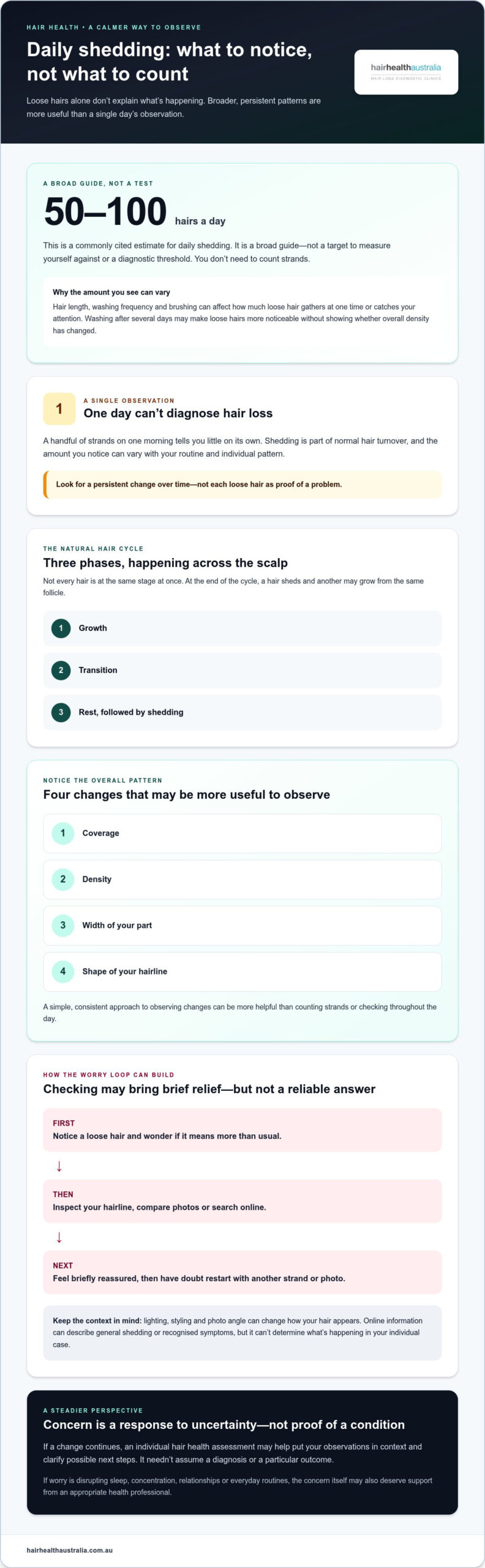
Hair naturally cycles through periods of growth, transition and rest. At the end of this process, a hair sheds and another may grow from the same follicle. This happens across your scalp, but not every hair is at the same stage at once. Shedding is part of normal hair turnover, and the amount you notice can vary with your routine and individual pattern.

Is it normal for hair to fall out every day?

Daily shedding is expected. A commonly cited estimate is around 50 to 100 hairs a day, but this is a broad guide, not a target to measure yourself against or a diagnostic threshold. You don’t need to count strands. Hair length, washing frequency and brushing can affect how much loose hair gathers at one time or catches your attention. For example, washing after several days may make loose hairs more noticeable without showing whether your overall density has changed.

Normal shedding is the routine release of hairs as part of the growth cycle. One day of observation cannot diagnose hair loss. A handful of strands on a particular morning tells you little on its own. It’s more useful to notice a persistent change in coverage, density, the width of your part or the shape of your hairline. These are changes in an overall pattern, not a single moment.

Why does the possibility of hair loss cause so much worry?

Hair can be closely tied to identity, confidence and how someone feels about their appearance. That connection is personal, and there’s no single correct reaction to noticing a change. If hair loss has affected someone in your family, or you’ve recently experienced a major life change, you may find yourself paying closer attention to every shed hair. The broader overview of Hair loss describes different causes and types, but general information can’t establish what’s happening for an individual.

It’s reasonable to want clarity. Worry deserves attention in its own right if it’s disrupting sleep, concentration, social plans or everyday routines, even when the cause of shedding is uncertain. You don’t have to dismiss the concern or decide what it means straight away. Start by distinguishing loose hairs from a change that continues over time. That can help you take a calmer approach to how to stop worrying about hair falling out without ignoring a change that may deserve closer attention.

How uncertainty and repeated checking can keep hair-loss worry going

Uncertainty can make a small observation feel like evidence. You notice a hair on your jumper, wonder if it means you’re losing more than usual, then inspect your hairline or search online for answers. Checking may bring brief relief, but it rarely settles the question for long. Another strand or a different photo can quickly restart the doubt.

This cycle can grow because checking feels like a way to gain control. Yet close-up photos, repeated mirror checks and comparisons with someone else’s hair don’t show the full context. Lighting, styling and the angle of a photo can change how your hair appears. Online information may describe normal hair shedding or recognised symptoms, but it can’t determine what’s happening in your case. Worry alone can’t confirm hair loss or identify its cause.

When does concern become a worry loop?

Notice the effect the concern is having rather than trying to label yourself. Are you checking repeatedly, seeking reassurance or changing plans because you’re worried about how your hair looks? Consider how much time the concern takes and whether it’s interfering with sleep, work, relationships or activities you usually enjoy. If distress is persistent or affecting daily life, discussing it with an appropriate health professional may help.

This doesn’t mean that caring about your hair is unusual or that you have a mental health condition. It’s a practical way to recognise when the worry itself deserves support, regardless of what’s happening with your hair.

Can stress make hair shedding feel more frightening?

Stress can affect how closely you monitor your hair, while a stressful physical or emotional event may also be relevant when considering a change in shedding. These are related but separate possibilities. Timing matters, as do other health changes and personal factors. A difficult period doesn’t automatically explain shedding, and feeling calmer isn’t a guaranteed way to stop it. Avoid blaming yourself for either the worry or the change.

Instead, focus on what can be clarified. If you’ve noticed a continuing change, an individual assessment can help put your observations in context. Hair Health Australia’s hair health check offers a way to seek clearer information and consider possible next steps, without assuming a diagnosis or particular result. For people in Sydney, this provides a more individual starting point than repeating searches that offer general answers but leave your own question unresolved.

Learning how to stop worrying about hair falling out doesn’t mean ignoring what you’ve noticed. It means recognising when checking is adding anxiety rather than useful information, and choosing a more considered way to understand a persistent change.

How to observe hair changes without turning them into a daily test

If you’ve noticed a possible change, the aim isn’t to monitor every strand. It’s to gather a small amount of useful information in a consistent way, then take a break from checking. Repeated inspections can make ordinary differences in lighting, styling or how your hair sits feel like new evidence.

Consistent observations over time are more informative than isolated shed hairs. A simple routine can help you notice a broad trend without turning your hair into a daily test. Choose a regular interval that feels manageable, and use similar lighting, hairstyle and angles each time. A brief note is often enough. You don’t need to photograph your scalp every day or count hairs after washing.

What should you record, and what should you leave alone?

Keep your notes neutral and factual. Record when you first noticed a visible change, where it appears, and whether it seems stable, improving or progressing. If relevant, note major health or life changes around the same period, such as an illness, medication change or particularly stressful event. These details provide context, but they don’t prove what caused the change.

Focus on broad features, such as overall coverage, a part that appears wider or a hairline that seems to have shifted. Try not to compare your hair with someone else’s. Daily photographs, repeated scalp inspections and strand counting can make small variations seem more meaningful than they are. If you want to check again, return to the observation schedule you chose rather than starting a new one.

What changes call for a timely hair health assessment?

A single unusual day of shedding may not tell you much. A persistent or clearly changing pattern is more useful to discuss in an assessment, particularly if you’re concerned or unsure how to interpret it. Sudden patchy changes, scalp symptoms such as irritation, or other new symptoms are reasons to seek timely clinical advice rather than relying on photos or online comparisons. Speaking with a medical doctor—whether consulting a private GP Edinburgh or booking in with your local clinic—can also help identify any underlying nutritional deficiencies or hormonal imbalances contributing to shedding.

An individual assessment can consider the pattern you’ve noticed alongside relevant context. You don’t need to diagnose yourself before seeking help. If you’re trying to understand a continuing change, Hair Health Australia’s hair health check can help replace guesswork with clearer next steps.

For a closer look at possible reasons a change may continue, see Why My Hair Loss Is Persistent: Diagnostic Clues. Use your notes to support a clearer conversation, not as a reason to keep searching for certainty. That’s one practical part of learning how to stop worrying about hair falling out while still taking a persistent change seriously.

How to Stop Worrying About Hair Falling Out: A Calm, Practical Guide

How to stop worrying about hair falling out: a practical reset

Worry can make you feel you need to solve the question right now. Instead, use a short reset to separate what you’ve observed from what you fear it means. You’re not trying to talk yourself out of a genuine concern. You’re choosing a proportionate next step rather than repeating checks that don’t provide new information.

What can you do when worry spikes?

Try this four-step reset when you notice yourself checking or searching again:

  • Pause. Step away from the mirror, brush or phone for a moment.
  • Name the uncertainty. Describe the observation plainly, without adding a conclusion.
  • Choose one useful action. Note a continuing change or arrange an assessment if needed.
  • Return to your day. Resist the urge to repeat the check for reassurance.

If you feel wound up, take a few slow breaths or focus on a grounding activity, such as noticing what you can see and hear around you. Give yourself time to settle before deciding whether action is needed. This pause doesn’t diagnose or resolve the hair concern. It gives you space to respond thoughtfully.

How can you avoid reassurance-seeking habits?

Set a realistic boundary around mirror checks and online searches, then use the same observation routine each time. For instance, decide not to search for symptoms again after you’ve made a note of a change. Ask someone you trust to listen to how you’re feeling, rather than repeatedly asking them to predict whether you’re losing hair. Reassurance can feel helpful briefly, but it can’t establish the cause.

Support ordinary wellbeing while you seek clarity. Keep up with sleep, regular meals and activities that help you feel steady. Handle your hair gently when washing and brushing, and avoid harsh pulling or unnecessary tension. These habits can support general wellbeing and reduce avoidable strain on your hair, but they can’t prevent every cause of hair loss or guarantee that shedding will stop.

It may help to write down a simple boundary in advance: observe according to your chosen routine, take one useful action if a change persists, then move on to another part of the day. This is a practical way to approach how to stop worrying about hair falling out without dismissing what you’ve noticed. If a persistent change is troubling you, an individual hair health assessment can help put your observations in context and clarify possible next steps.

Anxiety also deserves care in its own right. If worry is regularly disrupting sleep, work, relationships or everyday routines, consider discussing it with an appropriate health professional. Engaging with services like LEAPS Inc. for professional therapy and coaching can provide valuable support for stress and emotional well-being. You don’t need to know what’s causing a hair change before seeking support for how the uncertainty is affecting you.

How a hair health check can replace guesswork with clearer next steps

When you’ve noticed a change, general information can explain what may be possible, but it can’t tell you how your own hair and scalp are changing. An individual hair health check offers a structured way to consider what you’ve observed alongside your timeline and personal circumstances. It can help shift the focus from repeated speculation to a clearer discussion of possible next steps.

A hair health assessment considers your pattern and history, not one loose hair. A single observation rarely explains the bigger picture, while a continuing change may be easier to discuss in context. An assessment can inform suitable next steps, but it shouldn’t be treated as a guarantee of a particular diagnosis or result.

What can a personalised hair assessment help clarify?

A useful starting point is the change you’ve noticed: when it began, whether it appears to be continuing, and where it’s most visible. Your circumstances may also matter. Relevant health or life changes, family history and other factors can help put your observations in context, without proving that any one factor caused them.

Hair Health Australia provides tailored, non-surgical hair-loss care for men and women in Sydney, with an approach centred on hair and scalp assessment and individualised care. A structured assessment can guide discussion about possible next steps. You don’t need to arrive with a diagnosis, and one particular treatment won’t necessarily suit everyone. The aim is clearer information to support an informed decision.

How to take the next step without feeling pressured

Seeking information doesn’t commit you to a treatment programme. You can start by reviewing what a hair health check involves and deciding whether structured guidance feels useful. If you’re not ready to take that step, continue with proportionate observation rather than frequent checking. There’s no need to turn uncertainty into an urgent decision.

If you’d like to understand more about clinical hair treatment options, the guide Clinical Hair Treatment: A Professional Guide to Non-Surgical Restoration can provide further context. Learning about options can help you become better informed, but it doesn’t obligate you to pursue treatment. Any next step should take account of your individual circumstances and what matters to you.

If you’re still wondering how to stop worrying about hair falling out, a structured assessment may help replace online guesswork with a more individual perspective. Hair Health Australia’s tailored approach focuses on understanding your hair and scalp and considering suitable next steps, without promising regrowth or a particular outcome.

If you’re ready to seek clearer, individual guidance, Arrange a hair health check.

Move forward with a clearer plan

You don’t need to solve every question about your hair today. A steadier goal is to decide what would help you feel informed, then take that step without letting repeated checking take over your time. If you’re considering how to stop worrying about hair falling out, remember that seeking clarity is a choice, not a commitment to treatment.

Hair Health Australia provides tailored hair-loss care for men and women, with individualised, non-surgical treatment approaches in Sydney. A hair health check can be a starting point for discussing your concerns and considering what may suit your circumstances. Take time to understand your options and decide what feels right for you.

Arrange a hair health check when you’re ready to explore a more structured next step. You deserve information that helps you move forward with greater confidence, at a pace that feels manageable.

Frequently Asked Questions

Is it normal to lose hair every day?

Yes, some daily hair shedding is a normal part of the hair cycle, and the amount you notice can vary with your routine. A wash day may leave more loose strands visible than a day when you haven’t washed your hair. Rather than treating one day as a test, look for a lasting difference in coverage or pattern. If a change concerns you, an individual assessment can help put it in context.

Can worrying about hair loss make my hair fall out?

Worry by itself can’t confirm that hair loss is happening or explain its cause. Stress may be associated with changes in the hair cycle for some people, but health, family history and other circumstances can also be relevant. Relaxation can support wellbeing, but it isn’t a guaranteed way to stop shedding. If the change continues, note its timing and seek individual guidance rather than assuming anxiety is the explanation.

How can I tell whether my hair is thinning or just shedding?

Loose strands can occur without an obvious change to your overall hair, while a continuing shift in density, part width, hairline or coverage may be worth assessing. One mirror check or wash can’t establish the cause. If you’re unsure, note what looks different and when you first noticed it, then compare under similar conditions at a later point. Avoid using daily photos or strand counts as a substitute for an assessment.

When should I seek help about hair falling out?

Seek timely clinical advice if shedding persists, your hair’s appearance is clearly changing, or you notice sudden patches, scalp symptoms or other new symptoms. These signs don’t prove a particular condition, but they’re useful reasons to discuss what’s happening. An assessment can consider the pattern alongside your circumstances and timeline. Getting guidance is a sensible way to address uncertainty, not evidence that the cause must be serious.

Does stress-related hair shedding grow back?

Whether hair grows back depends on the cause and your individual circumstances, so a general answer can’t predict your outcome. Some temporary shedding may improve after its trigger has passed, while other patterns may call for a different assessment and plan. Avoid relying on a fixed recovery timeline or assuming stress is the only factor. If shedding continues, progresses or worries you, seek an individual evaluation to discuss what may be appropriate.

How do I stop checking my hair all the time?

Choose one manageable time to observe broad changes, and use brief notes instead of repeatedly inspecting your scalp. For example, record whether your part or hairline seems different under consistent conditions, then leave it until your next planned check. If you’re searching for reassurance, pause and identify one useful action before closing the search. If worry is affecting sleep, work or relationships, seek support for the distress too.

Can a hair health check tell me why my hair is falling out?

A hair health check can help consider your concerns and inform possible next steps, but it can’t guarantee a particular diagnosis or result. Before an assessment, it may help to note when you first saw a change and any relevant circumstances, such as a recent health change. If you’re in Sydney and would like structured guidance, explore Hair Health Australia’s hair health check to learn about taking that next step.

How to Improve Hair Density: The 2026 Clinical Checklist for Thicker Hair

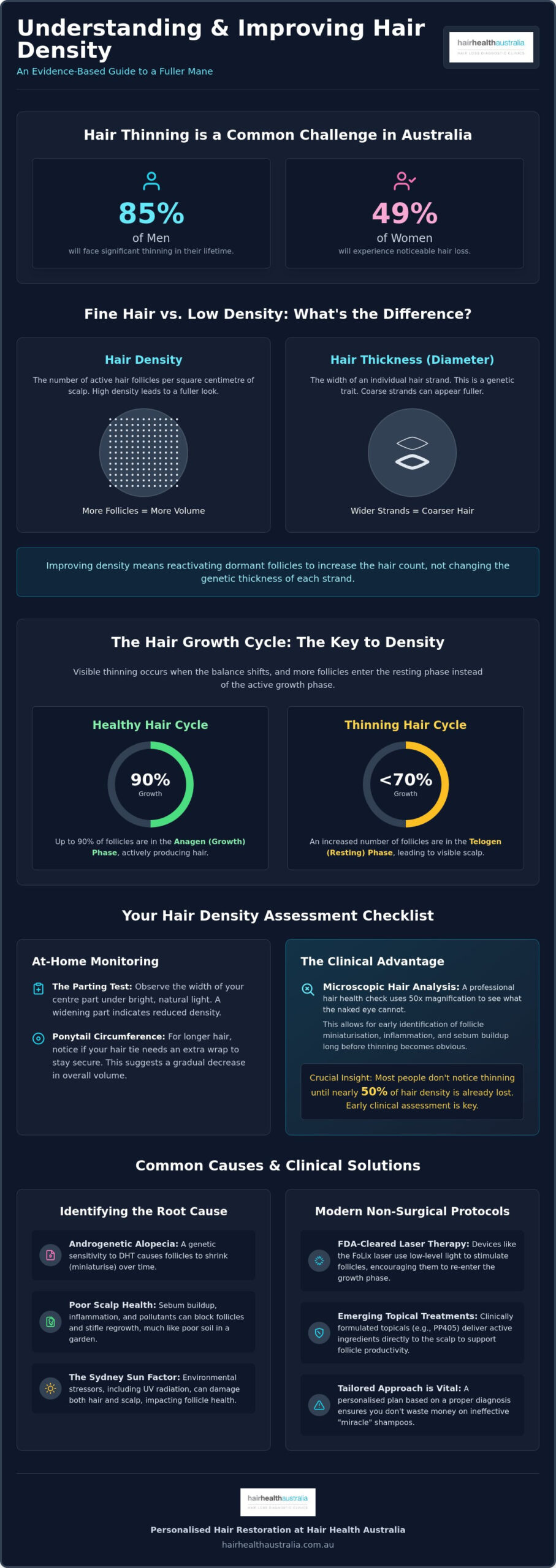
You’re standing under the harsh, bright lights of your bathroom mirror, and for the first time, you can see the distinct outline of your scalp through what used to be a thick fringe. It’s a confronting moment that often leads to a cycle of expensive miracle shampoos and the nagging fear that surgery is your only remaining option. We understand that seeing more scalp than hair can feel like losing a part of your identity. If you’ve been wondering how to improve hair density without resorting to a costly transplant, you aren’t alone. In fact, approximately 49% of Australian women and 85% of men will face this exact challenge in their lifetime.

This guide moves past the marketing hype to provide a clear, evidence-based roadmap for transitioning from thinning patches to a fuller mane. You’ll discover how the latest 2026 clinical diagnostics and non-surgical protocols, such as the FDA-cleared FoLix laser and emerging topical treatments like PP405, are changing the landscape of hair restoration. We’ll walk you through a systematic checklist to help you identify your specific root cause and implement a professional, actionable plan for visible regrowth.

Key Takeaways

  • Learn the clinical difference between fine hair and low density to better understand why your hair’s volume depends on the number of active follicles per square centimetre.
  • Adopt objective measurement tools, such as the Parting Test, to accurately monitor your progress and reduce the visibility of your scalp.
  • Discover the clinical science behind how to improve hair density by shifting follicles from the resting phase into active growth without the need for invasive surgery.
  • Recognise the impact of the Sydney Sun Factor and learn how specific amino acids provide the essential building blocks for a healthier mane.
  • Find out why a tailored approach is vital for success and how clinical programmes ensure you don’t waste money on ineffective “miracle” shampoos.

Understanding Hair Density: Clinical Definition vs. Cosmetic Perception

Clinical hair density is defined as the number of active follicles per square centimetre of your scalp. While many people use the terms “thick” and “dense” interchangeably, they represent two distinct biological realities. Understanding how to improve hair density begins with recognising that your hair’s appearance is a combination of follicle count and individual strand thickness. You might have thousands of follicles, but if each strand is fine in diameter, your hair may still lack volume. Conversely, someone with lower density but very coarse strands might appear to have a fuller mane.

The distinction between fine hair and thinning hair is vital for a correct diagnosis. Fine hair is a genetic trait relating to the small diameter of the hair shaft itself. Thinning hair, however, is a clinical reduction in density where follicles either produce shorter, weaker hairs or stop producing them altogether. This density is not uniform across the head. It is naturally highest at the vertex and crown, while the hairline and temples often show the first signs of depletion. Perceived density also depends heavily on the growth cycle. At any given time, about 85 to 90 percent of your hair should be in the Anagen (growth) phase. When this ratio shifts, more follicles enter the resting phase, leading to visible scalp show-through even if the follicles are still present. Gaining a deeper understanding of hair follicle anatomy reveals that these complex organs require specific conditions to remain in that active growth state.

The Role of Genetics and Age in Australian Populations

Hereditary patterns, specifically Androgenetic Alopecia, are the most common reason Australians seek advice on how to improve hair density. This condition causes follicles to slowly miniaturise over time under the influence of dihydrotestosterone (DHT). As we age, some follicles may enter a state of prolonged dormancy rather than permanent loss. A follicle can remain biologically viable and capable of revival even if it has ceased to produce a visible hair shaft for a period of time. Identifying this dormancy early is the key to successful non-surgical restoration.

Why Your Scalp Health Dictates Your Density

Think of your scalp as the fertile soil for a garden. If the soil is congested with sebum buildup or plagued by inflammation, the “crops” cannot thrive. Excess oil and environmental pollutants can block follicle openings, effectively stifling regrowth and contributing to further thinning. You can read more about identifying these environmental triggers in our guide on Scalp Health and Hair Loss: What You Need to Know. A compromised scalp environment often presents as persistent redness, itching, or sudden changes in oil production, all of which signal that the foundation for hair density is under threat.

The Hair Density Assessment Checklist: How to Measure Your Progress

Monitoring your progress is essential when learning how to improve hair density. While mirrors provide a daily snapshot, they often lack the precision required to track subtle biological shifts. You can start with the Parting Test. By separating your hair down the centre under natural light, you can observe the width of the exposed scalp. A widening part is a clear indicator of reduced follicle activity. For women, the Ponytail Circumference is a practical metric. If your usual hair tie requires an extra wrap to stay secure, it suggests a long-term shift in overall density. Photographic tracking is another useful tool, provided you maintain consistent lighting and angles to ensure your “before and after” shots are objective. However, visual inspection has its limits. Most people don’t notice thinning until they’ve lost nearly 50 percent of their hair density, meaning the naked eye is often too late to catch early-stage miniaturisation.

The Clinical Advantage: Microscopic Hair Analysis

To get ahead of the curve, a professional hair health check is the most reliable diagnostic tool. At Hair Health Australia in Sydney, we utilise 50x magnification to examine the scalp environment in detail. This allows us to identify miniaturisation, the process where follicles shrink and produce progressively thinner strands, long before the hair actually falls out. High-resolution scanning can also reveal “dormant” follicles that are still alive but currently in the resting phase. By identifying these viable follicles early, we can implement clinically-proven hair loss treatments that stimulate regrowth before the follicle loses its capacity to function. If you’re concerned about visible scalp, scheduling a diagnostic scan is the first step toward clarity.

Identifying the “Why” Behind Your Thinning

Successful restoration requires a clear understanding of the underlying cause. Your checklist should begin with ruling out common physiological triggers. Nutritional deficiencies, particularly low levels of Iron (ferritin), Zinc, and Vitamin D, are frequent culprits in Australian populations. These elements are essential for the metabolic processes within the hair bulb. Additionally, you should monitor your recent health history. High stress or significant illness can trigger Telogen Effluvium, a condition where a large percentage of follicles prematurely enter the shedding phase. For a deeper dive into these triggers, consult our clinical guide to hair loss causes. By ticking off these variables, you can determine if your thinning is a temporary reaction or a progressive condition requiring targeted intervention.

Clinical Strategies to Boost Follicle Productivity Non-Surgically

Gaining a clear understanding of how to improve hair density requires a shift in focus from the hair shaft to the follicle itself. The primary goal of any clinical restoration programme is to transition follicles from the resting (Telogen) phase back into the active growth (Anagen) phase. In Australian clinics, non-surgical regrowth is the preferred first line of defence. It focuses on preserving and revitalising your natural hair before the condition progresses to a stage where surgery becomes the only viable option. It’s a proactive approach that works in harmony with your body’s biological rhythms.

Patience and consistency are the cornerstones of this process. Unlike cosmetic fillers or temporary hairpieces, biological regrowth doesn’t happen overnight. Most medically-reviewed hair loss treatments require a committed period of three to six months before visible changes in density become apparent. This timeline aligns with the natural hair growth cycle. A common concern we hear is, “Is it too late for me?” The answer usually depends on follicle viability. As long as the follicle hasn’t been replaced by permanent scar tissue, there is a clinical opportunity to stimulate productivity and restore volume. Understanding the biological mechanisms behind hair growth support and clinical intervention can help you distinguish between evidence-based treatments and over-the-counter products that fall short of delivering real results.

Low-Level Laser Therapy (LLLT) and Photobiomodulation

LLLT is a sophisticated, non-invasive technology that uses specific wavelengths of light to energise cellular mitochondria within the hair follicle. This process, known as photobiomodulation, increases the production of adenosine triphosphate (ATP), which provides the energy needed for rapid hair cell division. By improving local blood flow, the treatment ensures that the hair bulb receives a constant supply of oxygen and essential nutrients. LLLT acts as a biological catalyst that energises cellular processes to wake up dormant follicles and return them to the active growth phase.

Clinical Topical Formulations and Growth Factors

While many people start their journey with supermarket brands, professional-grade topicals offer a significantly higher level of efficacy. These clinical formulations often combine potent growth factors with targeted DHT blockers to address the chemical triggers of thinning at the source. The delivery systems in these professional products are engineered to penetrate the scalp barrier more effectively, ensuring the active ingredients reach the follicle’s base. Understanding which bio-active ingredients are clinically validated is essential; our guide to the best hair regrowth treatment Australia clinics recommend in 2026 provides a detailed breakdown of TGA-listed therapeutics versus cosmetic-grade products. For those ready to move beyond generic solutions, a comprehensive hair health check provides the diagnostic foundation for a professional, non-surgical restoration protocol.

How to Improve Hair Density: The 2026 Clinical Checklist for Thicker Hair

The Lifestyle Foundation: Supporting Density from the Inside Out

Clinical protocols are only as effective as the biological environment they support. While advanced therapies address follicle productivity directly, your daily habits and environment provide the essential raw materials for regrowth. Understanding how to improve hair density requires looking beyond topical solutions to the internal and environmental factors that govern follicle health. Protein and amino acids are the primary building blocks of keratin production. Without an adequate supply of these nutrients, even the most advanced clinical stimulation will struggle to produce a robust hair shaft. This internal support system acts as the foundation for every other restoration effort you undertake.

Living in Australia introduces unique challenges, particularly the “Sydney Sun Factor”. High UV radiation doesn’t just age your skin; it triggers oxidative stress on the scalp. This process damages hair proteins and can lead to “inflammageing”, which is chronic, low-grade inflammation that gradually reduces density by shortening the growth phase of the follicle. While scalp massage is often touted as a miracle cure, its real value lies in supporting microcirculation. It’s a useful supplementary tool that ensures nutrients reach the hair bulb, but it must be paired with a comprehensive clinical plan to be effective. If you’ve been relying on retail supplements for hair growth support without seeing results, understanding the science behind clinical-grade interventions can help you make more informed choices.

The “Hair-Healthy” Diet Checklist

In Australian clinics, we frequently find that nutritional gaps are a silent driver of thinning. Iron and Ferritin levels are the most critical metrics to monitor. Low iron stores are the primary cause of density loss in many Australian women, as iron is essential for the oxygenation of hair cells. To support your restoration journey, focus on these key elements:

  • Iron and Ferritin: Essential for cellular energy and hair bulb metabolism.
  • Omega-3 Fatty Acids: Found in oily fish, these help reduce scalp inflammation for better follicle function.
  • Biotin and Zinc: These support the structural integrity of the hair shaft and help prevent premature breakage.

Environmental Protection for Your Scalp

Protection is just as vital as nourishment. Wearing a hat in the Australian sun is a strategic density preservation move, as it shields the scalp from UV-induced protein degradation. Additionally, be mindful of water quality. Frequent exposure to the chlorine in swimming pools or the mineral buildup from hard water can cause significant hair breakage. This breakage reduces your perceived density, making the hair look thinner than it actually is. Choosing clinical-grade shampoos that maintain the scalp’s natural pH balance will help preserve the protective barrier of your skin. If you’re ready to identify which environmental or internal factors are affecting your hair, book a hair health check today to receive a personalised diagnostic assessment.

Personalised Hair Restoration at Hair Health Australia

Determining exactly how to improve hair density for your specific scalp profile requires more than a generic serum or a supermarket shampoo. A “one-size-fits-all” approach fails because it ignores the unique biological triggers behind your thinning, whether they are hormonal, nutritional, or environmental. At Hair Health Australia, we specialise in non-surgical, clinically-backed regrowth programmes that are tailored to the individual. Our methodology moves beyond guesswork, using precise data to target the follicles that have the highest potential for recovery. By focusing on medical-grade protocols rather than cosmetic cover-ups, we help you achieve a fuller mane that is sustainably maintained.

From Diagnosis to Regrowth: Your 12-Month Roadmap

Restoring density is a biological process that follows a specific timeline. We guide our patients through a structured 12-month roadmap to ensure every phase of the growth cycle is utilised effectively:

  • Phase 1: Stabilisation. The first priority is to stop active shedding and stabilise your current hair count. We focus on deep-cleansing the scalp environment to remove DHT buildup and environmental pollutants that stifle growth.
  • Phase 2: Stimulation. Once the foundation is clear, we move into the intensive regrowth phase. This involves using clinical-grade stimulants and light therapies to wake up dormant follicles and increase the diameter of existing hair shafts.
  • Phase 3: Maintenance. After achieving visible density gains, we transition to a long-term maintenance protocol. This ensures your new growth remains healthy and resistant to future thinning triggers.

Start Your Journey Today

Taking the first step toward restoration can feel daunting, especially if you’ve spent years trying products that didn’t deliver. Our clinic provides an empathetic, “straight-talking” environment where we prioritise honest expectations and clinical results. We believe that empowerment comes through education, and we’re committed to helping you understand the “why” behind your hair loss before we begin the “how” of your treatment. If you’re ready to stop guessing and start growing, Book your Hair Health Check at our Sydney clinic today.

Empower Your Hair Restoration Journey

Transitioning from thinning hair to a fuller mane is a journey rooted in clinical science rather than cosmetic guesswork. You now understand that hair density is a precise biological metric; identifying the root cause of thinning via microscopic analysis is the most critical step in your restoration plan. By combining advanced non-surgical protocols with a supportive lifestyle foundation, you can effectively address the environmental and physiological factors that reduce follicle productivity. Learning how to improve hair density requires moving away from supermarket solutions and toward evidence-based, diagnostic-led care.

With over 15 years of clinical experience in Sydney, Hair Health Australia uses advanced microscopic diagnostic technology to create specialised non-surgical regrowth protocols tailored to your unique profile. You don’t have to accept thinning as a permanent reality or resort to invasive surgery. Take the first step toward thicker hair, book your Hair Health Check today.

The path to a thicker, healthier mane starts with clarity and professional guidance. We’re here to help you regain your confidence with a plan that is grounded in results and tailored specifically for you.

Frequently Asked Questions

Can I really increase the number of hair follicles I have?

You cannot increase the total number of hair follicles you were born with, but you can certainly increase the number of active ones. Clinical restoration focuses on waking up dormant follicles that have stopped producing visible shafts. By returning these follicles to the growth phase, you achieve a visible improvement in density without needing to create new biological structures.

How long does it take to see a visible change in hair density?

Visible changes in hair density generally require a commitment of three to six months. This duration is dictated by the natural hair growth cycle, as follicles need time to transition from resting to active production. While some patients notice scalp health improvements sooner, the physical thickening of the mane is a gradual biological process.

Does stress permanently reduce my hair density?

Stress-related thinning, known as Telogen Effluvium, is typically temporary and reversible once the trigger is managed. However, prolonged periods of high cortisol can exacerbate existing hereditary patterns. If you don’t address the underlying stress, the follicles may remain in a resting state for longer than usual, leading to a persistent reduction in density.

What is the best clinical treatment for thinning hair without surgery?

The most effective non-surgical approach is a multi-modal clinical programme that combines Low-Level Laser Therapy (LLLT) with professional-grade topicals. These treatments work synergistically to energise the hair bulb and block DHT. Because every scalp is different, the best results come from a protocol customised after a microscopic diagnostic assessment. For a comprehensive overview of clinically validated options, our reference guide on hair regrowth treatment Australia clinics use in 2026 outlines the key differences between TGA-listed therapeutics and cosmetic-grade products.

Can certain hairstyles make my hair look denser while I wait for regrowth?

Yes, certain cosmetic techniques can provide an immediate boost in appearance while your clinical treatment takes effect. Blunt cuts and shorter, layered styles often make the hair look fuller by removing weight that pulls strands flat. Additionally, professional styling and colour transformations from experts like Shampoo Avenue can create depth and dimension, making the hair appear thicker while you wait for long-term clinical results. However, you should avoid tight braids or high ponytails, as the constant tension can lead to traction loss and further thinning.

Is hair density loss always genetic, or can it be cured?

Hair density loss is not always genetic; it can be triggered by nutritional deficiencies, medication, or environmental stress. While genetic patterns like Androgenetic Alopecia cannot be “cured” in the traditional sense, they can be managed very effectively with consistent clinical care. Identifying the specific cause is the only way to determine if the loss is reversible.

How often should I have a professional hair health check?

We suggest a professional hair health check every six to twelve months to monitor your progress objectively. These regular scans allow us to use 50x magnification to detect miniaturisation before it becomes visible to the naked eye. Consistent tracking ensures your treatment remains aligned with your scalp’s changing needs.

Will improving my diet actually help my hair density?

A balanced diet is essential for providing the amino acids and minerals required for hair synthesis. Correcting a ferritin or zinc deficiency is a foundational step in how to improve hair density, as these nutrients fuel the metabolic activity in the hair bulb. Without this internal support, follicles cannot produce the strong, thick shafts needed for a dense appearance.