Stimulate Hair Follicles for Growth: 2026 Clinical Guide

That visible patch of scalp you’ve been noticing isn’t necessarily a sign of permanent loss, but rather a biological SOS from follicles that have shifted into a dormant state. If you are searching for how to stimulate hair follicles for hair growth, you’ve likely already realised that supermarket supplements and “miracle” oils rarely bridge the gap between marketing hype and medical reality. It’s incredibly frustrating to watch your hair density diminish while feeling like you’re just guessing at a solution. We understand the anxiety that comes with every morning spent checking the mirror for progress that hasn’t arrived yet.

This clinical guide provides a scientifically proven roadmap to revitalise those dormant follicles and restore your hair’s natural density without the need for invasive surgery. We will move past the confusion of the retail aisle to explore a systematic approach to scalp health, focusing on evidence-based methods that actually work. By the end of this article, you’ll understand how professional diagnostic tools like microscopic trichoscopy can identify recovery potential and why a personalised, non-surgical strategy is the most effective way to reclaim your confidence and your hair.

Key Takeaways

  • Understand the critical difference between dormant and dead follicles to determine your actual potential for natural regrowth.
  • Learn the clinical science behind how to stimulate hair follicles for hair growth by improving vasodilation and essential nutrient delivery to the hair bulb.
  • Evaluate the evidence-based efficacy of medical-grade therapies, such as Low-Level Laser Therapy (LLLT), compared to common home remedies and retail products.
  • Discover why a professional microscopic hair scan is the essential first step in identifying follicle viability and creating a personalised care plan.
  • Identify a clear, non-surgical roadmap to increase hair density and stop the shedding process using proven clinical protocols.

Understanding the Hair Follicle Lifecycle: Is Regrowth Possible?

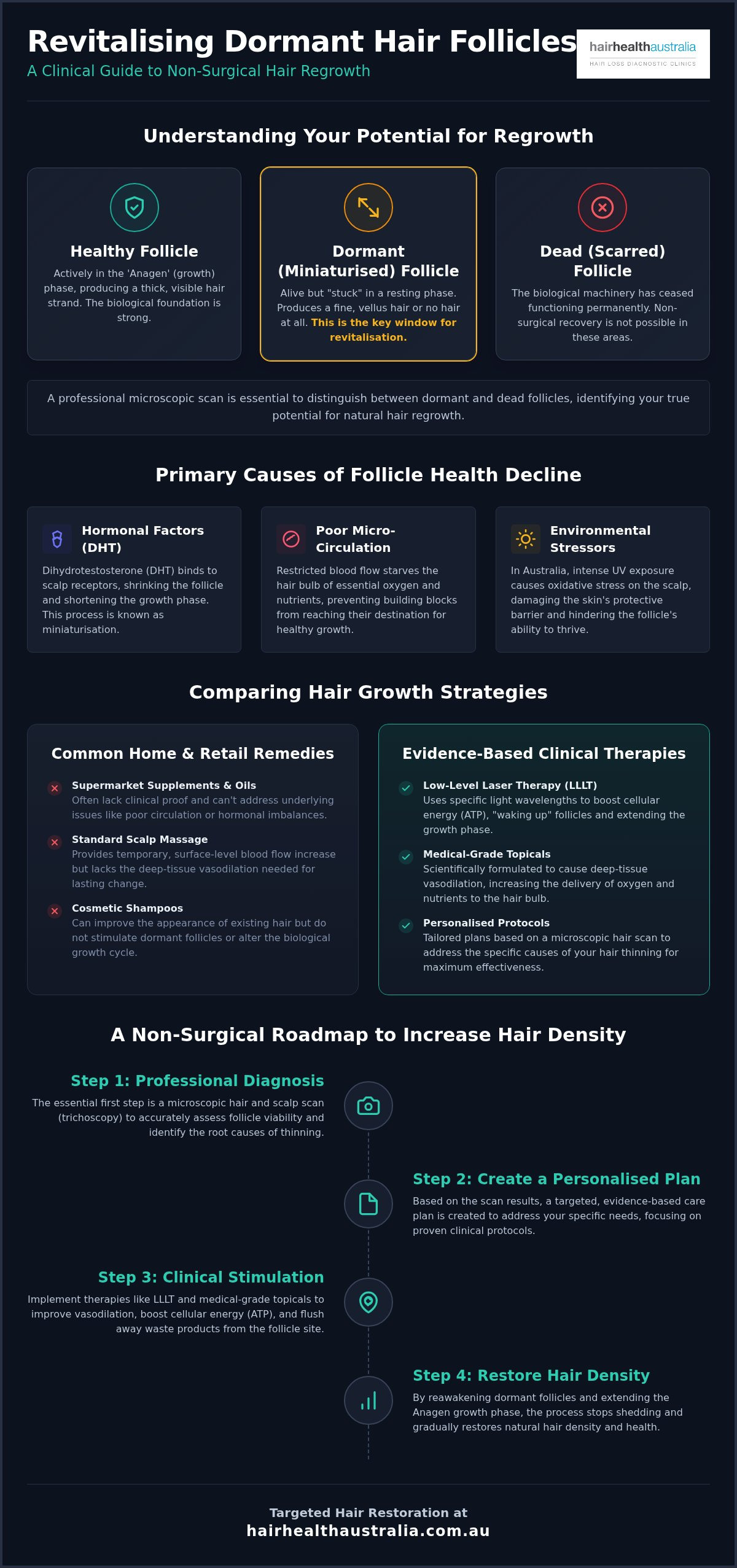
To understand how to stimulate hair follicles for hair growth, we must first view the follicle as a complex, living organ rather than a simple strand of protein. Each follicle operates on a biological clock, transitioning through phases of active production, regression, and rest. This hair follicle lifecycle determines the density and length of your hair. When the system is healthy, the Anagen (growth) phase lasts for years. However, when follicles are under stress, this phase shortens, leading to thinner, weaker strands. Follicular stimulation is the clinical process of extending the Anagen growth phase to prevent premature shedding.

A common misconception is that hair loss happens instantly. In reality, most people experience a process called miniaturisation. This is a gradual biological shift where the follicle physically shrinks, producing finer hair with each successive cycle until the strand becomes almost invisible. While the follicle is miniaturised, it remains viable and capable of recovery. This represents a critical window for intervention before the follicle loses its capacity for production entirely.

The Difference Between Dormant and Dead Follicles

Distinguishing between a dormant follicle and one that has permanently ceased production is the most vital step in any recovery journey. Dormant follicles are “wakeable”; they are alive but stuck in an extended resting phase or producing microscopic “vellus” hairs. Conversely, scarred or dead follicles have lost their biological machinery, making non-surgical recovery impossible. Because you can’t see the status of a follicle with the naked eye, a professional Hair Health Check is essential. This specialised microscopic scan allows us to see beneath the surface and identify exactly which areas have the potential for revitalisation.

Why Follicle Health Declines: Identifying the Culprits

Several factors contribute to the decline of follicle vitality, with genetics and the hormone Dihydrotestosterone (DHT) playing a primary role. DHT binds to receptors in the scalp, essentially choking the follicle and triggering the miniaturisation process. In Australia, environmental stressors add another layer of complexity. Intense UV exposure can cause oxidative stress on the scalp, damaging the skin’s barrier and hindering the follicle’s ability to thrive. This environmental damage often goes unnoticed until thinning becomes visible. Additionally, poor micro-circulation often starves the hair bulb of oxygen and nutrients. When the blood vessels delivering life-sustaining elements to the scalp are restricted, even a nutrient-rich diet won’t result in healthy hair growth because the building blocks simply aren’t reaching their destination.

The Science of Follicle Stimulation: Clinical Mechanisms That Work

Effective stimulation isn’t about applying a cosmetic product to the surface of the scalp. It requires a fundamental shift in the follicle’s internal environment. To understand how to stimulate hair follicles for hair growth, we must look at the biological “supply line” that feeds the hair bulb. Even the most expensive hair-growth vitamins will fail if the micro-circulatory system is too constricted to deliver those nutrients. We focus on “opening the pipes” through vasodilation, ensuring oxygen and essential building blocks reach the dermal papilla where hair production begins.

This process also involves boosting Adenosine Triphosphate (ATP) levels. ATP acts as the cellular fuel required to kickstart a follicle out of its dormant state and back into the active growth phase. Without this energy surge, the follicle remains in a state of suspended animation, unable to produce a healthy hair fibre regardless of how many topical oils you apply.

Increasing Micro-Circulation and Scalp Blood Flow

Clinical-grade stimulation differs significantly from a standard scalp massage. While manual massage provides a temporary surface-level glow, professional therapies use specific medical-grade topicals and technology to trigger deep-tissue vasodilation. This increased blood flow serves a dual purpose. It delivers fresh oxygen and nutrients while simultaneously performing a “cleansing” function. By flushing away metabolic waste and inflammatory markers from the follicle site, we create a pristine environment for new growth to take hold. If you aren’t sure whether your circulation is currently supporting growth, a professional Hair Health Check can provide the diagnostic clarity you need.

Blocking DHT: Protecting Follicles from Hormonal Shrinkage

Dihydrotestosterone (DHT) is the primary driver of follicle miniaturisation. This hormone binds to androgen receptors at the base of the hair, effectively “choking” the supply of life-sustaining blood. Over time, the follicle becomes so small it can no longer produce visible hair. Clinical strategies focus on inhibiting this binding process directly at the scalp level. By using targeted blockers, we can neutralise DHT’s impact without the systemic side effects often associated with oral medications. This creates a powerful synergy. While the blockers protect the follicle from hormonal attack, growth stimulants work to rebuild its strength and restore its size. It’s a two-pronged approach that addresses both the cause of the thinning and the mechanics of recovery.

Comparing Home Remedies vs. Professional Clinical Therapies

Many Australians start their restoration journey with over-the-counter solutions found in supermarket aisles. It’s a logical first step when you notice the first signs of thinning. However, understanding how to stimulate hair follicles for hair growth requires a realistic look at what these products can actually achieve. While retail items offer convenience, they often lack the potency and delivery mechanisms required to reverse established miniaturisation. Relying on a single “miracle” oil or shampoo is a common mistake that often leads to wasted time and further loss.

True restoration usually requires a multi-modal approach. This involves combining DHT blockers, targeted nutrient delivery, and cellular stimulation to address hair loss from every biological angle. A professional diagnostic approach moves beyond the guesswork of retail marketing to focus on what your scalp actually needs to recover.

Scalp Massages and Oils: What the Evidence Actually Says

Rosemary oil and caffeine shampoos have gained significant traction. Clinical data suggests these ingredients can support scalp health by providing mild antioxidant benefits and temporary surface-level stimulation. However, they rarely penetrate deep enough to reach the dermal papilla, which is the “engine room” of the follicle. Manual scalp massages do improve surface circulation, but they don’t provide the sustained, deep-tissue vasodilation needed for significant regrowth. For most individuals, these natural methods should be viewed as supportive maintenance rather than a primary recovery strategy. They work best when used to keep a healthy scalp in good condition, not to wake up dormant follicles that have been inactive for years.

Low-Level Laser Therapy (LLLT) and Medical-Grade Stimulants

Low-Level Laser Therapy, or photobiomodulation, represents a major shift from topical application to cellular repair. This technology uses specific wavelengths of light to stimulate mitochondria within the follicle cells. This process increases cellular energy production and repairs damaged tissues at the root. In a clinical centre, the equipment used delivers significantly higher energy density and consistency than portable home devices. This difference is crucial for results. Clinical-grade LLLT must meet strict Australian standards for safety and efficacy, ensuring the light reaches the necessary depth to trigger a genuine biological response. Consistency is the final piece of the puzzle. While a home device might be used sporadically, a structured clinical program ensures the follicles receive the precise “dosage” of stimulation required to see a visible increase in density. If you’re ready to move past trial and error, a professional Hair Health Check is the most reliable way to determine which clinical therapies will work for your specific hair type.
Stimulate Hair Follicles for Growth: 2026 Clinical Guide

A Step-by-Step Approach to Revitalising Your Scalp

Reviving dormant follicles isn’t a matter of luck. It’s a methodical clinical process. To understand how to stimulate hair follicles for hair growth effectively, you must follow a structured path that starts with evidence and ends with visible density. This journey moves from precise diagnostics to active stimulation and, finally, to long-term maintenance. Each stage is designed to remove the biological barriers that have been preventing your hair from thriving. We focus on results that are measurable, moving past the uncertainty of retail products.

Step 1: Professional Microscopic Hair Analysis

Before any treatment begins, we must determine if your follicles are capable of recovery. A microscopic hair analysis is the gold standard for this diagnosis. During this scan, we examine the scalp at up to 200x magnification to assess follicle spacing and individual hair shaft diameter. We also look for signs of scalp inflammation or sebum blockages that might be hindering growth. This data is critical. It allows us to distinguish between permanent loss and temporary dormancy, ensuring we only recommend a best hair regrowth treatment plan that is likely to succeed for your specific condition.

Step 2: Implementing a Targeted Non-Surgical Protocol

Once we’ve established viability, the next step is clearing the scalp of debris and excess sebum. These “plugs” can physically block the exit of new hairs and prevent topical stimulants from reaching the follicle root. After clearing the path, we implement a customised programme. The goal is to learn how to stimulate hair follicles for hair growth by creating the perfect environment for the hair bulb to flourish. This usually involves a combination of medical-grade topical stimulants and light-based therapies like LLLT. The frequency of your clinical visits is tailored to the severity of your thinning. While everyone’s biology is different, most patients begin to see the first signs of stabilisation and improved hair quality within the first 90 days of consistent therapy.

As the protocol progresses, Step 4 involves microscopic tracking. We don’t rely on “feeling” that it’s working; we use high-resolution scans to prove it. This allows us to see new “vellus” hairs maturing into thicker “terminal” hairs long before they are visible in a bathroom mirror. Finally, in Step 5, we adjust your maintenance plan. As your hair density improves, the intensity of the stimulation can often be reduced to a sustainable level that preserves your results for the long term. If you’re tired of guessing, the first step is to book your microscopic hair scan today.

Targeted Hair Restoration at Hair Health Australia Sydney

Hair Health Australia stands as a dedicated leader in non-surgical hair restoration within Sydney. Our commitment to clinical excellence ensures that every patient receives care rooted in modern science rather than marketing trends. We provide a supportive, professional environment where your concerns are met with objective, evidence-based solutions. While the retail market is flooded with generic kits, we recognise that hair loss is a deeply individual experience. A one-size-fits-all approach often fails because it ignores the unique biological markers of your scalp. By choosing a specialised centre, you shift from being a consumer of products to a participant in a clinical recovery process.

Why a Personalised Clinical Check is Your Best First Step

Many people lose years of potential regrowth by relying on guesswork. They cycle through various supplements and shampoos, often while their follicles continue to miniaturise. Our specialists focus on identifying the underlying cause of your thinning, whether it’s hormonal, environmental, or nutritional. We don’t just treat the symptoms; we address the biological “why” behind the loss. This diagnostic precision is the only way to truly understand how to stimulate hair follicles for hair growth for your specific hair type. We invite you to stop the trial-and-error cycle and book a Hair Health Check at our Sydney centre. This assessment provides the clarity needed to invest your time and resources into a protocol that actually works.

Our Non-Invasive Approach to Sustainable Hair Density

Our philosophy centres on long-term follicle health rather than temporary cosmetic cover-ups. While some seek immediate surgical results, our non-surgical methods offer a smarter, less invasive path to restoring density. We focus on revitalising the follicles you already have, leveraging their natural capacity for growth. Choosing a non-surgical hair loss clinic ensures you are guided by professionals who prioritise the health of your scalp as much as the appearance of your hair. It’s vital to remember that as long as your follicles are in a dormant state, recovery remains a very real possibility. Taking control of your hair health today means you won’t have to wonder “what if” tomorrow. We are here to act as your dedicated guide, helping you learn how to stimulate hair follicles for hair growth through a systematic, clinical roadmap.

Reclaim Your Hair Density with Clinical Precision

Restoring your hair density is a journey that begins with biological understanding, not surface-level cosmetic fixes. The key to recovery lies in identifying dormant follicles during the critical window of miniaturisation before permanent loss occurs. Understanding how to stimulate hair follicles for hair growth requires a systematic approach that combines deep-tissue vasodilation with cellular energy repair. By moving past the trial and error of supermarket products, you can focus on clinical protocols that have a documented impact on the hair bulb.

With over 15 years of clinical experience in Sydney, our dedicated non-surgical regrowth specialists use advanced microscopic diagnostic technology to remove the uncertainty from your recovery. We invite you to take the first definitive step toward a fuller head of hair. Book Your Professional Hair Health Check in Sydney Today to assess your follicle viability and receive a personalised roadmap for restoration. It’s often possible to save and revitalise your hair if you act while the follicles are still dormant. You don’t have to manage this process alone.

Frequently Asked Questions

Can dead hair follicles be stimulated back to life?

No, once a hair follicle has reached a state of permanent scarring or fibrosis, it cannot be stimulated back to life. However, many people mistake dormant follicles for dead ones. Dormant follicles are still alive but have stopped producing visible hair due to the miniaturisation process. This is why a professional assessment at our Sydney clinic is vital to determine if your follicles are truly lost or simply need the clinical intervention required to resume growth.

How long does it take to stimulate hair follicles for visible growth?

Visible results typically require three to six months of consistent clinical therapy. The biological process of shifting follicles from the resting phase back into the active growth phase takes time. You’ll usually notice a reduction in shedding within the first 90 days, followed by a gradual increase in density. This timeline is a key part of how to stimulate hair follicles for hair growth, as patience is essential while your scalp’s natural cycles reset.

Does scalp massage actually help with hair regrowth?

Scalp massage provides a temporary boost to surface-level blood circulation, which can support general scalp health. While it may help deliver nutrients more effectively, it is rarely enough to reverse clinical thinning or pattern baldness on its own. For genuine regrowth, you need targeted treatments that address hormonal factors like DHT and provide deep-tissue stimulation. We view manual massage as a helpful supplementary habit rather than a primary solution for restoring lost hair density.

What is the best clinical treatment for stimulating hair follicles in 2026?

The most effective approach in 2026 involves a multi-modal protocol that combines medical-grade Low-Level Laser Therapy (LLLT) with targeted topical stimulants. This combination addresses the two main requirements for growth: increasing cellular energy (ATP) and blocking the miniaturising effects of DHT. At our Sydney centre, we customise these treatments based on your microscopic scan results. This ensures you’re using the most potent non-surgical tools available to learn how to stimulate hair follicles for hair growth effectively.

Are there specific foods that help stimulate hair follicles?

Nutrition plays a foundational role in follicle health, but diet alone won’t reverse genetic thinning. Foods rich in iron, zinc, biotin, and lean proteins provide the building blocks your hair needs to grow. However, if your follicles are being restricted by DHT or poor micro-circulation, these nutrients won’t reach the hair bulb effectively. We recommend a balanced diet as part of a broader clinical strategy that ensures your scalp’s supply lines are open and functional.

Is it possible to stimulate hair follicles after years of baldness?

It depends entirely on whether the follicles are still viable or have been replaced by scar tissue. If an area has been completely bald and smooth for many years, the chances of stimulation are lower. However, if there is still fine “vellus” hair present, regrowth may be possible. A microscopic analysis at Hair Health Australia is the only reliable way to assess your potential. We focus on saving follicles before they reach the point of permanent closure.

What is the difference between home laser caps and clinical LLLT?

The primary differences are energy output and therapeutic consistency. Clinical LLLT devices used in our Sydney centre are medical-grade units that deliver a much higher light density and more precise wavelengths than portable home caps. This ensures the light energy actually penetrates deep enough to reach the hair bulb. While home devices offer convenience, they often lack the power required to trigger a significant biological response in follicles that have already begun the miniaturisation process.
Hair Growth Cycle Stages: An Australian Clinical Guide to Regrowth

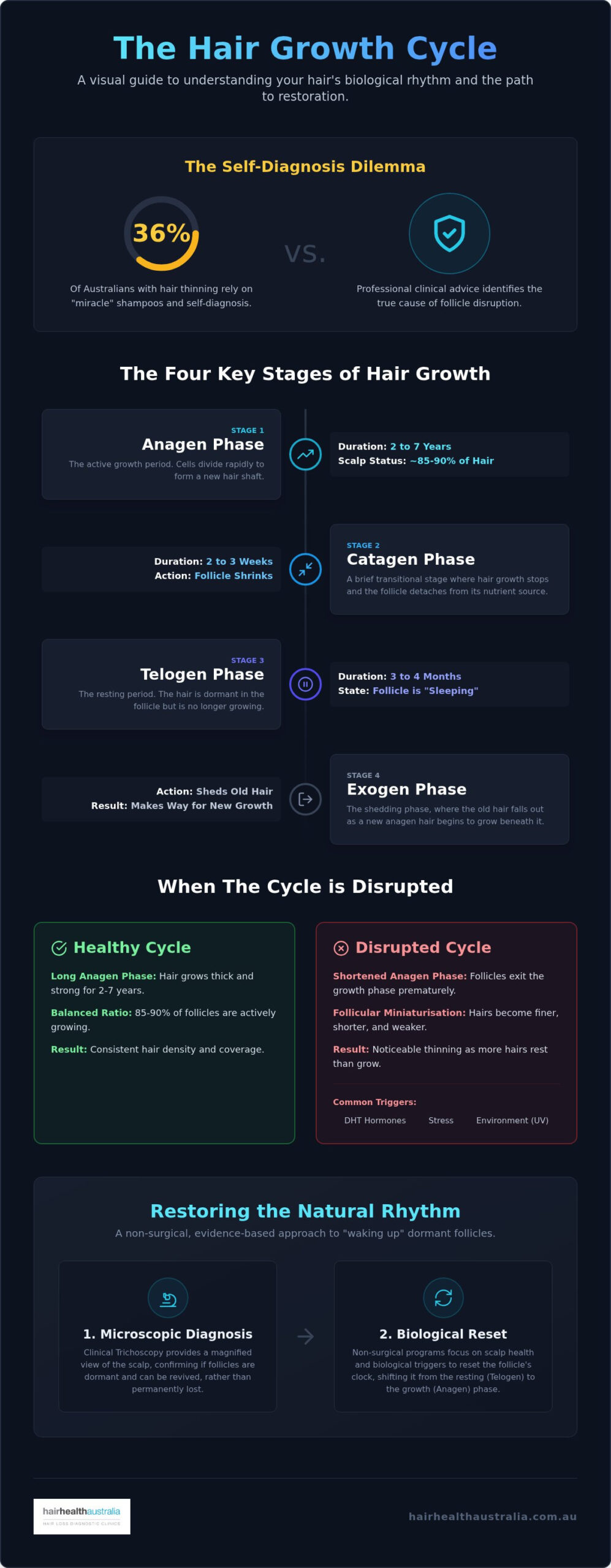
Did you know that roughly 36% of Australians experiencing hair thinning rely on “miracle” shampoos and self-diagnosis rather than seeking professional clinical advice? It’s incredibly frustrating to invest time and money into generic products that fail to address why your hair is actually falling out. You might feel a surge of anxiety during the exogen phase, mistaking natural shedding for permanent baldness. We understand that clinical terminology often feels like a barrier to finding real answers. This article provides a clear breakdown of the hair growth cycle stages Australia patients encounter, moving past the jargon to focus on biological facts.

You’ll learn that your follicles aren’t necessarily dead; they might simply be stuck in a resting phase. We promise to show you how non-surgical clinical diagnostics in Sydney, such as microscopic Trichoscopy, can identify these specific disruptions. We will explore the biological phases from growth to shedding and outline a non-surgical path to waking up your dormant follicles. By the end of this guide, you’ll have a science-based plan to restore your hair’s natural rhythm and regain your confidence without the need for invasive surgery.

Key Takeaways

  • Learn to identify the four distinct hair growth cycle stages Australia patients must monitor to distinguish between standard shedding and actual follicle disruption.
  • Discover why microscopic hair analysis, known as Trichoscopy, is the only reliable way to confirm if follicles can be “woken up” through clinical intervention.
  • Understand how non-surgical programs effectively reset the biological clock of your hair, moving follicles from resting phases back into active growth.
  • Identify the specific roles of DHT and follicular miniaturisation in thinning, providing clarity on why generic retail products often fail to deliver results.
  • Establish a realistic, evidence-based path to restoration that focuses on scalp health and biological triggers rather than invasive surgical options.

Understanding the Hair Growth Cycle: Why Your Follicles “Sleep”

Every hair on your scalp is produced by a hair follicle, which is a complex, self-renewing organ. These follicles don’t just grow hair continuously; they operate on a sophisticated biological rhythm. Unlike some animals that shed their coats seasonally, the human hair growth cycle is asynchronous. This means each of your roughly 100,000 follicles is in a different stage at any given time. This staggered timing is what keeps your hair looking thick and consistent. If your follicles were to synchronise, you would experience periods of total baldness followed by full regrowth. When you notice thinning, it’s often because this delicate timing has been disrupted, leading to more hairs resting than growing. Understanding the hair growth cycle stages Australia residents experience is vital for identifying these shifts early.

The Biological Clock of Your Hair

Your follicles receive constant biochemical signals that dictate whether they should actively produce a hair shaft or enter a period of dormancy. A common misconception is that thinning hair always means the follicle is gone forever. In many clinical cases, the follicles are simply “sleeping” or stuck in a prolonged resting phase. These dormant follicles are often still viable and capable of being “woken up” with the right clinical stimulation. Distinguishing between this temporary cycle disruption and permanent pattern baldness requires a professional eye. We look for signs of life that are invisible to the naked eye, focusing on rehabilitating the follicle’s internal clock rather than just treating the hair you see in the mirror.

Why Australians Should Monitor Their Cycle

The Australian climate and lifestyle play a significant role in follicle health. High UV levels can lead to scalp inflammation, while Sydney’s humidity and the stress of urban life can trigger a condition known as Telogen Effluvium. This occurs when a sudden shock to the body’s system, whether environmental, physical, or emotional, shunts a large percentage of follicles into the shedding phase at once. Because our environment is so demanding, monitoring your cycle becomes a proactive part of self-care. A comprehensive hair health check provides the diagnostic clarity needed to see if your thinning is a result of these external pressures or an internal biological shift. By identifying the specific hair growth cycle stages Australia patients are currently experiencing, we can implement a non-surgical plan to reset your growth cycle and restore density.

The Four Key Stages of the Hair Growth Cycle Explained

The hair on your head is always in motion, even when it appears static. To understand thinning, we must look at the individual hair growth cycle stages Australia patients navigate daily. Your visible hair density is essentially a mathematical ratio: the number of hairs in the growth phase versus those in the resting and shedding phases. When this ratio shifts, thinning becomes apparent. This happens because the timing of these stages has been compromised, often by internal biological triggers or external stressors.

Anagen and Catagen: Growth and Transition

The Anagen phase is the active growth period lasting 2 to 7 years. During this time, cells in the hair bulb divide rapidly, creating new hair growth that can reach significant lengths. In a healthy scalp, approximately 85% to 90% of your hair is in this stage at any given time. However, various factors can prematurely truncate this window. Hormonal effects on hair follicles, particularly the sensitivity to certain androgens, can cause follicles to miniaturise. This leads to shorter, finer strands that lack the pigment and strength of healthy hair.

Following this is the Catagen phase, a brief transitional stage lasting about two to three weeks. During this period, the hair follicle shrinks and detaches from the dermal papilla, which is its source of nutrients. It is a necessary pause in the biological process, marking the end of active growth before the follicle enters a period of rest.

Telogen and Exogen: Resting and Shedding

The Telogen phase is a resting period where the hair remains in the follicle but no longer grows. This typically lasts around three to four months. Many people mistake this phase for permanent loss, but the follicle is simply dormant, often with a new Anagen hair beginning to form underneath. If your hair feels thinner, it might be because a higher percentage of your follicles have moved into this resting state simultaneously.

The final stage, which frequently causes the most anxiety, is Exogen. This is the specific shedding phase where the old hair is released from the scalp. It is vital to understand that shedding is a part of the renewal process. It’s normal to shed between 50 and 100 hairs per day as part of a healthy hair growth cycle stages Australia profile. When you see hair in the shower or on your brush, it is often just the Exogen phase completing its work. If you’re concerned that your shedding rate exceeds these clinical norms, a professional hair health check can provide the data needed to differentiate between normal renewal and premature cycle disruption.

Disruptions to the Cycle: Recognising Premature Thinning

Thinning hair is rarely an overnight event. Instead, it is typically the result of a progressive change in the hair growth cycle stages Australia residents experience due to genetic or environmental factors. One of the most critical processes to understand is follicular miniaturisation. This occurs when the follicle becomes physically smaller over time, producing hair that is increasingly fine, short, and lacklustre. Unlike permanent follicle death, miniaturisation is often a reversible process if caught early enough through clinical intervention. Recognising these shifts before the follicle becomes completely dormant is the key to successful regrowth.

The Role of DHT in Cycle Shortening

Dihydrotestosterone (DHT) is the primary driver of genetic thinning. This hormone binds to receptors in the scalp, essentially “suffocating” the follicle and forcing it into a premature resting state. As the Anagen phase is truncated, the hair doesn’t have enough time to grow to its full potential. Over several cycles, robust terminal hairs transform into “vellus” hairs, which are the fine, translucent strands often seen at the hairline. Understanding the DHT blocker science is essential for anyone looking to halt this process and protect their existing density. Without addressing this hormonal interference, the follicle will continue to shrink until it can no longer produce a visible hair.

Local environmental triggers also play a significant role in Australian hair health. Many people deal with harsh water conditions or nutritional gaps, particularly in iron or vitamin D, which are essential for maintaining the growth phase. These factors can exacerbate genetic thinning, making the hair appear sparser than it otherwise would. Identifying these triggers allows us to create a more targeted, non-surgical plan for restoration.

Telogen Effluvium: The Sudden Shedding Event

While genetic thinning is gradual, Telogen Effluvium (TE) is a sudden “shock” to the hair growth cycle. This condition shunts a significant portion of follicles into the resting phase simultaneously. It usually occurs three to four months after a triggering event, such as a severe illness, high-stress period, or rapid weight loss. Because of this delay, many people don’t immediately connect the shedding to the original cause. The good news is that TE is typically temporary. With professional guidance and a structured clinical plan, we can help stabilise the cycle and encourage these follicles to return to the active growth phase, ensuring your hair growth cycle stages Australia profile returns to its healthy, asynchronous rhythm.

Hair Growth Cycle Stages: An Australian Clinical Guide to Regrowth

How to Identify Which Stage Your Hair Follicles Are In

Relying on a bathroom mirror or a generic online quiz often leads to more anxiety than clarity. While you might notice a wider part line or a receding temple, these visual cues only show the end result of a problem, not the underlying cause. To truly understand the hair growth cycle stages Australia patients are experiencing, we must look beneath the surface. A healthy, productive cycle is defined by consistent hair shaft diameters and a high density of active follicles. Without clinical magnification, you cannot distinguish between a follicle that is permanently inactive and one that is merely dormant and awaiting the right stimulus.

The Microscopic Advantage

Trichoscopy is a non-invasive diagnostic tool that magnifies the scalp by up to 200 times. This level of detail allows us to differentiate between robust terminal hairs and miniaturised vellus hairs that are barely visible to the naked eye. When we perform Microscopic Hair Analysis Australia, we scan for specific clinical markers that indicate follicle health. We look for “yellow dots”, which represent follicles blocked by sebum or keratin, and “black dots”, which can signify hairs that have broken off at the scalp level. These microscopic insights are the only way to verify if your follicles can be rehabilitated through non-surgical means.

Signs Your Cycle is Stuck in Telogen

While microscopic analysis provides the definitive answer, there are physical indicators that your cycle has stalled. You might feel that your hair has reached a “growth plateau” where it won’t grow past a certain length. This usually indicates a shortened Anagen phase, where hairs are falling out before they can reach their full potential. This “invisible thinning” occurs when the ratio of hairs in the growth phase drops, even if you don’t see large clumps of hair in the drain. Common signs that your cycle timing is disrupted include:

  • Increased scalp visibility even if your daily shedding seems normal.
  • A distinct lack of fine new “baby hairs” along the hairline or part line.
  • Hair that feels noticeably thinner and more “wispy” at the ends than at the roots.
  • A feeling that your hair density has decreased uniformly across the scalp.

These symptoms suggest your hair growth cycle stages Australia profile is skewed toward the resting phase. To move beyond guesswork and establish a clear clinical baseline, you should book a professional hair health check to receive a personalised diagnostic report and a non-surgical restoration plan.

Restoring the Cycle: Non-Surgical Clinical Treatments in Sydney

Once we’ve identified the specific hair growth cycle stages Australia patients are navigating, the focus shifts to restoration. Clinical intervention aims to “reset” the follicle, effectively shortening the resting phase and extending the active Anagen phase. This is achieved through a multi-faceted approach that addresses the biological environment of the scalp. Unlike surgical options that merely move hair from one area to another, non-surgical programs work to rehabilitate your existing follicles. By improving blood flow and delivering essential nutrients directly to the follicle base, we can encourage dormant hairs to return to a state of active growth.

Personalisation is the cornerstone of effective treatment. Because no two scalps are identical, a one-size-fits-all product from a chemist rarely provides the necessary potency or precision. We utilise clinical-strength topicals and advanced light therapies to stimulate cellular activity. These methods are designed to counteract the effects of DHT and environmental stressors discussed earlier. It’s important to maintain realistic expectations during this process. Because the biological cycle of a follicle cannot be rushed, visible regrowth typically takes between 3 and 6 months to become apparent. This timeline aligns with the natural resting and transition periods of the hair.

Clinically-Backed Regrowth Protocols

Our protocols often involve the use of growth factor therapies that nourish the dermal papilla. This is the “control centre” of the follicle that dictates hair thickness and length. A healthy growth environment also requires meticulous scalp health management. We address issues like inflammation and sebum buildup to ensure that new hairs have an unobstructed path to the surface. For a detailed look at modern options, you can explore our Best Hair Regrowth Treatment Australia 2026 guide. These clinically-backed methods provide a structured alternative to invasive procedures, focusing on long-term follicle vitality.

Your Path Forward at Hair Health Australia

The journey to restoration begins with an objective assessment. At our Sydney clinic, we move past guesswork by conducting a comprehensive Hair Health Check. This diagnostic phase ensures that any programme we design is tailored specifically to your needs and current cycle stage. We believe in transparency and evidence-based results, providing you with a clear roadmap for your hair’s recovery. You don’t have to accept thinning as an inevitability. Take the first step toward reclaiming your density and book your clinical diagnosis today.

Reclaiming Your Hair’s Natural Growth Rhythm

Understanding the hair growth cycle stages Australia residents navigate is the first step toward moving past the frustration of temporary fixes. We’ve explored how follicles often enter a dormant state rather than dying off completely, and how external stressors can prematurely trigger shedding. By identifying these disruptions through specialised microscopic Trichoscopy diagnostics, you can replace uncertainty with a science-based plan for restoration. Your hair density is a reflection of biological timing; with the right clinical support, that timing can be corrected.

At Hair Health Australia, we bring over 15 years of Australian clinical experience to every consultation. Our clinically-proven non-surgical methods are designed to nourish the follicle and extend the active growth phase without the need for invasive procedures. We invite you to Book Your Free Microscopic Hair Health Check in Sydney to gain a precise understanding of your scalp’s current health. It’s time to stop guessing and start a professional journey toward thicker, healthier hair. We’re here to guide you through every stage of your recovery.

Frequently Asked Questions

How long does each stage of the hair growth cycle last?

The duration of each stage varies significantly, with the Anagen (growth) phase lasting between two and seven years for a healthy adult. This is followed by the Catagen (transition) phase, which typically concludes within two to three weeks. The Telogen (resting) phase remains stable for approximately three to four months before the hair is finally shed. Understanding these hair growth cycle stages Australia wide helps patients set realistic expectations for regrowth timelines.

Can you restart the hair growth cycle once it has stopped?

Follicles that have entered a dormant or “sleeping” state can often be restarted through targeted clinical stimulation. It’s a common misconception that thinning always indicates permanent follicle death. In many cases, the follicle is simply stuck in a prolonged resting phase or undergoing miniaturisation. By using non-surgical methods to address the biological triggers of hair loss, we can effectively “wake up” these follicles and transition them back into the active Anagen phase.

Why is my hair shedding more than usual lately?

Increased shedding often indicates that a higher percentage of your follicles have entered the Exogen (shedding) phase simultaneously. This can be triggered by seasonal changes, nutritional gaps, or a temporary condition called Telogen Effluvium, which shunts hairs into the resting phase following stress or illness. While it’s normal to lose 50 to 100 hairs daily, excessive shedding in Sydney’s humid environment or after personal stress warrants a professional diagnostic check to ensure your cycle hasn’t been disrupted.

Is it normal for the hair cycle to slow down with age?

Yes, it’s biologically normal for the hair growth cycle to shift as we age, often resulting in a shorter Anagen phase and a longer Telogen phase. This transition causes hair to grow back finer and slower, a process known as follicular miniaturisation. While these changes are natural, they don’t have to be permanent. Our clinical programs in Sydney focus on extending the growth phase and maintaining follicle vitality to counteract age-related thinning without resorting to surgery.

What happens if the anagen phase is shortened?

A shortened Anagen phase leads to hair that never reaches its full potential length and becomes increasingly fine and translucent. This is the primary mechanism behind most forms of pattern thinning. When the growth period is truncated, the follicle spends more time resting and less time producing robust hair shafts. Over several cycles, this results in a visible loss of density, as the new hairs produced are significantly weaker and more susceptible to premature shedding.

How can I tell the difference between normal shedding and hair loss?

Normal shedding involves losing roughly 50 to 100 hairs per day as part of the natural renewal process. True hair loss, however, is characterised by a lack of regrowth or a noticeable change in the quality of the hair being produced. If you notice your part line widening or your scalp becoming more visible despite “normal” shedding, your hair growth cycle stages Australia profile may be compromised. Microscopic Trichoscopy is the gold standard for distinguishing between these two states.

Do non-surgical treatments actually work for all stages of the cycle?

Non-surgical treatments are specifically designed to target follicles in the Anagen and Telogen phases. By delivering growth factors and stimulating blood flow, these programs encourage resting follicles to reset and enter the growth phase while simultaneously nourishing active follicles to stay in Anagen longer. While they cannot “regrow” hair on a completely scarred or dead scalp, they are highly effective for rehabilitating miniaturised follicles that are still biologically active but currently dormant.

What is the best way to monitor my hair growth cycle at home?

While you can monitor visual cues like hair density at the temples or the amount of hair in your brush, home monitoring has significant limitations. You cannot see the microscopic changes in follicle diameter or identify early-stage miniaturisation in the mirror. The most effective way to monitor your cycle is through regular professional assessments. A clinical hair health check in Sydney provides a detailed baseline, allowing us to track your progress with microscopic precision over time.