Non-Surgical Alopecia Treatment Sydney: The 2026 Clinical Guide to Hair Regrowth

Did you know that approximately 40.8% of Australian men experience some degree of baldness, while hundreds of thousands of Australians are currently navigating the complexities of active alopecia areata? It’s common to feel a sense of anxiety when you notice your hair thinning, especially when off-the-shelf products fail to deliver on their promises. You’ve likely spent far too much time and money on shampoos that simply don’t work. Seeking a non-surgical alopecia treatment Sydney shouldn’t feel like a gamble or a choice between permanent loss and invasive surgery.

This guide provides a clear, evidence-based path to restoring your hair density using the latest clinical protocols available in 2026. We’ll explore how microscopic scanning and personalised, non-invasive plans can replace uncertainty with a visible, healthy transformation. You’ll learn how to identify your specific hair loss type and discover exactly which medical-grade strategies are proven to stabilise the scalp and stimulate regrowth without a single incision or day of downtime. By moving beyond visual guesswork, you can finally access a systematic approach to hair health grounded in clinical precision.

Key Takeaways

  • Understand that alopecia is a broad medical term and learn how to distinguish between reversible non-scarring loss and permanent scarring conditions.
  • Discover why microscopic hair analysis is the clinical gold standard for diagnosis, offering insights into follicle health that a simple visual inspection cannot provide.
  • Compare the benefits of a non-surgical alopecia treatment Sydney against invasive surgery to understand how revitalising existing follicles can often be the most effective first step.
  • Learn about the structured phases of a personalised regrowth programme, including the essential stabilisation phase designed to halt thinning before focusing on density.
  • Gain clarity on how a specialised, non-surgical clinical environment ensures your recovery plan is based on objective data rather than a one-size-fits-all approach.

Defining Alopecia: Why Non-Surgical Paths are the First Line of Defence

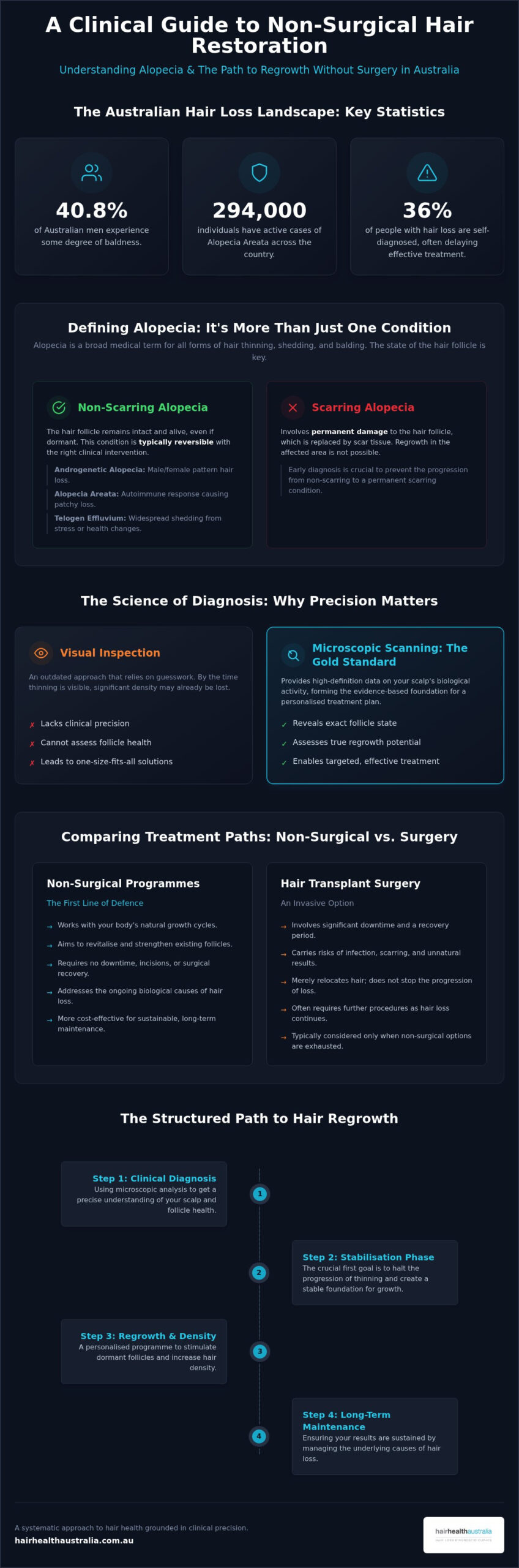
Many people assume that ‘alopecia’ refers exclusively to the autoimmune condition that causes sudden, circular patches of hair loss. In reality, Hair loss (alopecia) is a broad medical category encompassing every form of thinning, shedding, and balding. Understanding this distinction is the first step toward effective recovery. For the vast majority of Australians, hair loss is a progressive biological process rather than a sudden event. Statistics from 2026 indicate that approximately 40.8% of Australian men experience some degree of baldness, while active cases of alopecia areata affect up to 294,000 individuals across the country.

When you begin noticing changes in your hair density, the biological state of your follicles determines the path forward. Clinicians categorise hair loss into two main groups: non-scarring and scarring alopecia. Non-scarring alopecia is typically reversible because the hair follicle remains intact and alive, even if it’s currently dormant or miniaturised. Scarring alopecia involves permanent damage to the follicle. Identifying the difference early is vital. Choosing a non-surgical alopecia treatment Sydney allows for a targeted approach that focuses on revitalising these living follicles before they reach a stage of permanent inactivity.

Early intervention is the most significant factor in successful regrowth. Research suggests that 36% of people with hair loss conditions are currently self-diagnosed, often wasting valuable time on ineffective over-the-counter products. By identifying the underlying cause through a comprehensive Hair Health Check, we can determine if your follicles are still viable for restoration. This proactive approach stops the progression of thinning and creates a stable foundation for new growth.

Common Types of Alopecia Seen in Sydney Clinics

  • Androgenetic Alopecia: Often called male or female pattern hair loss, this is a genetic sensitivity to hormones that causes follicles to shrink over time.
  • Alopecia Areata: An autoimmune response where the body’s immune system mistakenly attacks the hair follicles, resulting in patchy loss.
  • Telogen Effluvium: A temporary form of widespread shedding often triggered by high stress, nutritional deficiencies, or significant health changes.

The Benefits of a Non-Invasive Approach

Opting for clinical, non-invasive protocols offers a level of safety and flexibility that surgery cannot match. Surgical procedures involve significant downtime and carry risks such as scarring or infection. In contrast, non-surgical programmes work in harmony with your body’s natural growth cycles to strengthen existing hair. This methodical approach is often more cost-effective for long-term maintenance, as it addresses the ongoing biological causes of hair loss rather than simply moving hair from one area to another. It’s a sustainable way to manage scalp health without the anxiety of a surgical recovery period.

The Science of Diagnosis: Why Microscopic Scanning Beats Visual Inspection

Visual inspection is the most common way people notice hair loss, yet by the time thinning is visible in the mirror, you may have already lost a significant percentage of your original hair density. Relying on “eye-balling” the scalp is an outdated approach that lacks the precision required for modern clinical care. Professional diagnosing hair loss requires a deeper look into the biological activity occurring beneath the surface. Without high-definition data, any treatment plan is based on guesswork rather than evidence.

Microscopic hair analysis serves as the essential foundation for any successful non-surgical alopecia treatment Sydney. This technology allows us to examine the exact state of your follicles in high definition, moving beyond what the naked eye can perceive. We aren’t just looking for the presence of hair; we’re assessing the potential for regrowth. This diagnostic phase identifies whether follicles are merely dormant or if they’ve progressed to a stage of miniaturisation where recovery requires immediate, specialised intervention.

What We Look for Under the Microscope

  • Follicle Density: We calculate the exact number of active hairs per square centimetre. This provides a quantifiable metric to compare against healthy averages for your specific age and hair type.
  • Hair Shaft Diameter: We identify the miniaturisation process. This occurs when hairs become progressively thinner and shorter with each growth cycle, which is a key indicator of genetic thinning.
  • Scalp Health: Our scans reveal underlying inflammation, excessive sebum buildup, or environmental damage. These factors often hinder the efficacy of clinical protocols if they aren’t addressed first.

The Importance of a Personalised Baseline

A data-driven baseline is essential because hair loss is never a uniform experience. Your treatment plan must be tailored to the specific stage of your follicles to be effective. Without this initial data, tracking your progress becomes subjective and often unreliable. We use these microscopic images to prove that regrowth is occurring at the root level long before the results are visible to you or those around you. This objective verification replaces anxiety with the confidence that your programme is working as intended.

If you’re concerned about thinning but don’t want to rely on trial and error, booking a Hair Health Check is the most reliable way to establish an accurate baseline. Microscopic analysis is the cornerstone of ethical hair restoration, ensuring every recommendation is based on verified biological evidence.

Non-Surgical Clinical Protocols vs. Hair Transplant Surgery

Choosing between clinical restoration and surgery is a pivotal decision in any hair recovery journey. The fundamental difference lies in the mechanism of action. Hair transplant surgery is a redistribution process; it moves existing follicles from a donor site, usually the back of the head, to thinning areas. It doesn’t address the underlying biological causes of loss. In contrast, a non-surgical alopecia treatment Sydney focuses on revitalising the follicles you already have, extending their growth phase and reversing the miniaturisation process before the hair is lost permanently.

The clinical landscape has evolved significantly. A recent review of non-surgical alopecia treatments confirms that protocols involving topical stimulants, DHT blockers, and Low-Level Laser Therapy (LLLT) are highly effective at stabilising the scalp environment. For many, these non-invasive paths are the most logical first step because they carry zero surgical risk and require no recovery time. While surgery can provide a cosmetic “quick fix,” it often fails to provide long-term density if the native hair around the grafts continues to thin due to unmanaged alopecia.

When to Choose Clinical Restoration Over Surgery

Surgery is rarely recommended for individuals in the early stages of thinning or those with active alopecia areata. If the scalp is in an inflammatory or autoimmune state, the body may simply attack the newly transplanted follicles, leading to a failed procedure. There’s also the risk of “shock loss,” where the trauma of surgery triggers the shedding of existing healthy hair in the surrounding area. For women, who typically experience diffuse thinning across the entire scalp rather than a receding hairline, clinical protocols are often the superior choice. They provide a holistic improvement in density that surgery cannot replicate in a diffuse thinning pattern.

Clinical Protocols: A Multi-Faceted Approach

Successful regrowth isn’t the result of a single “miracle product.” It requires a structured, multi-faceted programme that targets the hair growth cycle from several angles simultaneously. In our Sydney clinic, we combine medical-grade topicals with advanced clinical tools like laser therapy to stimulate cellular activity within the follicle. This integrated approach ensures that we aren’t just masking the problem but are actively improving scalp health and follicle function. For a deeper look at current clinical standards, you can refer to our guide on the Best Hair Regrowth Treatment Australia 2026. By following a disciplined, data-backed programme, you can achieve visible restoration while maintaining the natural integrity of your hair.
Non-Surgical Alopecia Treatment Sydney: The 2026 Clinical Guide to Hair Regrowth

Personalising Your Regrowth Programme: Clinical Strategies for Sydney Residents

Regaining hair density is a methodical process that requires patience and clinical oversight. While many seek an overnight fix, a successful non-surgical alopecia treatment Sydney residents can rely on typically unfolds over a 6 to 12-month period. This timeline aligns with the natural hair growth cycle, ensuring that every intervention is timed to maximise biological response. It’s about working with your body’s rhythm, not against it.

The first milestone is the Stabilisation Phase. Its primary objective is to halt the progression of thinning immediately. By addressing the hormonal or environmental triggers of loss, we “lock in” your existing hair density. You can’t restore what you haven’t first protected. Once stabilisation is achieved, we transition to the Regrowth Phase. During this stage, clinical protocols focus on stimulating dormant follicles, encouraging them to exit the resting phase and re-enter the active anagen stage. This transition is essential for restoring visible volume and scalp coverage.

Step-by-Step: The First 90 Days of Treatment

The initial three months are vital for setting the foundation of your recovery. During Month 1, the focus is on establishing a consistent clinical routine and calming any underlying scalp inflammation. By Month 2, most individuals notice a significant reduction in daily shedding, which is a clear sign that the stabilisation phase is taking effect. By the end of Month 3, while visible changes might still be subtle to the naked eye, microscopic scans often reveal the first signs of follicle revitalisation and improved hair shaft diameter.

Lifestyle Factors for Sydney Locals

Living in Sydney presents unique challenges for hair health. The intense Australian sun is a major factor; a thinning scalp has less natural protection against UV radiation, which can lead to oxidative stress and damage the follicle’s DNA. Factors like salt water exposure and urban pollutants in the CBD can also affect the scalp’s pH balance and hinder growth. Understanding these local variables is why choosing a non-surgical hair loss clinic in Sydney that understands our specific climate is so important. To ensure your plan accounts for these environmental stressors, we recommend starting with a comprehensive Hair Health Check to map out your personalised path to recovery.

Restoring Density with Hair Health Australia’s Professional Care

At Hair Health Australia, we believe that effective hair restoration begins with a partnership built on clinical expertise and empathetic understanding. Since establishing our clinic circa 2009, we’ve focused exclusively on non-invasive regrowth programmes for both men and women. Unlike clinics that offer both surgery and clinical care, we maintain a strict focus as a non-surgical specialist. This means our recommendations are never influenced by a desire to book surgical theatre time. We’re unbiased advocates for your hair health, dedicated to finding the most effective non-surgical alopecia treatment Sydney can provide for your specific biological profile.

Our Sydney clinic provides a supportive, professional environment where you can discuss your concerns with a specialist who understands the complexities of hair biology. We recognise that thinning hair is rarely just a cosmetic issue; it often carries a significant psychosocial impact that affects your daily confidence and social interactions. By combining advanced technology with a compassionate, objective approach, we aim to replace the anxiety of visual guesswork with the clarity of medical-grade data. Whether you’re navigating early-stage thinning or more advanced alopecia, our goal is to provide a clear, actionable path forward.

Why Our Sydney Clinic is Different

Transparency is the cornerstone of our clinical practice. we don’t believe in hyperbolic marketing or making promises that the biology cannot support. Instead, we provide realistic expectations based on the objective findings of your unique microscopic scan. Our team takes the time to explain the underlying causes of your hair loss, ensuring you understand exactly why a specific protocol has been recommended for your scalp. We invite you to regain your confidence and take control of your hair’s future through a proven, evidence-based clinical path that prioritises your long-term health.

Your Next Steps to Hair Recovery

Taking the first step toward restoration is a straightforward, methodical process. When preparing for your initial consultation, it’s helpful to note any recent lifestyle changes and a brief history of when you first noticed changes in your hair density. During this diagnostic appointment, we’ll perform a comprehensive scan to establish your baseline and identify viable follicles. Our commitment to your recovery continues throughout your entire programme, with regular monitoring and support to ensure your scalp health remains optimal. Book your clinical consultation at Hair Health Australia today and begin the process of restoring your hair density with precision, care, and clinical expertise.

Secure Your Path to Visible Hair Restoration

Understanding your specific type of hair loss is the critical first step toward effective recovery. By moving beyond visual guesswork and utilising advanced microscopic diagnostic technology, you can identify exactly which follicles are capable of revitalisation. This clinical approach ensures that your recovery plan is based on objective data rather than trial and error. With over 15 years of specialised clinical experience, our dedicated non-surgical Sydney clinic focuses on treating the underlying biology of thinning without the risks associated with invasive surgery.

Choosing a non-surgical alopecia treatment Sydney residents trust means committing to a structured, personalised programme that prioritises scalp health and follicle function. Whether you’re in the initial stabilisation phase or ready to stimulate new growth, professional oversight ensures your journey is methodical and transparent. You don’t have to navigate hair loss alone or settle for temporary over-the-counter solutions that fail to address the root cause.

Book Your Comprehensive Hair Health Check in Sydney today to establish your clinical baseline and receive a clear, evidence-based diagnosis. It’s time to replace uncertainty with a proven, scientific strategy and regain the confidence that comes with a healthy, dense head of hair.

Frequently Asked Questions

Is non-surgical alopecia treatment permanent?

Non-surgical treatments are designed to manage hair loss as a progressive biological condition rather than provide a one-off permanent fix. Because the underlying triggers, such as hormonal sensitivity or autoimmune responses, remain present in your system, long-term maintenance is required to sustain your results. Once you achieve your desired density, we transition you to a simplified maintenance protocol. This ensures your follicles remain in the active growth phase and don’t revert to miniaturisation.

Can I regrow hair if my follicles are already dormant?

Yes, regrowth is entirely possible if your follicles are dormant but still biologically viable. Dormant follicles are those that have entered an extended resting phase but haven’t yet reached a stage of permanent scarring or inactivity. Our microscopic analysis identifies these viable follicles by looking for specific signs of life beneath the scalp surface. If the follicle is still alive, we implement clinical protocols to stimulate it back into the active anagen stage.

How long does it take to see results from a non-surgical programme in Sydney?

Most patients begin to see the first measurable signs of improvement within three to six months of starting a non-surgical alopecia treatment Sydney programme. Initial results often appear as a significant reduction in excessive shedding followed by the emergence of finer, new hairs. Full restoration of density typically takes 12 months. This timeframe allows enough time for the hair to move through several complete growth cycles and gain significant shaft diameter and strength.

Are there any side effects to clinical hair loss treatments?

Clinical hair loss treatments are generally non-invasive and carry a very low risk of side effects compared to surgical options. Some individuals might experience mild, temporary scalp irritation or dryness when first introducing medical-grade topical stimulants. During your initial consultation, we review your medical history and scalp health to ensure the recommended protocol is suitable for your specific skin sensitivity. We prioritise a safe, comfortable recovery journey that doesn’t disrupt your daily life.

Is non-surgical treatment suitable for all types of alopecia?

Non-surgical protocols are highly effective for non-scarring types of hair loss, including androgenetic alopecia, alopecia areata, and telogen effluvium. These conditions involve follicles that are dormant or miniaturised rather than permanently destroyed. However, if you have advanced scarring alopecia where the follicle has been replaced by scar tissue, non-surgical methods may not be effective. A diagnostic scan is the only way to determine your specific suitability for clinical restoration before you begin a programme.

How much does a non-surgical hair loss programme cost in Sydney?

The cost of a clinical hair loss programme varies based on the complexity of your condition and the specific protocols required to achieve your goals. Because every scalp is unique, we don’t offer one-size-fits-all pricing or generic bundles. Instead, we provide a detailed, transparent cost breakdown following your initial diagnostic appointment. This ensures you only pay for the specific clinical strategies needed to address your unique pattern of thinning and your individual follicle health requirements.

Can I use clinical treatments alongside my current hair care routine?

You can usually integrate clinical treatments into your existing hair care routine, provided your current products don’t contain ingredients that hinder the absorption of topical stimulants. We often recommend specific medical-grade cleansers that optimise the scalp environment for our protocols. During your consultation, we’ll review your current products and advise on any minor adjustments needed. This ensures your daily routine supports, rather than obstructs, your personalised regrowth journey and overall scalp health.

Do I need a referral to visit your Sydney hair loss clinic?

No, you don’t need a referral from a GP or dermatologist to visit our Sydney clinic. We operate as a specialised direct-access facility for those seeking non-surgical solutions for thinning and hair loss. You can book a diagnostic appointment directly with our team to begin your initial Hair Health Check. This allows you to bypass long waiting lists and start your personalised clinical programme as soon as you’re ready to address your hair health concerns.
Hair Thinning Solutions for Women in Sydney: The 2026 Clinical Guide

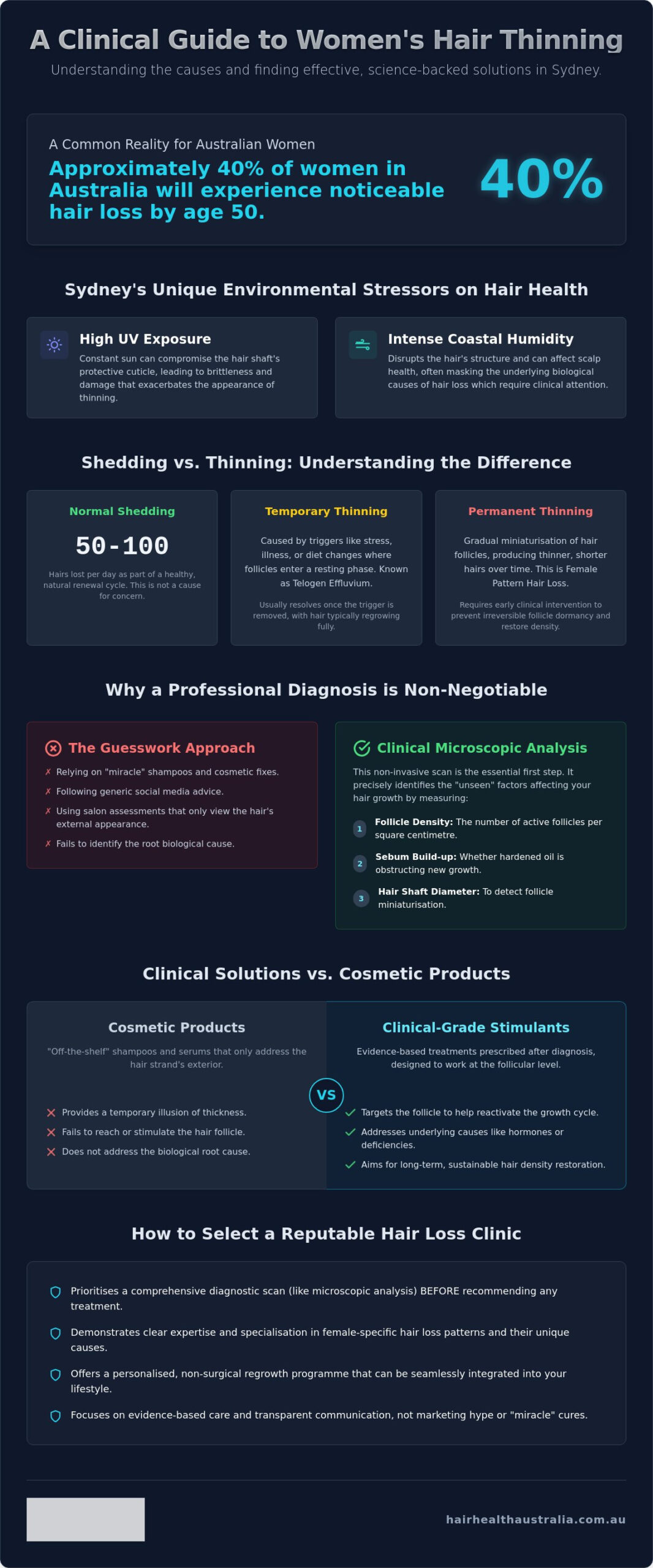
Did you know that approximately 40% of Australian women will experience some form of hair loss by the age of 50? While it is a common biological reality, finding effective hair thinning solutions for women Sydney locals can truly rely on often feels like a confusing maze of “miracle” shampoos and conflicting social media advice. You might find yourself checking the bathroom mirror every morning, feeling a pang of self-consciousness as you notice a widening part line or wondering if your hair will ever regain its former density. It is natural to feel anxious about the long-term progression of hair loss, but you don’t have to navigate this journey without a map.

This clinical guide is designed to replace that uncertainty with scientific clarity and a sense of professional support. You will learn how to move beyond generic shelf products by identifying the specific root cause of your thinning through a dedicated diagnostic process. We will explore the most advanced non-surgical treatments available in 2026, providing you with a clear, manageable plan to restore your hair density and reclaim your confidence. By focusing on evidence-based care rather than marketing hype, you can finally take the first step toward a lasting solution.

Key Takeaways

  • Identify the difference between standard shedding and clinical thinning by understanding how Sydney’s coastal humidity and UV levels impact hair shaft integrity.
  • Discover why microscopic hair analysis is a non-negotiable diagnostic tool for accurately assessing follicle density and scalp health before starting any treatment.
  • Evaluate the most effective hair thinning solutions for women Sydney specialists provide, focusing on clinical-grade stimulants rather than temporary cosmetic products.
  • Learn how to select a reputable clinic by prioritising those that offer comprehensive diagnostic scans and demonstrate expertise in female-specific hair loss.
  • Understand how a personalised, non-surgical regrowth programme can be seamlessly integrated into your lifestyle to achieve restored hair density and confidence.

Understanding Female Hair Thinning in the Sydney Climate

Sydney’s unique environmental conditions play a surprising role in the health of your scalp. While the coastal lifestyle is a drawcard, the combination of high UV exposure and intense humidity can compromise the hair shaft’s protective cuticle. This environmental stress, coupled with urban lifestyle pressures, often masks the underlying biological causes of hair loss. Identifying effective hair thinning solutions for women Sydney based requires a shift from superficial fixes to clinical diagnostics. Many women reach for “off-the-shelf” shampoos at the local chemist, but these products typically only address the hair strand’s exterior. They fail to reach the follicle, which is where the actual growth cycle is regulated.

It’s vital to distinguish between normal daily shedding and clinical thinning. Every woman loses between 50 and 100 hairs a day as part of a healthy renewal cycle. However, when you notice a decrease in overall volume or a change in the texture of your hair, it may indicate a disruption in the growth phase. Triggers such as iron deficiencies, hormonal shifts during menopause, or the chronic stress of a busy professional life in the CBD can all accelerate this process. Most chronic cases are a form of Pattern hair loss, which follows a predictable progression if left unaddressed.

Common Patterns: Widening Parts and Receding Temples

Many women first notice changes during a routine hair appointment. Your stylist might mention that your part line seems a little more prominent than usual. In female pattern hair loss, we often see a “Christmas Tree” pattern. This involves a widening of the centre part that is most noticeable at the front of the hairline. Unlike men, women rarely go completely bald; instead, they experience a diffuse thinning across the crown. This visual change can be deeply unsettling, often leading to a loss of confidence in social or professional settings. A professional hair health check can determine if these changes are part of a standard ageing process or a condition requiring clinical intervention.

Temporary vs. Permanent Thinning: Knowing the Difference

Determining whether your hair loss is temporary or permanent is the first step toward a solution. Telogen Effluvium is a common form of temporary shedding often triggered by a significant life event, such as illness, extreme stress, or rapid weight loss. In these instances, the hair follicles enter a resting phase prematurely. If the trigger is resolved, the hair usually regrows. Permanent thinning, however, involves the gradual miniaturisation of the follicle. Over time, the follicle produces thinner, shorter hairs until it eventually becomes dormant. Early intervention is the most critical factor here. Once a follicle has completely closed, it’s much harder to stimulate regrowth, making a timely diagnosis essential for maintaining your natural density.

The Diagnostic Essential: Why Microscopic Hair Analysis Matters

Many women begin their search for hair thinning solutions for women Sydney by browsing pharmacy shelves or asking their hairdresser for product recommendations. While these are common starting points, they often skip the most critical step: a clinical diagnosis. Microscopic hair analysis is a non-invasive diagnostic tool that allows a specialist to look beneath the surface of the scalp. By using high-magnification scanning technology, we can assess the actual health of the follicle rather than just the appearance of the hair strand. This process is essential because it identifies whether your thinning is caused by temporary shedding or a more permanent shift in your hair’s biology.

A clinical diagnosis differs significantly from a standard hair salon assessment. While a stylist focuses on the aesthetic quality of the hair you currently have, a clinical scan focuses on the hair you are losing and the environment it grows in. The scan reveals three primary metrics: follicle density, sebum build-up, and hair shaft diameter. Seeing these “unseen” factors is vital. For instance, a scalp may look healthy to the naked eye, but a microscopic view might reveal a layer of hardened sebum that is obstructing new growth. Understanding these micro-details ensures that any subsequent treatment is targeted at the actual problem rather than a perceived one.

What to Expect During a Hair Health Check in Sydney

The diagnostic process is methodical and transparent. During a consultation, a specialist uses a handheld microscopic camera to scan various areas of your scalp, including the crown, temples, and nape. You can view the live imagery on a screen in real-time, which often provides a powerful “aha” moment as you see the difference between healthy areas and thinning zones. Alongside the visual scan, you’ll discuss your medical history, nutritional habits, and stress levels. This holistic approach ensures that lifestyle factors are weighed against the biological data captured by the camera. If you are ready to see what is happening at the follicle level, you can book a comprehensive hair health check to begin your recovery journey.

Moving Beyond Visual Inspection

Visual checks often miss the early stages of follicle miniaturisation, a process where the hair follicle physically shrinks over time. According to Australian government health advice, this miniaturisation is a hallmark of female pattern hair loss and can begin long before you notice a significant change in the mirror. By the time thinning is visible to the naked eye, you may have already lost up to 50% of your hair density in that area. Accurate data allows for a personalised clinical hair loss diagnosis that catches these changes early while the follicles are still active. Data-driven scans remove the guesswork from hair recovery by replacing vague observations with measurable biological facts.

Comparing Hair Thinning Solutions for Women: Clinical vs. Cosmetic

When investigating the most effective hair thinning solutions for women Sydney residents often find themselves at a crossroads between masking the problem and treating the underlying cause. Cosmetic interventions, such as hair thickening fibres or specialised volumising styling, offer an immediate boost to your confidence. These are excellent tools for social events, but they function solely as a disguise. They do not alter the biological progression of thinning. Clinical solutions, by contrast, focus on the health of the follicle itself. While “natural” remedies like rosemary oil or biotin vitamins have gained popularity on social media, they are best viewed as supplementary support. They lack the concentrated potency required to reverse established follicle miniaturisation on their own.

Clinical-grade topicals and follicle stimulants are the foundation of a professional regrowth strategy. Unlike standard supermarket products, these formulations are designed to penetrate the scalp barrier and interact directly with the hair’s growth cycle. By extending the “anagen” or growth phase, these treatments help to maintain existing density while encouraging dormant follicles to produce stronger, thicker strands. This systematic approach ensures that you are not just managing the appearance of your hair, but actively protecting its future.

Non-Surgical Regrowth vs. Hair Transplant Surgery

For many women in Sydney, the decision between non-surgical therapy and hair transplant surgery comes down to the nature of their hair loss. Surgery is often less effective for women because female thinning tends to be diffuse across the entire scalp, rather than concentrated in one donor area. Non-surgical clinical programmes are often the preferred path because they require zero downtime. You can continue with your professional and social life in the city without the recovery period associated with invasive procedures. Furthermore, Female pattern baldness treatments that are non-invasive focus on preserving your natural hair, which is a more sustainable long-term strategy for maintaining overall volume.

The Science of Follicle Stimulation

The primary objective of a clinical programme is to “wake up” follicles that have become sluggish or dormant. This is achieved through a combination of scalp hygiene and targeted stimulation. A healthy, clear scalp environment is essential; if the pores are blocked by sebum or environmental pollutants, even the best stimulants cannot work effectively. It’s important to have realistic expectations regarding the timeline of your recovery. Because hair grows in cycles, you won’t see a dramatic change overnight. It typically takes several months of consistent care to see visible regrowth. If you are unsure where your follicles currently sit in this cycle, a professional hair health check can provide the data needed to choose the right stimulants for your specific needs.

Hair Thinning Solutions for Women in Sydney: The 2026 Clinical Guide

How to Choose the Right Hair Loss Clinic in Sydney

Selecting the right provider for hair thinning solutions for women Sydney can be the difference between a successful regrowth journey and a frustrating cycle of trial and error. Because female hair loss is biologically distinct from male pattern baldness, it requires a clinic with specific expertise in women’s hormonal, environmental, and nutritional triggers. You should prioritise clinics that lead with data rather than sales targets. A reputable specialist will never suggest a treatment plan without first performing a microscopic scan to verify the state of your follicles. This diagnostic-first approach ensures that you aren’t paying for solutions that your scalp isn’t biologically ready to receive.

Transparency is the hallmark of a professional clinical environment. When evaluating local Sydney clinics, look for those that provide clear, non-surgical treatment protocols and set realistic expectations from the outset. Regrowth is a methodical biological process that takes time, so be wary of any provider promising overnight results. It is also helpful to assess the clinic’s reputation by reviewing local case studies and patient feedback. Look for evidence of long-term maintenance plans, as managing hair thinning is often an ongoing commitment rather than a one-time fix. A dedicated partner in your hair health will focus on sustaining your results well after the initial regrowth phase.

Red Flags to Watch For in the Industry

The hair restoration industry can sometimes be clouded by hyperbolic marketing. One of the most significant red flags is a “guaranteed” result. In a clinical setting, every patient responds differently, and no honest specialist can guarantee a specific percentage of regrowth without first seeing how your scalp reacts to therapy. You should also be cautious of clinics that push expensive product bundles or “miracle” cures before they have even looked at your scalp under a microscope. A “one-size-fits-all” approach rarely works for the complexities of female thinning, which often requires a personalised combination of stimulants, scalp hygiene, and lifestyle adjustments.

The Value of a Personalised Consultation

Your initial visit should feel like a comprehensive educational session rather than a high-pressure sales pitch. This is your opportunity to understand the “why” behind your thinning and to see the evidence for yourself. It is helpful to prepare a list of questions regarding the specialist’s experience and the specific technologies they use. Before you attend a non-surgical hair loss clinic in Sydney, ensure they are willing to discuss the science behind their methods openly. The ideal consultation experience empowers the patient by providing a clear diagnosis, a transparent view of their follicles on screen, and a logical path forward that respects their individual goals. If you are ready to move from uncertainty to clinical action, you can book your professional hair health check today to receive a definitive assessment of your scalp health.

The Hair Health Australia Approach to Women’s Regrowth

At Hair Health Australia, we understand that living in a fast-paced city like Sydney requires a hair restoration strategy that is both effective and efficient. Our Redfern clinic acts as a dedicated centre for women who are seeking expert care without the invasive nature of surgical procedures. We bridge the gap between generic hair care and clinical medicine by offering non-surgical regrowth programmes that are specifically tailored to the local environment and urban lifestyle. By combining diagnostic precision with a supportive, empathetic environment, we help you transition from the anxiety of hair loss to the confidence of a clear, science-based recovery plan.

Real progress is measured in stages, and we believe in setting realistic expectations from your first visit. While every woman’s biology is unique, our clinical data shows a predictable timeline for those following our hair thinning solutions for women Sydney programmes. After three months of consistent care, most patients notice a significant reduction in daily shedding as the hair cycle begins to stabilise. By the six-month mark, the increased diameter of the hair shafts often leads to visible improvements in density and coverage. At 12 months, the full benefits of our follicle stimulation become apparent, resulting in a noticeably fuller part line and restored volume across the crown.

Our Signature Diagnostic Process

Our approach begins with a complimentary microscopic analysis, a step we believe is essential for any successful treatment. This scan allows our specialists to show you exactly what is happening on your scalp, from sebum levels to follicle health, in real-time on a high-definition screen. We use these objective findings to build your bespoke regrowth plan, ensuring every stimulant and topical we recommend is necessary for your specific condition. We prioritise education and transparency at every stage, so you always understand the biology behind your treatment rather than just following a list of instructions.

Clinically-Backed, Non-Invasive Solutions

We focus on sustainable regrowth that works with your body’s natural processes. Because we don’t rely on surgery, there is no downtime, recovery period, or scarring to manage. Instead, we use regular follow-up scans to monitor your progress and fine-tune your programme as your scalp health improves. This ongoing verification ensures your treatment remains effective and aligned with your goals as you progress through different stages of regrowth. Ready to regain your confidence? Book your free Hair Health Check today.

Taking the First Step Toward Hair Restoration

Navigating the various hair thinning solutions for women Sydney offers doesn’t have to be an overwhelming experience. By prioritising a professional microscopic diagnosis over generic pharmacy products, you can identify the specific biological triggers affecting your scalp. You’ve learned that effective regrowth relies on treating the follicle rather than simply masking the thinning with cosmetic disguises. Whether you’re dealing with seasonal shedding or long-term pattern loss, the key is clarity. A structured, evidence-based clinical plan replaces guesswork with results.

Our Sydney-based specialists bring over 15 years of experience to every consultation, ensuring your journey is guided by expertise and realistic expectations. We’re committed to providing clinically-backed non-surgical regrowth programmes that fit seamlessly into your daily life. If you’re ready to replace anxiety with a clear path forward, it’s time to see what’s happening beneath the surface.

Book Your Free Microscopic Hair Health Check in Sydney

Reclaiming your hair density is a journey that starts with a single, informed decision. We’re here to support you every step of the way as you restore both your hair and your confidence.

Frequently Asked Questions

What is the most effective hair thinning solution for women in Sydney?

The most effective approach is a personalised clinical programme that begins with a professional microscopic diagnosis. Because every woman’s hair loss is driven by different factors, such as hormones, stress, or nutrition, there is no single product that works for everyone. Non-surgical hair thinning solutions for women Sydney specialists provide focus on waking up dormant follicles and extending the growth phase through targeted stimulants and scalp hygiene.

Can thinning hair actually grow back if the follicles are still alive?

Yes, regrowth is possible as long as the hair follicle has not become completely dormant or replaced by scar tissue. The process of follicle miniaturisation means the hair becomes finer and shorter over time, but it can often be reversed with the right clinical intervention. Early diagnosis is the most important factor in successfully restoring your natural hair density before the follicle closes permanently.

How much does a typical female hair loss treatment programme cost in Sydney?

The cost of a treatment programme depends on several factors, including the underlying cause of your thinning and the specific therapies required to address it. Most clinical paths involve an initial diagnostic phase followed by a structured period of active treatment and ongoing maintenance. While prices vary across the industry based on technology and expertise, investing in a data-driven plan ensures you aren’t wasting money on generic products that don’t work.

Is female pattern hair loss the same as male pattern baldness?

While both conditions are often linked to genetics and the hormone DHT, they manifest very differently in women. Men typically experience a receding hairline or a bald spot at the crown, whereas women usually see diffuse thinning across the entire top of the head. This often results in a widening part line, which is why specialised hair thinning solutions for women Sydney based clinics offer are so important for targeted results.

What should I expect during my first visit to a Sydney hair loss clinic?

Your first visit should be a comprehensive diagnostic session rather than a simple sales meeting. A specialist will use a microscopic camera to perform a detailed scalp scan, allowing you to see your follicles and scalp health on a screen in real-time. You will also discuss your medical history, lifestyle, and any recent stressors to ensure the resulting treatment plan addresses the actual root cause of your thinning.

Are there any side effects to non-surgical hair regrowth treatments?

Non-surgical clinical treatments are generally very well-tolerated and designed to be non-invasive. Because these programmes focus on topical stimulants and scalp health rather than systemic medications or surgery, the risk of side effects is minimal. Some women with highly sensitive skin might experience minor scalp redness or tingling, but your specialist will monitor your progress closely to ensure the programme is comfortable for you.

How long does it take to see visible results from clinical hair therapy?

Hair grows in specific biological cycles, so patience is a necessary part of the recovery process. Most women begin to notice a reduction in excessive shedding within the first three months of a clinical programme. Visible regrowth and improved density typically become apparent between six and twelve months, as new, thicker hairs reach a length where they contribute to your overall volume.

Do I need a GP referral to visit Hair Health Australia?

No, you don’t need a referral from a GP to visit our clinic or book a hair health check. Many women choose to come to us directly when they first notice changes in their hair density or part line. While we always encourage you to discuss your health with your regular doctor, our specialists are available to provide immediate expert analysis and a clear path forward for your hair restoration.