
Did you know that in gold-standard clinical trials, the actual net risk of sexual dysfunction from finasteride was only 1.7% higher than those taking a placebo? It’s completely understandable if you feel anxious or hesitant about starting your hair restoration journey. When you search for finasteride side effects men, you’re often met with a wall of conflicting anecdotes and alarming headlines that make it difficult to separate clinical reality from internet hearsay. This 2026 clinical guide provides a transparent, evidence-based breakdown of the actual risks so you can move forward with clarity rather than fear.
We’ll examine the latest 2026 regulatory updates from the MHRA and FDA, explain how to distinguish between true physiological changes and the nocebo effect, and explore the personalised, non-surgical alternatives available at our Sydney clinic. Our goal is to replace uncertainty with a structured, diagnostic-led path. By understanding the science behind the medication, you can make an informed decision that prioritises both your hair health and your overall wellbeing. We believe that knowledge is the best tool for managing your results safely and effectively.
Key Takeaways
- Discover the statistical reality of the “1-2% Rule” and why clinical data often contradicts the alarming narratives found in online forums.
- Learn how to distinguish between true physiological finasteride side effects men experience and the “nocebo effect” triggered by psychological expectation.
- Explore how localised topical formulations and professional clinical monitoring can reduce systemic absorption while still protecting your hair density.
- Understand why a personalised Hair Health Check is a critical first step to identify the root cause of thinning before starting any hormonal treatment.
- Gain clarity on the latest 2026 safety mandates from global health authorities to ensure your hair restoration plan is both modern and evidence-based.
Understanding Finasteride and the Reality of Side Effects for Men
Finasteride isn’t just a simple hair loss pill; it’s a precision medical tool designed to interrupt the hormonal process that causes hair thinning. For many Australian men, the decision to start treatment is often clouded by a sense of hesitation. When you search for finasteride side effects men, you’re likely to find a mix of clinical data and worrying personal stories. It’s vital to start with a clear definition. Finasteride is a 5-alpha reductase inhibitor. Its primary job is to block the conversion of testosterone into dihydrotestosterone (DHT), which is the main driver of male pattern hair loss.
The Biological Mechanism of DHT Inhibition
DHT is a potent androgen that binds to receptors in your scalp if you’re genetically predisposed to hair loss. This binding causes the miniaturisation of hair follicles, where the hair becomes thinner and weaker over time. By looking into the pharmacology and history of finasteride, we can see how this medication effectively lowers DHT levels to protect those follicles. While traditional oral tablets reduce DHT systemically throughout the body, some modern clinical applications use topical formulations to target the scalp more directly. Because you’re modulating hormone activity, professional supervision is essential to ensure the treatment is balanced correctly for your individual needs.
Why Men Fear Finasteride: The Internet vs. The Clinic
Anxiety regarding sexual health or long-term hormonal changes is a common topic during our consultations in Sydney. Much of this fear is linked to “Post-Finasteride Syndrome” (PFS), a term used for persistent symptoms reported after stopping the drug. We approach these concerns with clinical empathy, but we also highlight the gap between peer-reviewed evidence and the anecdotes found on unregulated forums. Clinical trials consistently show that adverse reactions are statistically rare. However, the internet can make these outliers feel like an inevitable outcome. We’ve found that the best way to address these fears is through a diagnostic-led approach. A Hair Health Check allows us to establish a baseline for your health before any treatment begins. This ensures that your hair restoration journey is grounded in science rather than speculation. By moving away from a “one-size-fits-all” pill regime, we can monitor your progress and adjust your plan based on how your body actually responds.
The Most Common Side Effects: What the Clinical Data Actually Shows
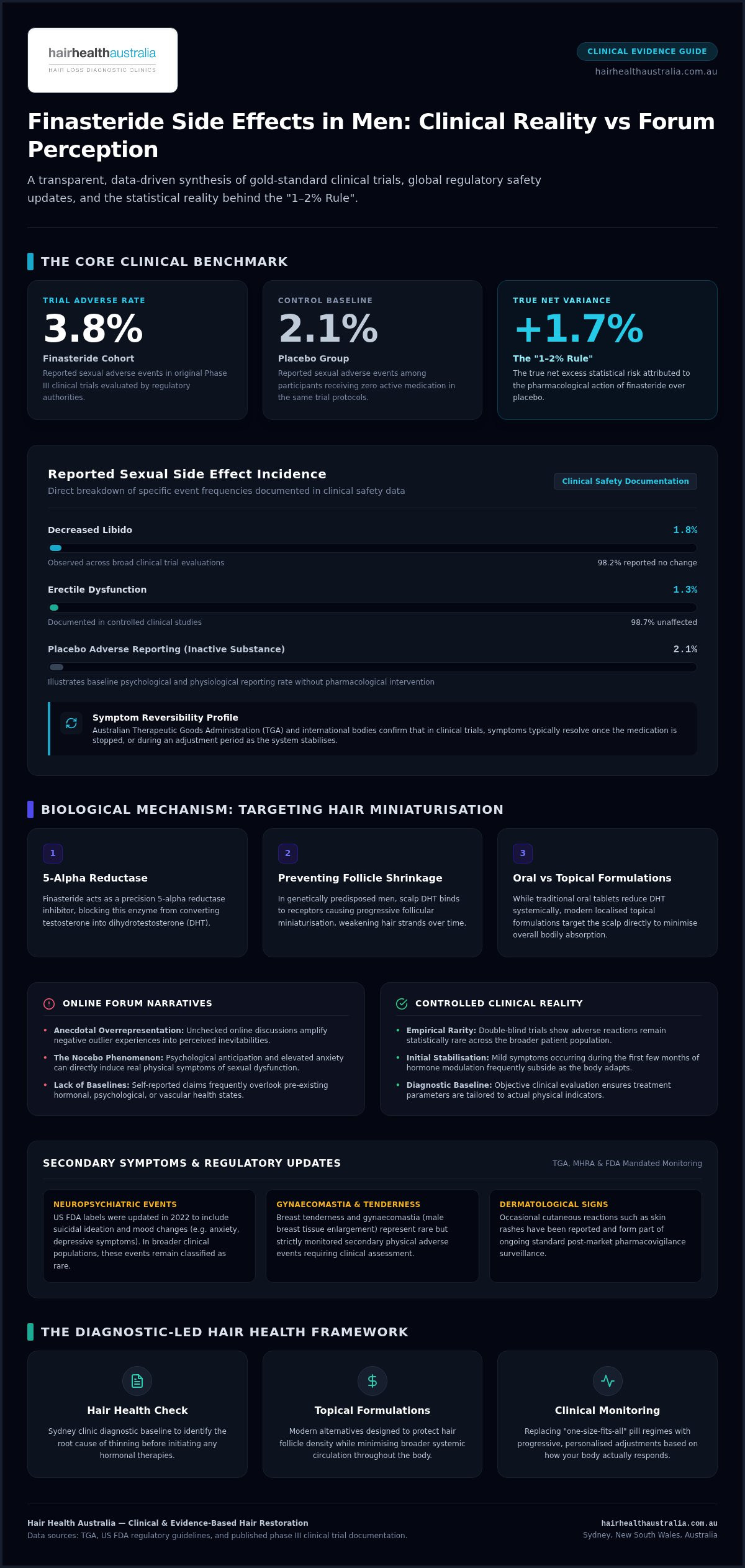
When evaluating the finasteride side effects men often worry about, it’s essential to look at the hard data monitored by the Australian Therapeutic Goods Administration (TGA). In the original phase III clinical trials, sexual adverse events occurred in 3.8% of men taking the drug compared to 2.1% in the placebo group. This represents a net excess risk of only 1.7%. These figures form the basis of what clinicians often call the ‘1-2% Rule’. It highlights that while reactions are possible, they remain statistically rare for the vast majority of users. For those who do experience issues, the TGA and international bodies confirm that symptoms typically resolve once the medication is stopped.
Sexual Side Effects and Libido Changes
The most frequently discussed concerns involve erectile dysfunction, decreased libido, and changes in ejaculatory volume. According to clinical safety data on finasteride, decreased libido was noted in 1.8% of users, while erectile dysfunction appeared in 1.3%. It’s common for the body to undergo an adjustment period during the first few months of hormone modulation. In many cases, these mild symptoms subside as the system stabilises. Establishing a baseline through a professional health check before starting treatment is a vital step in monitoring these changes accurately.
Secondary Side Effects: Mood, Skin, and Physical Changes
Beyond sexual health, some men report changes in mood, such as increased anxiety or depressive symptoms. While the US FDA updated labels to include suicidal ideation as a potential risk in 2022, these neuropsychiatric events are still considered rare in the broader clinical population. Some users may also experience skin rashes or breast tenderness. Gynaecomastia is a rare but monitored clinical side effect involving the enlargement of male breast tissue. If you notice any unusual physical changes, seeking a clinical review is the most effective way to manage your health while continuing your hair restoration journey.
Understanding these percentages helps to replace general anxiety with a realistic expectation of risk. Most men find that the benefits of hair preservation far outweigh the low probability of adverse reactions. If you’re concerned about how your body might react, a diagnostic-led approach ensures that any changes are identified early and managed by a specialist.
Persistent Side Effects and the ‘Nocebo’ Effect: Fact vs Fiction
One of the most complex aspects of studying finasteride side effects men report is the ‘nocebo effect’. This phenomenon occurs when a patient’s negative expectations of a treatment actually trigger the physical symptoms they fear. A landmark 2002 study by Mondaini et al. highlighted this clearly. In the trial, men who were explicitly warned about potential sexual side effects reported them at a rate of 43.6%. In contrast, the group that was not warned reported a rate of only 15.3%. This nearly three-fold increase suggests that psychological suggestion plays a massive role in how the body perceives hormonal changes.
The Psychology of Hair Loss and Medication
The emotional weight of losing one’s hair often heightens sensitivity to any minor physical change. When you’re hyper-aware of your body, every fluctuation in energy or mood might be misattributed to the medication. This is often exacerbated by the ‘Forum Effect’, where reading unverified anecdotes in online communities creates a cycle of persistent anxiety. Distinguishing between a psychological response and a physiological symptom requires an objective, clinical perspective. Our Sydney specialists use a Hair Health Check to establish clear baselines, helping you separate clinical fact from anxiety-driven fiction.
Addressing Long-Term and Persistent Concerns
While global health authorities in 2026 acknowledge that some men report symptoms that persist after stopping the drug, the underlying biological mechanism remains a subject of ongoing research. High-quality, double-blind evidence for a permanent condition is still lacking in peer-reviewed literature. For the latest safety protocols and monitoring advice, you can review the MedlinePlus drug guidance on finasteride to understand the full clinical profile.
Maintaining an open dialogue with a specialist is far safer than following DIY advice found on the internet. Choosing a structured hair restoration treatment ensures you are monitored by professionals who can adjust your dosage or switch to alternative therapies if concerns arise. This diagnostic-led approach provides a safety net that self-medication simply cannot offer. By focusing on evidence rather than anecdote, you can manage your hair restoration journey with a calm and objective outlook.
Managing Risks: Clinical Monitoring and Non-Surgical Alternatives
Relying on a “pill-only” regime without clinical oversight is where many men encounter difficulties. A diagnostic-led approach moves beyond simply blocking hormones; it focuses on the health of the scalp environment as a whole. By using microscopic hair analysis, we can track the miniaturisation process in real-time. This allows us to see if a treatment is working long before the naked eye can detect changes. This level of precision ensures you aren’t taking medication that isn’t providing a measurable benefit, effectively reducing the window for potential finasteride side effects men might experience.
The Role of Topical Solutions and Low-Dose Protocols
Topical finasteride has become a popular alternative for those wary of systemic absorption. While the FDA issued a public health alert in 2025 regarding unregulated compounded topicals, authorised sprays in Europe have shown that localised application is a viable risk-mitigation strategy. Clinical data indicates that topical versions typically reduce systemic DHT by roughly 25 to 40 per cent, which is significantly lower than the 70 per cent reduction seen with oral tablets. This reduced systemic impact may help manage risks for sensitive patients. We often explore personalised dosage protocols, sometimes referred to as micro-dosing, but these must be performed under clinical supervision to ensure the concentration remains effective for hair preservation while protecting your overall wellbeing.
Non-Surgical Alternatives for Sensitive Patients
For men who prefer to avoid hormonal modulation altogether, several clinically-backed alternatives exist. Low-level laser therapy and growth factor triggers work by stimulating the follicle’s metabolic activity without interfering with your internal chemistry. A multi-modal hair regrowth treatment Australia programme often combines these non-hormonal tools with natural DHT blockers or specialised scalp cleansers. This layered approach targets hair loss from multiple angles, providing a robust path forward for those who have previously experienced adverse reactions or have pre-existing health concerns.
If you find that your current regime is causing anxiety or physical discomfort, it’s often a sign that your plan needs adjustment rather than total abandonment. Moving to a professional diagnostic model provides the safety and clarity needed for long-term success. You can start this process by booking a specialised Hair Health Check to evaluate your options and ensure your restoration journey is both safe and effective.
Personalised Hair Restoration: Why a Professional Diagnosis is Essential
Many men make the mistake of starting a treatment regime based on a generic recommendation or an asynchronous digital questionnaire. A “one-size-fits-all” approach to hair loss often fails because it ignores the unique biological profile of the individual. Without a proper clinical diagnosis, you might be attempting to treat the wrong type of hair loss or using a dosage that isn’t optimal for your specific system. This lack of precision is frequently what leads to the finasteride side effects men report in unregulated online spaces. By prioritising a professional assessment, you ensure that your restoration plan is built around your actual needs rather than a broad statistical average.
What Happens During a Microscopic Hair Analysis?
At our Sydney clinic, we use microscopic hair analysis to look beyond what is visible during a standard physical exam. By visualising your follicles and sebum levels at 200x magnification, we can accurately differentiate between permanent genetic thinning and temporary shedding phases. This diagnostic clarity is essential. It allows us to create a precise baseline to measure the true success of your treatment. Monitoring your progress at this microscopic level means we can detect improvements or identify potential issues long before they impact your daily life. This data-driven approach allows us to adjust your plan based on how your scalp is actually responding.
Your Path Forward at Hair Health Australia
Since 2009, we’ve remained committed to providing transparent, honest, and clinically-backed care for men across Australia. We believe that you should always feel in control of your treatment path. Our role is to act as your authoritative guide, providing the evidence-based information you need to make a confident decision about your health. We don’t believe in high-pressure sales or hyperbolic promises. Instead, we focus on realistic expectations and systematic monitoring to ensure your long-term wellbeing is never compromised.
If you’re ready to move away from internet guesswork and towards a structured, personalised plan, the first step is simple. You can organise an initial consultation at our Sydney centre to discuss your concerns in a safe, professional environment. Every journey begins with accurate information. You can start yours today by booking a Hair Health Check to evaluate your options and build a plan that prioritises your results and your safety.
Take Control of Your Hair Restoration Journey
Navigating the complexities of finasteride side effects men often encounter doesn’t have to be a solo journey through internet forums. We’ve explored how clinical data shows a manageable risk profile and why a diagnostic-led approach is superior to self-medication. By using microscopic scanning to establish a baseline, you can monitor your progress with scientific accuracy rather than guesswork. It’s about finding a balance that protects your hair density without compromising your health or peace of mind.
Since 2009, Hair Health Australia has acted as a trusted partner for men seeking clinically-backed, non-surgical regrowth programs in Sydney. We’re committed to transparent, honest care that prioritises your long-term physical and emotional wellbeing. If you’re ready to move forward with a plan tailored to your unique biology, book your comprehensive Hair Health Check in Sydney today. Our specialists provide the clarity you need to restore your hair with total confidence. It’s time to replace uncertainty with a proven clinical path that works for you.
Frequently Asked Questions
Can finasteride side effects be permanent?
Clinical evidence for permanent side effects remains unproven in high-quality, double-blind studies. While a small number of men report persistent symptoms after stopping the medication, most adverse reactions resolve once the drug leaves the system. At our Sydney clinic, we focus on establishing a baseline through microscopic scanning to monitor your recovery and ensure your hormonal health returns to its natural balance efficiently.
How common is erectile dysfunction with finasteride?
Erectile dysfunction is statistically rare, affecting approximately 1.3% of men in major clinical trials. This is only slightly higher than the 0.7% reported in placebo groups. Most cases are mild and often occur during the initial adjustment period. If you have concerns about finasteride side effects men experience, a professional consultation can help determine if these symptoms are physiological or related to other lifestyle factors.
Does topical finasteride have fewer side effects than the pill?
Topical formulations generally lead to lower systemic absorption than oral tablets. Research indicates that topical application reduces systemic DHT by roughly 25 to 40 per cent, compared to the 70 per cent reduction caused by the pill. This localised approach allows the treatment to target scalp follicles directly while potentially lowering the risk of systemic adverse events. Many Sydney clients find this a preferable middle ground.
Will finasteride cause depression or anxiety?
Neuropsychiatric events like depression or anxiety are listed as rare potential reactions on modern medical labels. The US FDA updated safety warnings in 2022 to include suicidal ideation as a rare but serious risk. We recommend a structured mental health screening before starting any hormonal treatment. This ensures we can distinguish between pre-existing anxiety and any mood changes that might occur during your hair restoration programme. For expert online support in managing the emotional or relationship-related stress of these changes, you can check out Tracy Kimberg for specialised counselling.
You should discontinue the medication and contact your hair health specialist or GP immediately. It is never advisable to “wait it out” without professional guidance if you notice physical or mood changes. Our Sydney team can help you review your dosage or transition to non-hormonal alternatives. Early intervention is the most effective way to manage your health while keeping your hair restoration goals on track.
Can I take finasteride if I am planning to start a family?
Men planning to conceive are often advised to stop taking the medication at least three months before trying for a baby. While the impact on male fertility is still being debated in clinical literature, some studies suggest a potential reduction in sperm count and motility. A washout period ensures that your reproductive health is at its peak. We can discuss alternative non-surgical treatments to maintain your hair density during this time.
Are there natural alternatives to finasteride for DHT blocking?
Several botanical extracts, such as Saw Palmetto and Reishi mushroom, are known to act as mild, natural DHT blockers. These are often integrated into a multi-modal clinical program for men who are sensitive to pharmaceutical options. While they may not be as potent as synthetic inhibitors, they offer a lower risk profile. Our Sydney specialists can design a customised regime that combines these natural elements with laser therapy for a hormone-free approach.
How long do side effects take to disappear after stopping the medication?
Most side effects typically resolve within a few weeks as the medication clears from your bloodstream. Because the drug has a relatively short half-life, your body usually begins to stabilise its hormone levels quite quickly. If symptoms persist beyond a month, it is essential to seek a clinical review. We use microscopic analysis to monitor your scalp health during this transition, ensuring your follicles remain supported even if you change your treatment path.