The most promising drug-free hair regrowth option may not be the one making the biggest claims. What matters first is whether an approach fits the cause of your hair loss. If you’re weighing devices, procedures, supplements or natural remedies, it’s understandable to feel unsure about which options have a reasonable evidence base and which may not suit you.
Drug-free approaches differ in the strength of evidence, practical demands and suitability for different patterns of thinning. This article compares the main options, including low-level laser therapy, platelet-rich plasma and natural ingredients. It explains their limitations, why results can differ and what to consider before investing time or money in an approach.
A personalised assessment can help clarify your hair-loss pattern and possible causes before you decide what to explore. We’ll outline useful information to prepare for a hair health assessment and explain how Hair Health Australia’s non-surgical programmes for men and women may offer a considered next step, without promising a particular outcome.
Key Takeaways
- The label “drug-free” doesn’t establish that an approach works. Consider the evidence and its limitations.
- Compare drug-free hair regrowth options by evidence, suitability, practical commitment, risks and how progress is assessed.
- Evidence for a treatment category doesn’t automatically support every brand, device or service within it.
- Before weighing options, note when thinning began, where it appears and any relevant changes or symptoms.
- A personalised hair health assessment can help clarify your pattern and goals before you consider non-surgical care.
Drug-free hair regrowth options: what they can and cannot do
It’s understandable to look for ways to address thinning without medication. You may prefer to avoid a particular treatment, or want to understand the alternatives before deciding what to do. But “drug-free” describes an approach, not its effectiveness. Consider devices, procedures and supplements in light of their own evidence and the possible reason your hair is changing.
Hair regrowth approaches aim to support hair growth or retention; cosmetic coverage changes how hair looks, while routine hair care cleans and styles it. These goals can overlap, but a product that makes hair look fuller or improves scalp comfort doesn’t necessarily address the process causing thinning. And a plausible explanation of how an approach might work isn’t proof that it will help a particular person.
Why the cause of hair thinning matters
Gradual thinning around the crown, temples or part line may follow a patterned course. Sudden or more diffuse shedding can have a different explanation. Androgenetic alopecia, commonly associated with pattern hair loss, differs from telogen effluvium, a pattern of increased shedding that can occur after a trigger such as illness or significant physical stress. These descriptions aren’t a diagnosis, and similar changes can have different causes.
Note how and where the change began, whether it is continuing, and whether you’ve noticed scalp symptoms such as persistent irritation or discomfort. Sudden shedding, a changing pattern or scalp symptoms make assessment particularly relevant. A hair health assessment can help build an individual picture before you weigh up possible approaches. An option discussed for patterned thinning, for example, may not address shedding with another cause.
Drug-free does not automatically mean risk-free or proven
Low-level laser therapy (LLLT) is a device-based approach discussed for hair loss. A general overview of LLLT describes its proposed mechanism, but that rationale is a starting point, not a guarantee of benefit. Evidence may vary by treatment category, the people studied and how an approach is used. A result reported in a study doesn’t establish that every device or individual will produce the same outcome.
Procedures and supplements have their own practical demands and potential risks. A supplement may be unnecessary or unsuitable, while a device or procedure may involve ongoing use, discomfort or other considerations. “Natural” doesn’t mean risk-free, and “non-invasive” doesn’t mean effective for every cause of hair loss. Consider the evidence, possible downsides and how progress would be reviewed instead of relying on a biological claim or promotional promise alone.
Medication and drug-free care aren’t universally preferable in either direction. A sensible comparison depends on your health, the pattern and likely cause of hair loss, and your priorities. Hair Health Australia offers personalised, non-surgical hair-loss programmes for men and women. An assessment-led discussion can help clarify your pattern, scalp health and goals before you consider a suitable next step, without assuming one approach fits everyone.
Drug-free hair regrowth options: the main approaches to compare
Light-based devices and non-drug procedures
Low-level light therapy uses a device to deliver light to the scalp, with the aim of supporting hair growth. Depending on the device, it may require regular, ongoing sessions or use at home. Evidence and suitability can vary, so look at the specific device and the research behind it rather than assuming findings about one device apply to all. The Mayo Clinic’s overview of hair loss treatments also underlines the value of understanding the cause before considering options.
Platelet-rich plasma (PRP) is a procedure that uses a person’s own blood, which is processed before being administered to the scalp. It may involve repeated appointments and clinical considerations, including discomfort and cost. Calling it drug-free doesn’t establish its likely benefit for an individual or remove the need to consider potential risks and suitability.
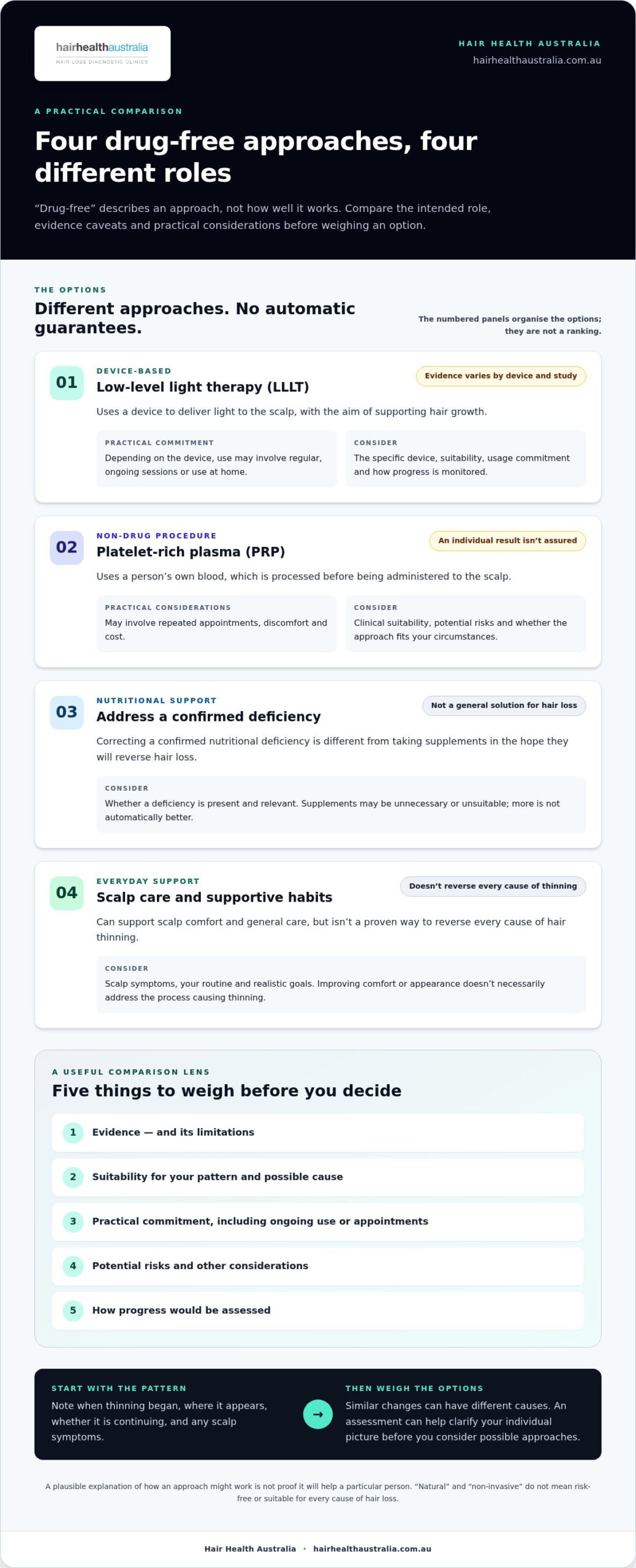
| Option | Intended role | Evidence caveat | Assessment considerations |
|---|---|---|---|
| Low-level light therapy | Device-based support for hair growth | Evidence can differ by device and study | Usage commitment, suitability and progress monitoring |
| PRP | Scalp procedure using processed blood | Results aren’t assured for an individual | Clinical suitability, appointments, discomfort and cost |
| Nutritional support | Address a confirmed deficiency | Supplements aren’t a general solution for hair loss | Whether a deficiency is present and relevant |
| Scalp care and supportive habits | Maintain scalp comfort and general care | Not a proven way to reverse every cause of thinning | Symptoms, routine and realistic goals |
Nutrition, scalp care and supportive habits
Correcting a confirmed nutritional deficiency is different from taking supplements in the hope they’ll reverse hair loss. Supplements may be unsuitable or unnecessary, and more isn’t automatically better. Avoid starting a supplement regime or restrictive diet based on broad online claims. The relevant question is whether a deficiency or dietary issue has been identified and whether addressing it is appropriate for you.
Gentle, consistent scalp care can support comfort and help you notice changes, but it shouldn’t be mistaken for a treatment that reliably reverses follicle-related loss. If a product irritates your scalp, stop using it and seek appropriate advice. Track the approach you try and any changes you observe, rather than relying on memory or a single photograph.
In Sydney, Hair Health Australia offers personalised, non-surgical hair-loss programmes for men and women. Non-surgical doesn’t automatically mean drug-free, so an assessment can help clarify your pattern, scalp health and goals before options are discussed. A Hair Health Check offers an individual starting point for that conversation.
How to compare drug-free hair regrowth options realistically
Use the same questions for each approach instead of comparing headline claims. Consider the strength of the evidence, whether the people studied resemble your situation, the time and effort involved, potential risks, and how any change would be measured. No single drug-free option suits every cause of hair loss. Suitability depends on the pattern and likely cause, as well as your health and preferences.
Separate evidence for a treatment category from evidence for a particular brand or service. A study of one type of device, for example, doesn’t automatically show that every device performs similarly. Look for research on the specific approach being promoted and check whether its use matches the conditions studied.
- Evidence: Is the claim supported by human research, or mainly by an explanation and anecdotes?
- Suitability: Does the evidence relate to the pattern or cause being considered?
- Commitment and risks: What ongoing use, appointments, discomfort or other downsides might be involved?
- Monitoring: How will change be assessed, and what would count as a meaningful outcome?
What counts as useful evidence?
Give more weight to well-designed human studies that explain who took part, what was compared and how outcomes were measured. Read the limitations, too. A small or short study may offer an early signal, not a settled answer. Testimonials or before-and-after images alone can’t establish what results are likely for you, because lighting, styling and other differences can change how hair appears.
Check that the evidence supports the claim being made. Preliminary findings should be described as preliminary, not presented as an established benefit. If a product or service makes a specific therapeutic claim, verify any relevant Australian regulatory information before relying on it. Marketing language such as “clinically proven” is not a substitute for clear details about the research.
Set expectations for progress and monitoring
Visible change, if it occurs, may take time, and there’s no universal timeframe for every approach or person. Agree on how progress will be reviewed before starting instead of judging by day-to-day impressions. Results can’t be guaranteed, and whether progress can be maintained may depend on the underlying cause and the plan being followed.
For a practical comparison, you could:
- Take photographs from consistent angles, in similar lighting, with your hair prepared the same way.
- Keep a brief record of use, appointments, scalp symptoms and any changes you notice.
- Use clinical measurements where appropriate, and compare like with like at review points.
These checks won’t prove that an approach caused a change, but they can make observations more consistent. A personalised assessment can help clarify what to monitor, so you’re not judging an option against an outcome it wasn’t intended to address.
A practical way to decide which drug-free option to explore
You don’t need to choose a device, procedure or supplement before understanding what may be driving the change. A step-by-step approach can help you move from noticing hair loss to comparing drug-free hair regrowth options that may be relevant to your situation, without treating online claims as a personal recommendation.
- Describe the change. Note when you first noticed thinning or shedding, where it appears and whether it seems stable or is changing. Record any scalp discomfort or visible irritation.
- Record relevant context. Think about changes in your general health or routine around the time it began, and note family history if you know it. These details can help build a clearer picture, though they don’t diagnose the cause.
- Review the possibilities. Once the pattern and context are considered, compare approaches by their evidence, suitability, practical commitment and potential downsides. Don’t assume an option discussed for one pattern will fit another.
- Decide how progress would be reviewed. Before starting an approach, consider what you’d monitor and how you’d record it, such as with consistent photographs or relevant clinical measurements.
Prepare for an informed hair health assessment
A short written summary can make an assessment more useful. Include when the change began, how it has progressed, where it’s most noticeable, and any family history or shifts in your general health or routine. List the hair products, supplements and treatments you currently use, including prescribed treatments. This information provides context. It isn’t a reason to start or stop anything on your own.
An assessment should help clarify the pattern, scalp health and your individual goals, then inform a tailored plan. It isn’t a promise of a predetermined result. The aim is to make your next decision more informed, including whether a drug-free approach is suitable to explore.
Know when general self-care is not enough
Sudden, patchy or rapidly changing hair loss deserves prompt clinical assessment rather than reliance on general self-care or trying several options at once. Include any scalp discomfort, persistent irritation or other visible changes in your notes. These details may help explain what’s happening, but they can’t establish a cause by themselves.
If you’re already using prescribed treatment, don’t start or stop it based on general information in an article. Discuss changes with the clinician who prescribed it. This keeps decisions connected to your circumstances and avoids making a treatment change without individual advice.
For a personalised starting point, book a Hair Health Check to help clarify your hair pattern and goals before weighing possible next steps.
How Hair Health Australia can support a drug-free regrowth discussion in Sydney
Reading about devices, procedures and other drug-free approaches can help you understand the choices, but it can’t show which one fits your hair pattern or goals. Hair Health Australia is a Sydney-based clinic offering personalised, non-surgical hair-loss treatment programmes for men and women. The starting point is an individual assessment, not an assumption that one option suits everyone.
Non-surgical care and drug-free care aren’t interchangeable terms. A non-surgical programme may involve considerations beyond the broad categories discussed in this article, so explain your preferences clearly. If avoiding hair-loss medication is important to you, raise it as part of the conversation. The aim is to understand your priorities alongside your pattern of thinning and scalp health, then consider an appropriate next step without promising a particular result.
What a personalised, non-surgical approach means
Personalised care starts with the details that make your situation individual: where thinning appears, how it has changed, your scalp health and what you hope to achieve. These factors help shape a discussion about suitable care rather than applying a standard answer to everyone. Hair Health Australia provides programmes for men and women focused on hair loss, including thinning hair, pattern baldness, hair density and scalp health.
For broader context on non-surgical care, read this guide to clinical hair treatment. It can help you frame questions about your options, while an individual assessment keeps the discussion connected to your circumstances.
A clear next step for Sydney readers
The Hair Health Check provides an individual starting point for understanding your hair concerns. Before an assessment, it may help to prepare a brief timeline of when the change began, notes on where it appears and a list of current products or treatments. You can also share relevant changes in your health or routine, along with what you’d like to discuss, such as whether drug-free approaches are a priority.
An assessment can support more informed decisions about possible care, but it can’t guarantee regrowth. Its value is in clarifying your pattern and goals before you weigh up next steps. Hair Health Australia’s personalised, non-surgical programmes are a considered pathway for men and women seeking support with hair loss, without assuming a specific modality or outcome in advance.
To begin with an individual starting point, start your hair health check.
Make your next step an informed one
You don’t have to settle on a treatment simply because it’s popular or labelled natural. A more useful next step is to clarify what you want help with, what you’re comfortable considering and what questions remain. That gives any discussion of drug-free hair regrowth options a practical focus, grounded in your concerns rather than broad claims.
Before an assessment, write down the main change you’ve noticed and the outcome that would matter to you. You might want to understand a widening part, increased shedding or changes in scalp health. Bringing those priorities into the conversation can help shape a considered discussion of suitable care and what to monitor, without assuming a particular result.
Hair Health Australia’s Sydney team provides personalised, non-surgical programmes for men and women. An assessment is a sensible starting point for exploring your concerns, not a promise of regrowth. Start your Hair Health Check and take the next step with greater clarity.
Frequently Asked Questions
Can hair regrow without medication?
Yes, hair can regrow without medication in some situations, but it depends on why it was lost. If shedding follows a temporary trigger, growth may recover as the underlying issue settles. Other causes may need specific care, and not every form of hair loss is reversible. If you’ve noticed a persistent change, an assessment can help clarify what may be contributing before you choose an approach.
Are drug-free hair regrowth treatments effective for everyone?
No. Drug-free hair regrowth options aren’t suitable or effective for everyone because hair loss has different causes and patterns. A device or procedure studied for one type of thinning may not be relevant to another. Consider whether the evidence applies to your situation, what commitment is involved and how progress will be reviewed. Be cautious of testimonials that suggest one person’s outcome predicts yours.
Is low-level light therapy a proven option for hair regrowth?
Low-level light therapy has research support as a possible option for some people, particularly in studies involving patterned hair loss, but that doesn’t establish benefit for every person or device. Check whether claims relate to the specific device and pattern being discussed. Consider whether you can follow the recommended routine consistently, since occasional use may not reflect how the approach was studied.
Can vitamins or supplements regrow thinning hair?
Supplements may help address hair changes linked to a confirmed nutritional deficiency, but they aren’t a reliable general treatment for thinning. Taking a supplement without knowing whether you’re deficient may not address the cause and could be unsuitable for your circumstances. Discuss persistent shedding or concerns about nutrition with an appropriate health professional before starting supplements, particularly if you take other medicines.
How long do drug-free hair regrowth options take to work?
There isn’t one timeframe that applies to every approach or person. Hair growth changes gradually, and any visible difference may take time to assess. Before beginning, ask how and when progress will be reviewed, and record comparable photographs rather than relying on daily impressions. If you’re not seeing the change you expected, reassess the plan and whether it matches the likely cause rather than simply adding more products.
Can hair loss return after a drug-free treatment programme ends?
It can, depending on the cause of hair loss and what the programme was intended to address. Some approaches may need continued use or follow-up to maintain progress, while changes related to a resolved trigger may behave differently. Before finishing a programme, discuss what to expect afterwards, what signs to monitor and whether a maintenance plan is appropriate. Don’t assume that stopping will have the same effect for everyone.
When should I get a hair health assessment for thinning?
Arrange an assessment if thinning persists, progresses or is difficult to explain. Seek prompt clinical assessment for sudden, patchy or rapidly changing loss, or if you have scalp discomfort or visible irritation. For Sydney readers, Hair Health Australia’s Hair Health Check offers an individual starting point for discussing your pattern and concerns. Take a timeline of changes and a list of current products or treatments to make the discussion more useful.