How Sydney City Pollution May Affect Hair Health

Could the impact of city pollution on hair health Sydney residents worry about explain a change in their hair, or might something else be going on? Dryness, scalp irritation or increased shedding can prompt questions about traffic fumes, dust or smoke. Pollution may affect the scalp and hair shaft, but it isn’t established as a sole cause of permanent hair loss.

It helps to separate plausible environmental effects from other possible contributors, including genetics, hormonal changes, nutritional deficiencies and stress. Online claims can make that distinction difficult. Understanding what the evidence suggests, and where it has limits, is a more useful starting point.

This article explains how urban pollutants may affect scalp comfort and hair condition, what research can and can’t tell us about thinning, and practical ways to care for your hair on poor-air-quality days. It also covers when persistent changes may warrant an individual hair health assessment.

Key Takeaways

  • Learn how airborne particles such as PM2.5 differ from gases, and why that matters when considering scalp and hair exposure.
  • Understand which surface changes may be consistent with exposure, and why they don’t explain every pattern of shedding or thinning.
  • Explore what the evidence can and can’t establish about the impact of city pollution on hair health Sydney residents may be concerned about.
  • Use a simple hair-care routine on affected air-quality days, and know where to find NSW EPA updates.
  • Recognise when ongoing shedding, thinning or scalp discomfort may warrant an individual hair health assessment.

What Sydney city pollution means for your scalp and hair

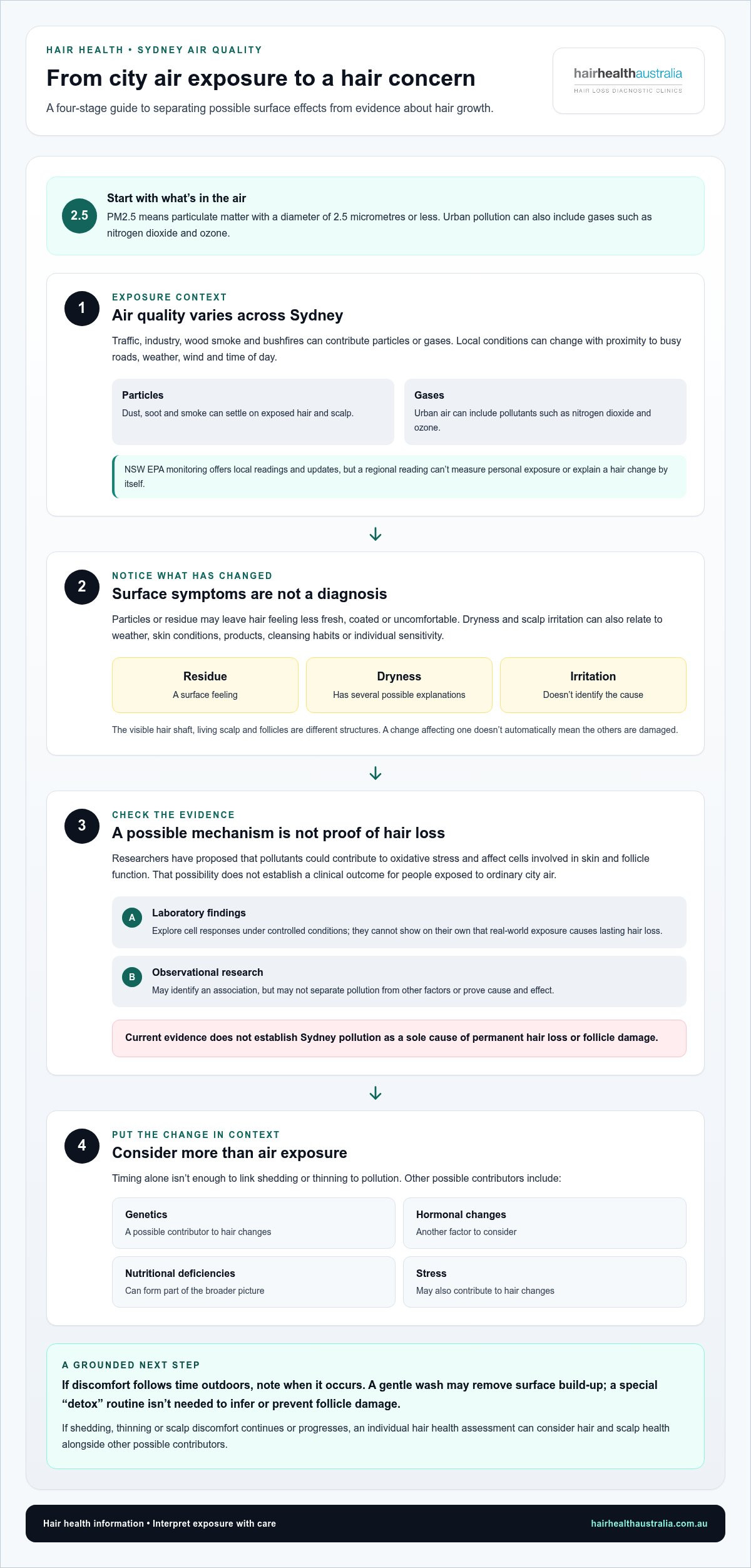
Urban air pollution is a mix of tiny airborne particles and gases from sources such as motor vehicles, industry, wood smoke and bushfires. Particles can include dust, soot and smoke; gases include pollutants such as nitrogen dioxide and ozone. Levels change over time, and conditions outside your home may differ from those recorded at a monitoring station.

PM2.5 is particulate matter with a diameter of 2.5 micrometres or less. These particles are small enough to be inhaled into the respiratory system. That health context doesn’t establish what they do to an individual’s hair. For a general overview of the effects of air pollution, distinguish broad environmental impacts from evidence specific to the scalp and hair.

Which air pollutants are relevant in urban Sydney?

Traffic-related air pollution can include particles and gases from vehicle emissions, but exposure varies across Sydney. Proximity to busy roads, weather, wind and time of day can all affect local conditions. Smoke from bushfires is another reason air quality can change. Check NSW EPA air-quality monitoring information for current local readings and updates.

The impact of city pollution on hair health Sydney residents may be concerned about depends partly on what they’re exposed to and for how long. A regional reading provides useful context, but it can’t measure personal exposure or explain a hair change by itself.

Hair shaft, scalp, and hair follicle: what is different?

The hair shaft is the visible strand above the skin, made mostly of non-living keratin. The scalp is living skin, and hair follicles sit within the skin and produce hair. These structures are related, but a change affecting one doesn’t automatically mean the others are damaged.

Particles or residue on the hair may affect how clean or comfortable it feels. Scalp irritation is a different concern from damage to a follicle, which can’t be confirmed simply by looking at a strand. Appearance alone can’t identify the cause of a change, so don’t assume pollution is responsible.

Possible effects of air pollution on the scalp or hair are not proof that pollution has caused hair loss. Research into environmental exposure and hair health is still developing, and visible changes can have several explanations. Exposure is one possible part of the picture, not a diagnosis or a complete account of someone’s hair health.

How urban air pollutants may interact with scalp and hair

Pollution can meet the hair and scalp at the surface, while possible effects deeper in the skin raise different questions. Residue or discomfort after time outdoors doesn’t, by itself, show that a follicle has been affected or that hair growth has changed.

What may happen on the hair and scalp surface?

Airborne particles can settle on exposed hair and scalp, as they do on other surfaces. Depending on conditions and your usual routine, this may contribute to a feeling of residue or leave hair feeling less fresh. Those experiences aren’t specific to pollution. Styling products, cleansing frequency and individual sensitivity can also affect how the scalp feels and the hair behaves.

Dryness or irritation can have many explanations, including weather, skin conditions and hair-care products. If discomfort follows time outdoors, note when it occurs, but don’t treat the timing as proof of a cause. A gentle wash may remove surface build-up; a special “detox” routine isn’t needed to infer or prevent follicle damage.

What does research say about follicles and hair growth?

Researchers have proposed that pollutants could contribute to oxidative stress, an imbalance between reactive molecules and the body’s ability to manage them. In theory, this could affect cells involved in skin and follicle function. A plausible biological mechanism, however, isn’t the same as a demonstrated clinical outcome in people exposed to ordinary city air.

Studies of air pollution and hair health vary in their methods and what they measure. Laboratory findings can explore how cells respond under controlled conditions, but can’t show on their own that real-world exposure causes lasting hair loss. Observational research may identify an association, but can’t always separate pollution from other factors or prove cause and effect. Without clear, directly relevant clinical evidence, it would be misleading to treat Sydney pollution as an established cause of permanent follicle damage.

A proposed effect on follicle cells is a mechanism to investigate, not proof that pollution causes hair loss in people. The impact of city pollution on hair health Sydney readers are trying to understand should therefore be considered cautiously. Current evidence doesn’t make pollution a complete explanation for persistent shedding or patterned thinning.

If changes continue or progress, an individual assessment can consider hair and scalp health alongside other possible contributors. A hair health check can help provide that broader context without assuming pollution is the cause or promising a particular outcome.

A change in how your hair feels after time outdoors is different from a gradual change in its density. Residue, dryness or scalp discomfort may be worth noticing, but none identifies the cause on its own. Shedding or thinning can have several contributing factors, so timing alone isn’t enough to link a change to air pollution.

Surface irritation or residue

You may notice a coated feeling in your hair, dryness or an uncomfortable scalp. These are observations, not proof of pollution damage. Hair-care products, cleansing habits, weather and individual sensitivity can also affect how your scalp and hair feel.

Ongoing shedding or patterned thinning

You may notice continuing changes in how much hair you shed or in the density of particular areas. These changes need broader context. They can’t be explained by pollution exposure alone, and appearance doesn’t provide a diagnosis.

Which changes might be temporary or surface-level?

Surface residue or discomfort may be noticeable after exposure, but the same sensations can have other explanations. Pay attention to what you observe, such as scalp irritation or dry-feeling hair, without assuming a cause or expecting a particular recovery time. Persistent or progressive changes in density are different from a surface concern and deserve closer attention.

When might thinning need a broader explanation?

Family history, hormonal changes, general health, stress, nutrition and hair-care practices may all be relevant when hair changes. They’re considerations, not diagnoses. Pollution exposure doesn’t rule out another contributor, and more than one factor may be involved. An individual assessment can help put persistent changes in context.

Persistent thinning shouldn’t automatically be attributed to pollution. The impact of city pollution on hair health Sydney residents notice can’t be judged from one symptom or a single day’s exposure. It’s more useful to distinguish concerns about scalp comfort or residue from continuing changes in shedding or density.

If you’re concerned, note when you first noticed the change, where it appears, whether it’s progressing, and any relevant changes in your health or hair-care routine. This information can support a more considered discussion without turning a personal observation into a self-diagnosis. A hair health check can help assess persistent changes in the context of your individual hair and scalp health.
How Sydney City Pollution May Affect Hair Health

Practical ways to care for your hair on Sydney’s polluted-air days

You don’t need a complicated routine or a special “anti-pollution” product to care for your hair after being outdoors. Focus on comfort and your usual scalp needs. The impact of city pollution on hair health Sydney residents are concerned about isn’t fully understood, so sensible care should remove surface residue without promising to prevent follicle changes or hair loss.

A simple routine after time outdoors

If your hair or scalp feels dusty or uncomfortable, wash it when it suits your usual routine. Choose a gentle cleanser that works for your hair and scalp, and rinse thoroughly. Washing frequency varies, so consider your scalp’s oiliness, activity and product use rather than following a fixed schedule because you’ve been outside.

  • Cleanse gently if you notice residue. Washing removes surface material, but isn’t proof of follicle protection.
  • Avoid vigorous scrubbing, especially if your scalp is already irritated.
  • Keep your regular routine steady where possible, rather than introducing several new products at once.

If irritation continues, don’t treat it as evidence of pollution damage. Products, skin sensitivity and other factors may also be relevant. A simpler routine can make it easier to notice whether a particular product or habit seems to aggravate discomfort.

Adjusting your routine when Sydney air quality changes

Air quality varies across locations and over time, so one reading won’t represent every part of Sydney. Check NSW EPA air-quality updates for local monitoring information, particularly when smoke or visible haze is present or an air-quality alert has been issued. Use those readings as context, not as a measure of your personal exposure.

During poor-air episodes, follow relevant official advice. If it recommends reducing prolonged outdoor exposure, adjust your outdoor plans accordingly. Hair coverings may reduce direct contact with particles on the hair, but shouldn’t be treated as a medical safeguard or a way to prevent hair loss. Keep any covering comfortable and avoid tight styles that pull on the hair.

For everyday care, keep to practical steps: wash when needed, handle the scalp gently and avoid unnecessary changes prompted by alarming product claims. If your scalp feels uncomfortable, note when symptoms occur and whether anything else in your routine changes. That information may be useful if you seek advice.

Exposure alone doesn’t mean you need an assessment. If shedding, thinning or scalp concerns persist, progress or worry you, an individual hair health check can consider your broader circumstances. Book a Hair Health Check to discuss ongoing changes in the context of your hair and scalp health.

When to seek a hair health assessment in Sydney

Pollution may be one part of the context around a hair or scalp concern, but it isn’t a complete explanation. If you notice ongoing shedding, thinning or scalp discomfort, an individual assessment can consider the pattern and your wider circumstances rather than assume city air is responsible. You don’t need to prove that pollution caused a change before asking for guidance.

Consider an assessment if a change persists, appears to be progressing or is causing concern. The impact of city pollution on hair health Sydney residents may experience can’t be determined from appearance alone. Similar visible changes may have different explanations, and identifying relevant factors requires individual context.

What information can help explain a change?

Before an appointment, note when you first noticed the change and whether it has continued or shifted. It may help to describe where you see thinning or shedding, any scalp symptoms, and whether your usual hair-care routine has changed. These observations offer context, but they aren’t a checklist for diagnosing yourself.

Family history, general health changes, medications, stress, nutrition, hair-care practices and environmental exposure may also be relevant. You don’t need to decide which factor is responsible. An assessment can consider the pattern alongside this background and help determine what further steps may be appropriate.

A measured next step for Sydney readers

Hair Health Australia takes a personalised approach to persistent hair concerns, with non-surgical hair-loss treatment programmes for men and women. An assessment can put changes in context and guide an individual discussion about hair and scalp health. It doesn’t assume pollution is the cause or guarantee a particular result.

If you’re unsure whether a change warrants attention, consider how long it has been present, whether it’s progressing and how concerned you feel. Ongoing or worrying changes are a reasonable reason to seek an individual assessment. You can learn more about the hair health check and decide whether it’s a suitable next step for you.

Arrange a hair health check

Take the next step with clarity

Understanding the impact of city pollution on hair health Sydney residents may notice can help make sense of changes, but it can’t identify their cause. Rather than linking every symptom to a particular day or place, pay attention to changes that persist and seek individual guidance if they concern you. A clearer picture starts with your own hair and scalp history.

Hair Health Australia takes a personalised, clinically focused approach to hair-loss concerns, with non-surgical options for men and women. An individual hair health check can put persistent changes in context and support a considered discussion about possible contributing factors. There’s no need to assume pollution is responsible or expect a particular outcome before taking that step.

If you’re ready to discuss a change that’s been on your mind, arrange a hair health check. Take a measured next step towards a clearer understanding of your hair and scalp health.

Frequently Asked Questions

Can city pollution cause hair loss?

Current evidence doesn’t establish ordinary city pollution as a direct cause of lasting hair loss. Researchers are investigating possible links between pollutants and hair or scalp biology, but a proposed mechanism or association doesn’t prove that exposure caused an individual’s thinning. If you’re concerned about the impact of city pollution on hair health Sydney, consider other possible influences too, including family history, health changes and medicines.

Can pollution make your scalp itchy or your hair feel dry?

You may notice an itchy or uncomfortable scalp, or hair that feels dry, after spending time in polluted air, but these symptoms aren’t specific to pollution. A new styling product, hot water or an existing sensitive-skin condition may also be relevant. If irritation starts after changing a product, pause its use if appropriate and see whether symptoms settle. Persistent or worsening scalp symptoms deserve individual advice.

Does washing your hair remove pollution?

Washing can help remove particles and residue sitting on the hair and scalp, but it can’t prevent later exposure or prove that follicles are protected. Use a cleanser suited to your hair and scalp, and rinse well. If your hair feels dry, avoid repeatedly shampooing to chase a sense of complete “decontamination”. A comfortable, consistent routine is more useful than aggressive scrubbing or adding several products at once.

How can I check air quality in Sydney?

Check the NSW Environment Protection Authority’s air-quality information for current monitoring readings and alerts. Use the nearest relevant monitoring location as a guide, while remembering that conditions can differ across Sydney and readings won’t represent your exact personal exposure. During smoke or haze, check updated official advice before planning prolonged outdoor activity. A clear-looking day doesn’t replace monitoring information, and a reading doesn’t explain a hair change.

Is pollution-related hair damage permanent?

It isn’t possible to predict permanence from appearance or exposure alone, and current evidence doesn’t establish that typical Sydney pollution causes permanent follicle damage. Hair that feels coated or dry isn’t the same as confirmed follicle injury. If you notice ongoing changes in density or shedding, don’t assume they’ll resolve once air conditions improve. An individual assessment can help clarify what may be contributing and whether further evaluation is appropriate.

When should I get persistent hair thinning checked?

Arrange an assessment if thinning or shedding continues, progresses or is causing concern, especially if you’ve noticed a new pattern or a change in scalp comfort. Beforehand, note when it began, where it’s most visible and any relevant health or hair-care changes. These details can help put the concern in context. Hair Health Australia provides personalised, non-surgical hair-loss treatment programmes for men and women, guided by individual needs.
Non-Surgical Hair Loss Clinic Sydney: What to Expect

What if the most useful first step isn’t choosing a treatment, but understanding why your hair is thinning? If you’re considering a non-surgical hair loss clinic Sydney residents can access, you’ll want a clear picture of the assessment, possible approach and commitment involved before deciding what to do.

Hair loss can have different causes, and a programme focused on supporting hair growth is not the same as cosmetic hair replacement or transplant surgery. A personalised assessment can help you discuss your hair and scalp concerns, whether a non-surgical programme may suit your circumstances, and what expectations are realistic. It’s a practical starting point, not a promise of a particular result.

In this article, you’ll learn how non-surgical hair loss care works, what an assessment can help you consider and how an individualised care pathway differs from cosmetic options. We’ll also cover what to discuss about commitment and progress, so you can take a considered next step with Hair Health Australia’s personalised care for men and women in Sydney.

Key Takeaways

  • A non-surgical hair loss clinic Sydney can help you explore options through an assessment-led approach, rather than treating every case of thinning the same way.
  • Noting when hair loss began, how it has changed and what concerns you most can make an assessment more useful.
  • Clinical regrowth care, cosmetic hair systems and transplant surgery address different needs. Understanding the distinctions helps you focus on the option that fits your circumstances.
  • An individualised programme and progress discussions can help you understand the proposed approach and keep expectations realistic.
  • A hair health check is a considered first step towards understanding your concerns and possible next steps, not a promise of a particular result.

What does a non-surgical hair loss clinic in Sydney do?

A non-surgical hair loss clinic Sydney residents can visit provides assessment-led support for people concerned about thinning or pattern baldness. Non-surgical hair loss care is an individualised approach to understanding hair and scalp health and considering options that may support regrowth, without surgery or cosmetic coverage. The aim is to consider your circumstances and appropriate next steps, not to promise a particular result.

Hair thinning can have different causes and patterns. Family history, health and personal circumstances may all be relevant, so noticing a change doesn’t confirm its cause. An individual assessment helps put your concern in context and consider whether a non-surgical programme is suitable. General background on hair loss and its different types is available in Understanding Hair Loss, but it can’t establish what’s happening in your individual case.

Hair Health Australia provides personalised, non-surgical programmes for men and women, focused on thinning hair, pattern baldness, follicle stimulation and scalp health. Its hair health check is a considered starting point for discussing your concerns and possible next steps.

Clinical regrowth care and cosmetic hair replacement are different

These approaches serve different needs. A regrowth-focused programme considers hair health and whether an individualised course of care may be appropriate. A hair system or wig changes visible appearance by providing cosmetic coverage; it doesn’t address the underlying cause of hair loss. Neither approach suits everyone.

Sydney Hair Clinic’s presentation of hair systems illustrates the distinction: a system is a cosmetic hair-replacement option, rather than a programme focused on hair health. Transplant surgery is different again, involving a surgical procedure. When comparing options, first identify your priority: cosmetic coverage, a non-surgical approach to thinning, or information about surgery.

  • Non-surgical regrowth care: considers hair and scalp health through an individualised programme.
  • Hair systems and wigs: provide cosmetic coverage to change appearance.
  • Transplant surgery: is a surgical approach, not non-surgical clinical care.

Who may consider non-surgical hair loss care?

Men and women noticing thinning or pattern baldness may wish to explore non-surgical care. Whether a particular programme is suitable depends on individual hair health, the nature of the concern and personal circumstances. A symptom or photograph alone can’t establish the cause or determine the right approach.

You don’t need to arrive at an assessment with a firm conclusion. It can help to describe what you’ve noticed, when it began and what you want to understand. From there, you can consider the findings and whether an individualised programme makes sense for you, with expectations grounded in your situation.

How a Sydney hair loss assessment can guide your treatment pathway

An assessment gives structure to the questions behind hair thinning. Instead of jumping straight to a treatment, it brings together what you’ve noticed, relevant context and your hair health concerns. For someone considering a non-surgical hair loss clinic Sydney, this can clarify what to discuss next and whether an individualised programme may be appropriate.

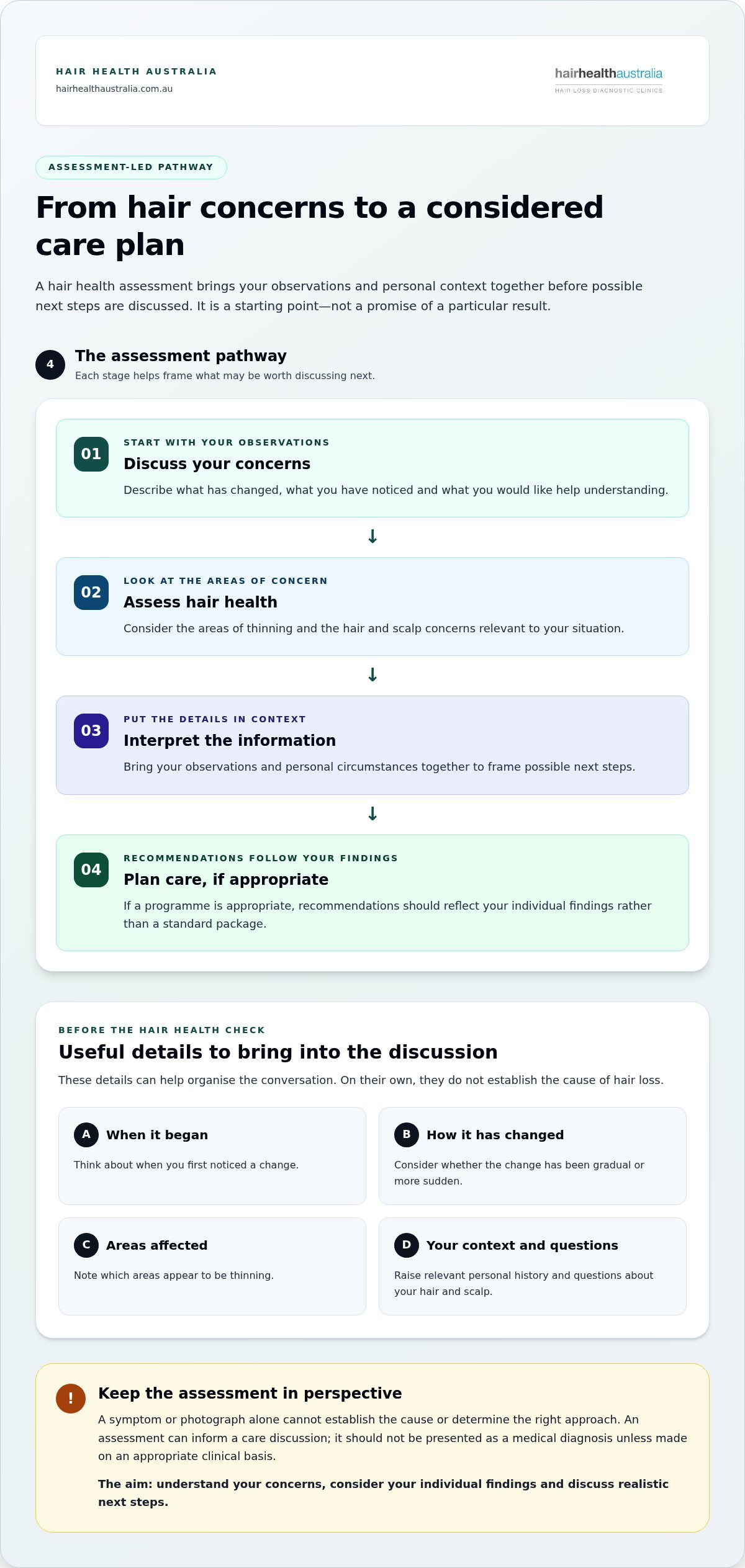
The process can be understood in four steps:

  • Discuss your concerns. Describe what has changed, what you’ve noticed and what you’d like help understanding.
  • Assess hair health. Consider the areas of thinning and the hair and scalp concerns relevant to your situation.
  • Interpret the information. Bring your observations and personal context together to frame possible next steps.
  • Plan care. If a programme is appropriate, recommendations should reflect your individual findings rather than a standard package.

What information can a hair health check bring together?

Before your hair health check, think about when you first noticed a change, whether it has been gradual or more sudden, and which areas appear affected. You can also raise relevant personal history and questions about your hair and scalp. These details help frame the discussion; they don’t, by themselves, establish the cause of hair loss.

A hair health check is a starting point for discussing your concerns before considering a programme. It can help organise what you’ve observed and what you want to find out, without treating an online image or a single symptom as a diagnosis.

How assessment findings shape a personalised plan

Recommendations should follow from the information gathered, not from a one-size-fits-all offer. The pattern of thinning, when it began and your personal circumstances may all affect which next steps are worth discussing. Hair Health Australia’s programmes are personalised for men and women, with a focus on thinning hair, pattern baldness, follicle stimulation and scalp health.

An assessment can inform a care discussion, but it shouldn’t be presented as a medical diagnosis unless it’s made on an appropriate clinical basis. If the cause is unclear or your concerns suggest a need for medical evaluation, that distinction matters. General information about non-invasive hair loss treatments can introduce different approaches, but it can’t determine which option suits your circumstances.

The value of the check is clarity, not a guaranteed outcome. Before deciding whether to proceed, make sure you understand what a proposed programme is intended to address, how it relates to your concerns and what questions remain.

If you’re ready to organise your concerns and explore possible next steps, you can start with a hair health check.

Clinical regrowth, hair systems or surgery: what is the difference?

These options are sometimes grouped together because they relate to hair loss, but they serve different purposes. A clinical regrowth programme considers hair and scalp health; a hair system changes appearance by providing coverage; transplant surgery is a procedure. Knowing the distinction helps you focus on the support you’re seeking, rather than comparing options as if they do the same job.

Option Purpose Approach May address
Non-surgical clinical care Consider hair health and potential regrowth support. An individualised assessment and programme. People exploring a non-surgical approach to thinning or pattern baldness.
Hair system or wig Change the visible appearance of hair. Cosmetic coverage using a hairpiece or system. People prioritising coverage or an appearance change.
Transplant surgery Address hair loss through a surgical procedure. A procedure involving the movement of hair follicles. People considering a surgical option after appropriate assessment.

Non-surgical clinical care versus hair replacement systems

A hair system and a clinical programme answer different priorities. Someone seeking cosmetic coverage—such as hairpieces or follicle simulation and camouflage treatments from specialists like Ogzy Skin & Scalp Tattoo—may value the appearance an aesthetic solution provides, while someone concerned with thinning may want to explore an approach focused on hair health. One isn’t automatically a substitute for the other, and neither is right for every person or cause of hair loss.

Hair Health Australia provides personalised, non-surgical hair loss programmes for men and women. Its focus is hair health, including thinning hair and pattern baldness, rather than changing appearance with a hairpiece. Readers comparing cosmetic approaches can explore Non-Surgical Hair Replacement Sydney Options separately, keeping in mind that replacement and regrowth care have distinct aims.

Non-surgical care versus transplant surgery

Transplant surgery is a procedural option. It differs from non-surgical care in its approach and the decisions involved, so the two shouldn’t be treated as interchangeable. Whether surgery is appropriate depends on individual circumstances and assessment; it isn’t inherently the best choice for everyone.

This article focuses on Hair Health Australia’s personalised non-surgical programmes for men and women. They offer a pathway centred on hair health rather than a surgical procedure, but suitability and response can vary. An assessment can help clarify which concerns matter and what options may be relevant, without promising a particular outcome.

In short, consider your priority: supporting hair health, achieving cosmetic coverage, or exploring a surgical procedure. If you’re looking for a non-surgical hair loss clinic Sydney pathway, Hair Health Australia focuses on individualised regrowth care. This distinction can help you ask more focused questions and decide what to explore next.

Non-Surgical Hair Loss Clinic Sydney: What to Expect

What Sydney clients can expect from a non-surgical treatment journey

A non-surgical hair loss clinic Sydney pathway should help you understand what care involves before you commit to a programme. The journey moves from discussing your concerns to considering an individualised approach, then reviewing how things are going. It isn’t a guaranteed route to regrowth; the right next step depends on your hair health and circumstances.

In practical terms, the process may involve:

  • Starting with an assessment: discuss what you’ve noticed and what you hope to address.
  • Considering suitability: use the information gathered to explore whether a non-surgical programme fits your needs.
  • Discussing an individualised programme: understand what the proposed care is intended to address and what it involves.
  • Reviewing progress: discuss changes and concerns so they can inform conversations about your care.

Some causes or stages of hair loss may call for a different clinical approach. An assessment can help frame whether a programme is suitable; it shouldn’t be treated as a guarantee that a particular option will work for everyone. Hair Health Australia’s personalised programmes are designed for men and women, with a focus on thinning hair, pattern baldness, follicle stimulation and scalp health.

How to set realistic expectations

Response can vary with individual hair health and the approach recommended. Before proceeding, discuss what the programme is intended to address, what it can’t promise and how progress will be considered. Ask questions if any part of the recommendation is unclear. This keeps decisions grounded in your circumstances, rather than in general claims or someone else’s results.

It’s also reasonable to clarify what would count as meaningful progress for you. Your priorities might include understanding a change in hair density or feeling confident about the plan, not simply expecting visible regrowth. A measured conversation about goals and limitations can help you decide whether the commitment feels appropriate.

What ongoing care and progress discussions are for

Non-surgical care may involve ongoing commitment, so progress discussions have a practical purpose: they give you an opportunity to review what you’ve noticed, raise questions and consider whether the plan remains suitable. They don’t guarantee a particular outcome, and a discussion isn’t proof that a programme will produce the same response for everyone.

There’s no single timeline or review schedule that applies to every person. The focus is on interpreting progress in light of your individual circumstances and discussing any relevant adjustments to the care plan. For further context on non-surgical restoration, see Clinical Hair Treatment: A Professional Guide to Non-Surgical Restoration.

If you’d like to begin by discussing your hair health and possible next steps, arrange a hair health check.

Hair Health Australia: a Sydney pathway to non-surgical hair loss care

Hair Health Australia provides personalised, non-surgical hair loss programmes for men and women in Sydney. The focus is understanding each person’s concerns and considering care in light of their circumstances, rather than beginning with a one-size-fits-all treatment or a promised result.

A hair health check offers a considered first step. You can explain what you’ve noticed, ask questions and discuss possible next steps before deciding whether a programme feels suitable. The check is not a guarantee of regrowth, and expectations should remain realistic. Its value is helping frame an informed discussion about your hair health.

A tailored approach for men and women

Hair loss concerns differ from person to person. Hair Health Australia’s programmes are designed for men and women, with a focus on thinning hair, pattern baldness, follicle stimulation and scalp health. An individualised approach keeps the discussion centred on your concerns and circumstances, rather than assuming the same recommendation suits everyone.

Women exploring their options may also find it useful to read Hair Loss Treatment for Women: The 2026 Australian Clinical Buying Guide for further context. Whatever your starting point, an assessment helps you discuss the concern before considering a care pathway. It’s not a reason to diagnose yourself from a symptom or choose a treatment based only on a general description.

Take a considered first step in Sydney

If you’re unsure where to begin, note what you’ve observed and what you’d like to understand. You might write down when the change first caught your attention, which areas concern you and what questions you have about hair and scalp health. This can make the conversation more focused and help keep your priorities clear.

From there, the hair health check can help bring your concerns into a clearer discussion of possible next steps. A non-surgical hair loss clinic Sydney pathway should make space to talk about suitability, what a proposed programme is intended to address and any limitations. If care is recommended, the decision remains yours. Take time to consider the information and whether the approach fits your needs.

Hair Health Australia’s approach is grounded in personal assessment and realistic expectations. Hair loss has different causes, and a non-surgical programme won’t be suitable for every person or situation. A clear conversation can help you understand what’s being proposed without implying a fixed timeline or guaranteed outcome.

If you’re ready to discuss your concerns and explore possible next steps, book your hair health check.

Take a considered next step for your hair health

Deciding to explore care doesn’t mean you need to have chosen a treatment or know why your hair is thinning. Begin with practical questions: what changes have you noticed, what would you like to understand, and what would make a care plan feel right for you? A non-surgical hair loss clinic Sydney pathway can turn those questions into a focused discussion without asking you to assume a particular result.

Hair Health Australia’s hair health check is a starting point for discussing your individual concerns and possible next steps. It can help you consider whether personalised non-surgical care for men or women fits your circumstances, with realistic expectations rather than a guaranteed outcome. You don’t need to decide on a programme before understanding the approach. Take the first step at your own pace: book your hair health check. A clearer understanding of your options can make the next decision feel more manageable.

Frequently Asked Questions

Is non-surgical hair loss treatment effective?

It may help support hair health for some people, but results aren’t guaranteed and depend on individual factors. The cause and extent of hair loss, personal hair health and the recommended approach all matter. Be cautious of claims that promise the same outcome for everyone. A useful discussion covers what a programme is intended to address, its limitations and how progress will be considered in your circumstances.

Can a non-surgical hair loss clinic help both men and women?

Yes. Hair Health Australia provides personalised hair loss programmes for men and women in Sydney. Hair loss concerns differ between individuals, so recommendations should take account of the person’s situation rather than assume one approach suits everyone. If you’re concerned about thinning, an assessment gives you an opportunity to explain what you’ve noticed and discuss whether non-surgical care may be relevant to your needs.

What happens during a hair health check?

A hair health check is a starting point for discussing your concerns and possible next steps. You can describe when you noticed a change, which areas concern you and any relevant personal context. The discussion helps organise those observations before considering whether a personalised programme may be suitable. It isn’t a promise of a particular result, nor should a check alone be treated as a medical diagnosis.

How long does non-surgical hair loss treatment take to show results?

There isn’t one timeframe that applies to everyone, and a specific result or date can’t be guaranteed. Response depends on individual hair health and the care approach considered. Before starting, discuss what progress might reasonably mean in your circumstances and how it may be reviewed. Another person’s experience isn’t a reliable prediction of your outcome.

Is non-surgical treatment suitable for advanced hair loss?

It depends on the individual situation, so the stage of hair loss alone can’t determine suitability. An assessment can help clarify your concerns and whether a non-surgical programme is a reasonable option to discuss. If the cause or extent of hair loss needs medical evaluation, distinguish that from a general hair health discussion. Avoid choosing a treatment based only on photographs or online descriptions.

How much does non-surgical hair loss treatment cost in Sydney?

The cost depends on the individual programme and the care recommended, so there isn’t a single figure that applies to every person. Before deciding whether to proceed, discuss the proposed approach and its costs. Hair Health Australia’s hair health check can be a starting point for discussing your concerns and potential next steps.

Is a hair system the same as hair regrowth treatment?

No. A hair system changes appearance by providing cosmetic coverage, while regrowth-focused care considers hair health and a potential non-surgical treatment pathway. They address different priorities, and neither is automatically right for every person. If you’re deciding what to explore, consider whether your immediate priority is coverage or an approach focused on your own hair and scalp health.