
What if a sign of new growth brought relief one day and doubt the next? The emotional journey of hair regrowth can include hope, impatience and worry, sometimes all at once. Hair changes can affect confidence and self-image, while gradual progress can be difficult to judge from day to day.
If the process feels emotionally uneven, that doesn’t mean you’re responding the wrong way. Regrowth isn’t always easy to see or experience as a steady upward path, and there’s no single feeling you’re supposed to have. Set realistic expectations and focus on observations you can describe, rather than judging progress by how you feel on a particular day.
This article explores emotions that can accompany hair loss and regrowth, practical ways to manage uncertainty, and when extra support may help. It also explains how an individual hair health check can give you a clearer picture of your concerns and help you consider next steps with more information and less guesswork.
Key Takeaways
- The emotional journey of hair regrowth is personal. Recognise how changing hair affects you without comparing your response with anyone else’s.
- Hope and apprehension can coexist when you seek support, and your feelings don’t have to follow a set sequence.
- When progress feels hard to judge, choose a consistent, manageable way to notice changes rather than expecting immediate reassurance.
- If checking, comparing or discussing your hair adds to your distress, set boundaries that feel right for you.
- A personalised hair health check can help clarify your concerns and inform a discussion about possible next steps.
Why the emotional journey of hair regrowth begins with hair loss
The emotional journey of hair regrowth often starts before you change your routine or appearance. It begins when you notice your hair is different and start working out what that change means to you. You might feel self-conscious, frustrated or sad. You might feel relieved to seek answers, or simply want to understand what’s happening. These are possible responses, not stages you have to pass through.
Hair loss can also create uncertainty about what to do next. Looking for information or support is a reasonable response to a concern that matters to you. It isn’t vanity or an overreaction, and you don’t need to prove your feelings are serious enough before taking them into account.
Why changes in hair can feel personal
Hair can be part of how someone expresses themselves, recognises their appearance or follows familiar grooming routines. A change might stand out in photographs, in a social setting or while styling your hair. For someone else, it may have little effect on identity or confidence. There’s no single meaning attached to hair, and no one else can decide what the change should mean to you.
Some people connect hair with a particular life stage, family resemblance or sense of self. Others are more concerned about the practical disruption to their routine. Identifying what specifically feels difficult can help you explain your concern, whether you’re talking with someone you trust or seeking information. The psychological distress caused by hair loss is discussed in broader overviews of the condition, but each person’s experience remains their own.
Making room for mixed emotions
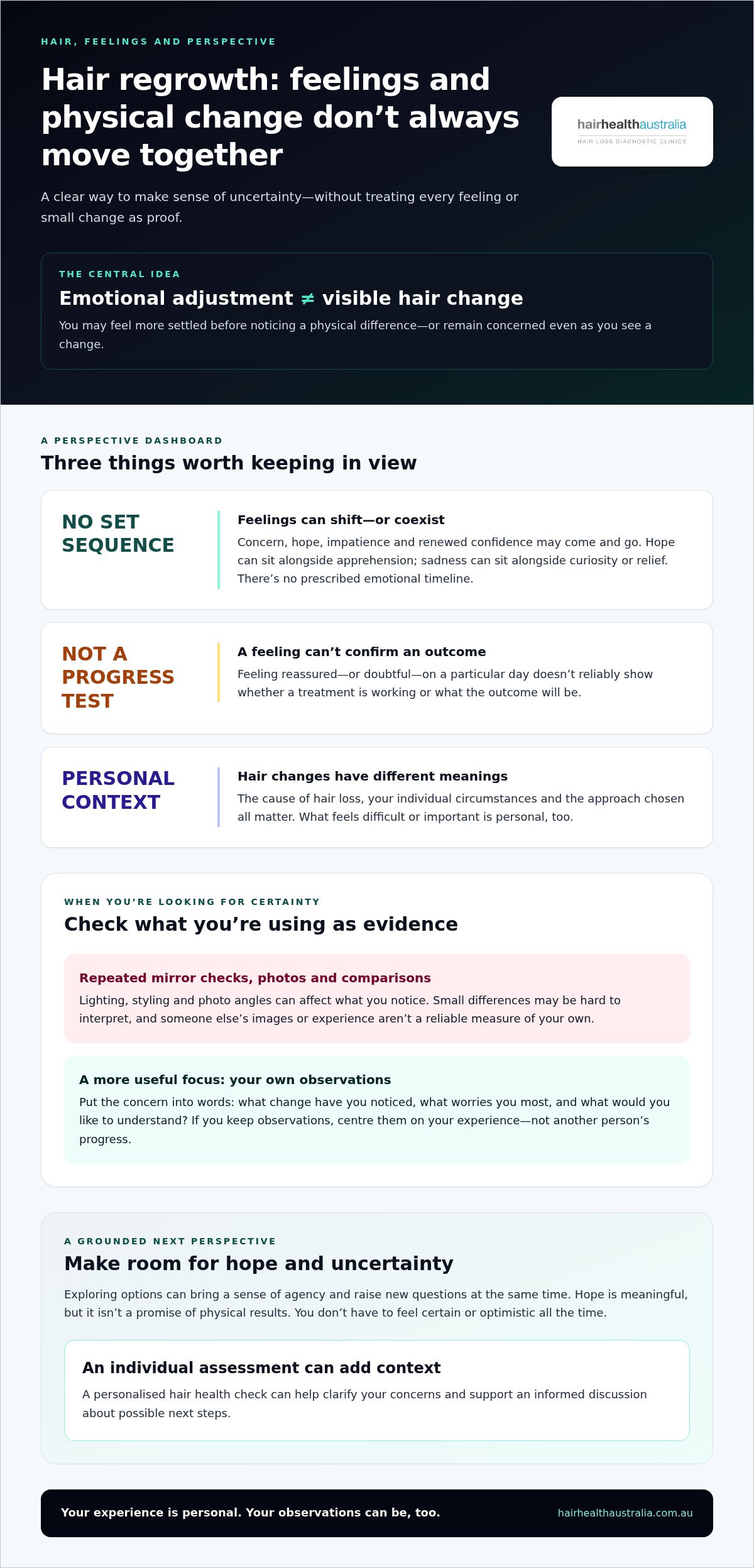
There isn’t a prescribed emotional timeline. You may feel hopeful about exploring options and apprehensive about what treatment might involve. Sadness about the change can sit alongside curiosity or relief at taking a first step. There is no single correct emotional response to hair change; what it means depends on the person, their circumstances and their expectations.
Feelings can shift with circumstances. A photograph or a comment might bring the concern into focus, while a busy week leaves less room to think about it. Neither response proves that you care too much or too little. Notice what you’re feeling without turning it into a judgement about your character or what progress should look like.
If you want a clearer understanding of your situation, a personalised hair health check can help replace guesswork with an individual assessment. Hair Health Australia provides personalised, non-surgical treatment programmes for men and women. Clinical guidance can be one practical next step, while leaving room for your emotional response to unfold in its own way.
What emotions can arise at different points in the hair regrowth journey?
There’s no set emotional sequence to follow. You might move between concern, hope, impatience and renewed confidence, or feel relatively steady while you work out what’s happening. These responses can come and go rather than marking clear stages. The emotional journey of hair regrowth is personal, and feelings don’t reliably indicate whether a treatment is working or what the outcome will be.
Seeking help can bring a sense of agency: you’re gathering information and considering a plan. It can also raise questions about what comes next, whether an approach will suit you and how you’ll feel while waiting. Both reactions can be present at once. Exploring options doesn’t require you to feel certain or optimistic all the time.
From noticing change to seeking answers
Repeatedly checking the mirror, taking photos or comparing your hair with how it looked months ago can seem like a way to find certainty. But lighting, styling and photo angles affect what you notice, so small differences can be hard to interpret. Online comparisons can add to the doubt because other people’s experiences and images aren’t a reliable measure of your own.
Instead, put the concern into words: what change have you noticed, what worries you most, and what would you like to understand? This can make a conversation about your hair more focused. If you choose to keep observations, centre them on your own experience rather than treating someone else’s progress as a benchmark.
Hope, patience and changing expectations
Beginning a plan may feel encouraging because you’ve taken a step towards understanding your hair. That hope is meaningful, but it isn’t a promise of physical results. The cause of hair loss, your individual circumstances and the approach chosen all matter. Avoid treating a particular outcome as certain before receiving individual guidance.
Waiting for visible change can test your patience. Hair can be difficult to assess consistently, and close attention can make every fluctuation feel important. Some days you may feel reassured; on others, you may question whether anything has changed. Neither reaction is a dependable assessment on its own. If uncertainty starts to dominate, a professional discussion can help put your observations in context.
Emotional adjustment and visible hair changes may not move together. You might feel more settled before noticing a physical difference, or remain concerned even as you see a change. There’s no need to make your confidence wait for a particular result. Give yourself room to respond honestly and consider what would help you feel informed and supported now.
If you’re ready to replace guesswork with an individual assessment, a personalised hair health check can help clarify your concerns and support an informed discussion of possible next steps.
How to handle uncertainty when hair regrowth feels slow or unclear
Seeking professional guidance or beginning treatment can offer a sense of direction, but it doesn’t automatically remove worry or self-consciousness. You may still wonder whether you’re seeing a change or feel uneasy about what might happen next. That uncertainty doesn’t mean you’ve made the wrong decision. The emotional journey of hair regrowth can continue alongside practical steps to understand and manage hair loss.
Realistic expectations don’t have to dampen hope. They help you make decisions based on your individual situation, rather than on a promise that progress will be immediate or look a certain way.
Why progress can be difficult to interpret
Hair can look different depending on lighting, styling, how it’s parted and the angle you’re viewing it from. A single photograph or mirror check can create a strong impression without giving a dependable picture of change. If a difference worries you, note what you observed and discuss it with a qualified health professional rather than trying to diagnose the cause yourself.
Separate what you notice from what you fear it means. For example:
- Observation: “My part looks wider in this particular photo.”
- Interpretation: “My hair must be getting worse.”
The observation is something you can describe; the interpretation is a conclusion that may need more context. Keeping that distinction in mind can make conversations about your concerns clearer and less driven by a worrying moment.
When expectations need a reset
Your preferred appearance and the goals discussed as part of your care may not be identical. Explain what matters to you, then clarify how any proposed approach relates to your situation. Different causes and individual circumstances mean no single treatment is right for everyone, and the same plan can’t promise the same result for each person.
A treatment plan can support informed care, but it can’t guarantee a particular physical result or emotional outcome. That honest limit doesn’t remove the value of seeking help; it makes room for decisions grounded in what is known about you.
If you’re unsure what your observations mean, a personalised assessment can help clarify your concerns and support a more informed discussion of possible next steps. Hair Health Australia’s hair health check offers an individual starting point, so you don’t have to draw conclusions from day-to-day impressions alone.
Practical ways to care for yourself during hair regrowth
Small, manageable steps can make the process feel less consuming. Try this adaptable sequence when hair concerns take up more attention than you’d like:
- Name the concern. Write down what’s bothering you, such as uncertainty about a change or discomfort in a particular situation.
- Choose one useful action. Note a question for a clinical conversation, take a break from checking, or speak with someone you trust.
- Review how it feels. Notice whether the action gave you more clarity or ease. If it didn’t help, try a different step next time.
This isn’t a test you need to pass. The aim is to find practical ways to care for yourself, not to make every difficult feeling disappear.
Build a steady, realistic progress routine
If you’re repeatedly inspecting your hair, keep observations and questions in one place for a clinical conversation instead. If you use progress photos, take them in similar lighting, with a similar hairstyle and viewing angle. You don’t need to follow a set photo schedule; consistency matters more than frequent checking. If documenting changes starts to increase distress, it’s reasonable to pause.
Keep other parts of your life in view, too. Make space for activities, relationships and routines that help you feel like yourself, whether that means catching up with a friend, enjoying a hobby or getting on with your day without checking your hair. Hair care can matter without becoming the measure of your whole wellbeing.
Talk about hair loss on your own terms
You can choose whether to share your concerns and how much to say. A simple “I’m thinking through some changes to my hair, and I’d appreciate you listening rather than offering advice” can set the tone. You can also say, “I’d rather not discuss my appearance today.” Trusted support may help, but privacy is a valid choice as well.
It’s fine to set boundaries if repeated questions, comparisons or unsolicited suggestions leave you feeling more self-conscious. A brief response followed by a change of subject can be enough. Respecting personal boundaries is one of the key signs of a healthy relationship, allowing you to feel supported without being scrutinised. Choose the kind of support that feels useful to you.
If distress is persistent, overwhelming or affecting daily life, consider speaking with an appropriate health professional. The emotional journey of hair regrowth can involve practical questions as well as personal ones. A hair health check can provide an individual assessment to help clarify your concerns. Arrange a hair health check to discuss your situation and possible next steps.
How a personalised hair health check can make next steps clearer
When hair changes are difficult to interpret, an individual assessment can help turn broad worries into clearer questions. You may be concerned about shedding, changes in density or how your scalp feels. Rather than assuming one cause or one emotional response, a personalised hair health check gives you space to discuss what you’ve noticed and what you want to understand.
What a personalised assessment contributes
A hair health check can replace guesswork with a more informed discussion of your concerns and possible next steps. You don’t need to arrive with a firm diagnosis or a decision about treatment. Explain what has changed, how it’s affecting you and what you hope to learn. Clearer information can make it easier to weigh options without relying on online comparisons or assumptions about someone else’s experience.
Hair Health Australia provides personalised, non-surgical hair-loss treatment programmes for men and women, with a focus on clinically backed approaches and scalp health. The right conversation starts with your individual circumstances. No programme can promise a particular result, and seeking information doesn’t commit you to treatment.
Choosing a next step without rushing
You can take time to understand your options before deciding whether treatment feels right for you. If you’re a woman exploring changes in your hair, reading about female hair-loss treatment may help you identify questions for a professional discussion. Any approach should be considered in light of your own concerns and circumstances, not as a guaranteed route to a specific appearance.
For Sydney readers seeking professional guidance, a hair health check can be a practical starting point. It can help organise what you’ve noticed into a clearer conversation about possible non-surgical care. You’re allowed to ask questions, take time to consider the information and decide what feels appropriate for you.
The emotional journey of hair regrowth can involve uncertainty even when you’re taking thoughtful steps. A personalised assessment can offer clarity about your situation, while leaving the decision about what to do next in your hands. Book your hair health check to discuss your concerns and explore possible next steps.
Choose a next step that feels right for you
You don’t need to have every answer before taking a step. The emotional journey of hair regrowth isn’t a test of patience or positivity, and your feelings don’t have to match anyone else’s. For now, decide what you’d like to understand better and what kind of support would feel useful.
A conversation about your hair can turn uncertainty into clearer questions. Explain what you’ve noticed, what concerns you and what you hope to learn, then take time to consider the information. Seeking guidance doesn’t mean you have to commit to treatment. It gives you the chance to make a more informed choice based on your own situation.
If you’re ready to take that first step, book your hair health check. Move forward at a pace that feels manageable, with clear information and care that respects your individual needs.
Frequently Asked Questions
Is it normal to feel anxious while waiting for hair regrowth?
Feeling anxious while you wait can be an understandable response to uncertainty, but it doesn’t mean something is wrong with you. Notice whether the worry is occasional or starting to affect sleep, concentration or everyday decisions. If you’re unsure what a physical change means, write down what you’ve observed and raise it with a qualified health professional rather than relying on repeated checking for reassurance.
Can hair regrowth improve confidence straight away?
How long does the emotional journey of hair regrowth take?
There’s no standard duration. Your feelings may change with new information, personal circumstances and how much attention hair concerns are taking in daily life. The emotional journey of hair regrowth may not match the pace of physical changes, so avoid setting a deadline for feeling confident or settled. If you keep notes, include how you’re coping as well as questions about your hair, then discuss both with a health professional.
What if my hair does not regrow as much as I hoped?
If the outcome differs from what you hoped for, it’s reasonable to feel disappointed and ask what that means for your care. Avoid deciding from appearance alone that a plan has failed or that you caused the result. Talk through your concerns and goals with a qualified professional. You can then consider what options, if any, fit your needs without assuming a particular result is achievable.
Can I feel hopeful and upset about hair loss at the same time?
Yes. Hope about seeking answers can exist alongside sadness, frustration or concern about what has changed. These feelings don’t cancel each other out, and you don’t need to choose one as the “right” response. If it helps, tell someone you trust, “I’m hopeful about understanding this, but I’m also finding it hard.” You can ask them to listen without trying to fix the situation.
Should I take photos to track hair regrowth?
Photos are optional, and they’re useful only if recording them doesn’t increase your worry. If you choose to take them, keep them private and label them with the date so you’re less reliant on memory. Don’t treat a photo as a diagnosis or a verdict on your progress. Bring images to a clinical discussion if useful, and ask for help interpreting what they do and don’t show.
When should I seek support for the emotional impact of hair loss?
Consider speaking with a GP or mental health professional if distress persists, feels overwhelming or begins to interfere with work, relationships, sleep or activities you usually value. You don’t need to wait until things feel unmanageable. Sydney readers who also want help understanding their hair concerns can arrange an individual hair health check through Hair Health Australia. If you’re at immediate risk of harm, call 000.