
Minoxidil is not a treatment for every type of hair loss. In Australia, topical minoxidil is approved for hereditary hair loss in women, so minoxidil for women reviews in Australia need to be considered in light of the cause. It may not address non-genetic shedding. Sudden or unexplained hair loss calls for a different approach to hereditary pattern thinning.
It’s understandable to want clear evidence before committing to daily treatment, especially when shedding or early changes can be unsettling. This guide explains what clinical trials in women show, when minoxidil may help, how long results can take to assess, and what ongoing use involves.
You’ll also find an overview of topical strengths and application directions, important safety considerations, and factors that affect minoxidil costs in Australia. The aim is to help you weigh product claims against realistic expectations and understand when identifying the cause of hair loss should come first.
Key Takeaways
- Minoxidil is intended for hereditary pattern hair loss, so identifying the cause matters when shedding is sudden or unexplained.
- Strength and application frequency differ between topical products; follow the directions for the specific formulation.
- Assessing results takes consistent use over several months, and continued use is needed to maintain its effect.
- Clinical trials in women found increased hair counts with topical minoxidil, with results varying by strength and study duration.
- When comparing Australian product costs, consider pack size and how long the supply lasts, as well as the ongoing nature of treatment.
What is minoxidil – and does it work?
Topical minoxidil is approved in Australia for hereditary hair loss in women, but it isn’t a universal treatment for shedding. Its strength, formulation and application schedule matter, and the cause of hair loss shapes whether it’s appropriate.
Minoxidil strengths and application frequency
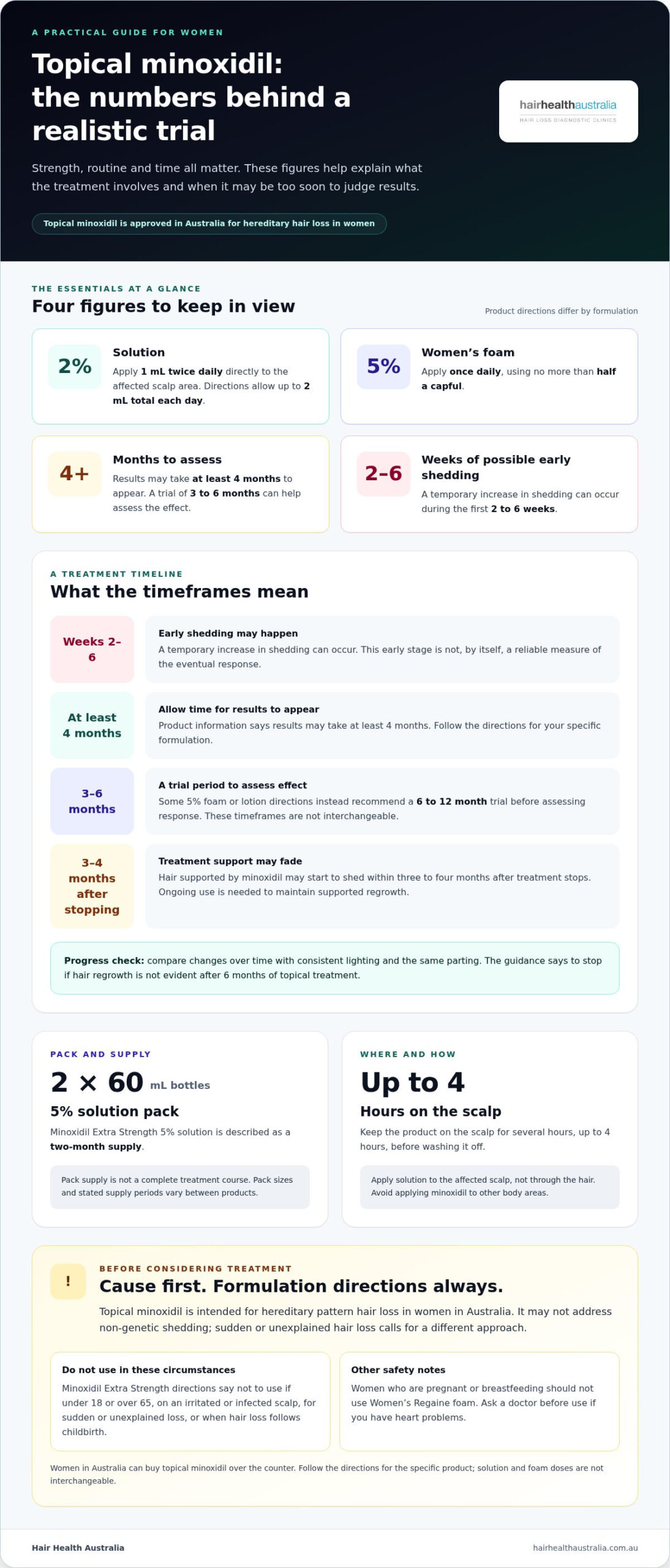
Minoxidil comes in topical strengths of 2% and 5%, with different directions for solution and foam. For women, Australian products include 2% solution and 5% foam. Strength matters because it affects the product directions, dose and frequency, so don’t assume two formulations are interchangeable.
For 2% solution, directions recommend applying 1 mL directly to the affected scalp area twice daily, up to 2 mL total each day. Women’s 5% foam is applied once daily, with no more than half a capful. Some 5% foam or lotion directions recommend a 6 to 12 month trial before assessing response.
Women in Australia can buy topical minoxidil over the counter; it doesn’t require a prescription. Topical products include a 2% solution and 5% foam. For comparison, 20 mg/mL equals 2%, while 50 mg/mL equals 5%. These are scalp treatments, not tablets.
Follow the directions for the specific formulation. Apply solution directly to the affected scalp, rather than spreading it through the hair. Foam has a separate dose: no more than half a capful. Keep the product on the scalp for several hours, up to 4 hours, before washing it off. Avoid applying it to other body areas.
Product directions also set limits for use. Minoxidil Extra Strength shouldn’t be used by people under 18 or over 65, or on a scalp that is red, inflamed, irritated, painful or infected. Don’t use it for sudden or unexplained loss, or when hair loss follows childbirth. Women who are pregnant or breastfeeding shouldn’t use Women’s Regaine foam. Ask a doctor before use if you have heart problems.
Women’s minoxidil review experiences
Australian women’s reviews are personal accounts, not a reliable measure of how well minoxidil works for everyone. Experiences vary: some reviewers focus on visible regrowth, while others describe the effort of daily application or early shedding. That difference matters when weighing anecdotes against clinical evidence.
A temporary increase in shedding can occur during the first 2 to 6 weeks. Product information says results may take at least 4 months to appear, so a review written soon after starting can reflect an early stage, not the eventual response. Reviews also can’t establish whether someone’s hair loss is hereditary, which is the type topical minoxidil is approved to treat in Australia.
Treatment duration and discontinuation
Women may need at least 4 months to see results from minoxidil. A trial of 3 to 6 months helps assess its effect, while ongoing daily use maintains supported regrowth.
Ongoing use and stopping treatment
Minoxidil supports hair growth only while you apply it regularly. Keep this in mind when planning for maintenance, not just the first signs of regrowth.
Hair supported by minoxidil may start to shed within three to four months after you stop. This reflects the loss of treatment support, not a reason to restart or increase the dose without considering the cause of hair loss. If you stop, note when shedding changes and discuss persistent concerns with a health professional.
Pack supply and treatment duration
A pack’s stated supply period helps you understand how product quantity relates to regular use. Pack sizes and stated supply periods vary by product, so check the specific product’s packaging and directions.
Minoxidil Extra Strength 5% solution is sold as two 60 mL bottles, described as a two-month supply. These supply periods differ because the formulations and directions differ. Use the specific product’s directions rather than treating one pack’s duration as a guide for another.
Time to results for women
For women, minoxidil may take at least 4 months before results appear. A 3 to 6 month trial provides time to assess whether treatment is helping, while some 5% foam or lotion directions recommend 6 to 12 months before assessing response.
These timeframes aren’t interchangeable: follow the directions for your formulation. If hair regrowth isn’t evident after 6 months of topical treatment, the guidance says to stop treatment. Avoid judging progress from one day’s shedding; compare changes over time, using consistent lighting and the same parting.
Plan for the daily routine as well as the supply period. Missing applications can affect consistency, while using more than directed won’t shorten the time needed to assess a response. Keep a simple record of applications and visible changes, such as whether your part looks broader or narrower. This gives you a clearer basis for reviewing progress than relying on memory.
Stopping also changes the longer-term picture: hair growth supported by minoxidil may not remain after treatment ends. Consider this ongoing commitment before starting, particularly when comparing a four-month foam supply with a two-month solution supply. Pack duration describes the product supply, not a complete treatment course.
If you’re deciding whether ongoing treatment fits your pattern of hair loss, a hair health check can help you consider the next step. Hair Health Australia’s Female Hair Loss Treatment is relevant when you’re seeking support for female hair loss and want to understand treatment options.
Product price
The cost of topical minoxidil in Australia depends on the formulation, pack size and supply period. Compare the quantity with the stated duration, rather than treating a lower shelf price as better value. Treatment also involves continued use, so the upfront pack cost is only one part of the longer-term decision. Retailer, pack configuration and promotional offers can all affect what you pay.
Women’s Regaine foam comes in 60 g aerosol cans. A two-can pack is described as a four-month supply. Minoxidil Extra Strength 5% solution is sold as two 60 mL bottles, described as a two-month supply. These stated durations help you compare pack sizes, but the products have different formulations and application directions.
For a practical comparison, record each product’s strength, formulation, pack size and stated supply duration. Foam and solution may not last equally long, so shelf prices alone don’t show the relative cost of regular use. The application schedule also affects how quickly you use a pack. Follow the product directions rather than applying less to make a supply last longer.
The search phrase “minoxidil for women reviews Australia” may lead to retailer listings with different pack formats or promotional offers. Treat a displayed discount as a current offer, not a reliable guide to future purchases. Before comparing listings, check that they refer to the same formulation and quantity. Then consider how often you’ll need to replace the pack, based on its stated supply period.
Pack sizes and storage
Pack size affects replacement frequency and the amount of product you’ll store. The two 60 g Women’s Regaine foam cans are described as a four-month supply, while two 60 mL Minoxidil Extra Strength bottles are described as a two-month supply. This distinction helps with purchase planning, but neither pack duration represents the full length of treatment.
Storage instructions matter alongside pack size. Women’s Regaine foam should be stored below 25°C, and its listed shelf life is 1095 days. Keep the product below that temperature and follow its label for storage and use. Australian heat can make storage conditions especially relevant, such as when choosing where to keep a pack at home.
Minoxidil is intended to stimulate hair growth in hereditary hair loss, not address every cause of thinning. That distinction matters when weighing repeated product purchases. The search phrase “minoxidil for women reviews Australia” can surface personal experiences, but a review alone can’t establish whether the product suits a particular pattern of hair loss.
To compare options, weigh formulation, pack size, supply duration and the ongoing daily routine together. This gives you a more useful picture of value than a temporary promotion or shelf price alone. Consider storage requirements too, especially if your usual storage area may exceed the stated temperature limit.
5% Minoxidil solution
Minoxidil Extra Strength is a topical 5% solution for the scalp. Each millilitre contains 50 mg of minoxidil, and the product is registered in Australia as AUST R 82363. Topical minoxidil is approved for hereditary hair loss in women and men. It isn’t a general treatment for every type of alopecia or baldness.
The directions recommend applying 1 mL directly to the affected scalp area twice daily. Don’t exceed 2 mL total in one day. Apply the solution to the scalp, not along the hair shafts or elsewhere on the body. Regaine should remain in contact with the scalp for several hours, up to 4 hours.
Consistency matters more than using extra solution. Applying more than directed won’t make the treatment work faster and exceeds the recommended daily dose. The two 60 mL bottles are described as a two-month supply when used as directed. That pack duration reflects the twice-daily application schedule.
Some users notice increased hair shedding during the first 2 to 6 weeks. This temporary change can occur early in minoxidil treatment, so it may be confusing if thinning appears more noticeable at first. Track changes over time rather than responding by increasing the dose. Product information says results may take at least 4 months to appear.
The solution contains 56.46% w/w ethanol. On average, 1.7% of an applied topical solution dose reaches systemic circulation. These product details don’t change the scalp application directions. Avoid applying the solution to skin beyond the intended scalp area, and follow the product label for use.
Minoxidil Extra Strength shouldn’t be used by people under 18 or over 65. Don’t apply it to a scalp that is red, inflamed, irritated, painful or infected. The directions also advise against use during pregnancy or breastfeeding, for sudden or unexplained hair loss, or when there’s no family history of hair loss. Stop use if an allergic reaction occurs.
Hair loss following childbirth is another reason not to use this product. Women who are pregnant or breastfeeding should also avoid Regaine Women’s foam. If you have heart problems, ask a doctor before using minoxidil. These precautions matter because the treatment is intended for hereditary pattern hair loss, not every cause of shedding.
Topical minoxidil isn’t effective where the hair follicle is gone, such as after a burn injury. That distinction is important: a 5% strength doesn’t make the solution suitable for every bald area. Match the product directions to the pattern and cause of hair loss, and don’t use it on parts of the body other than the scalp.
Clinical trial results in women
Clinical trials give a clearer measure than individual reviews of hair thinning. In women with androgenetic alopecia, studies compared topical 2% and 5% minoxidil against placebo. They measured nonvellus hair counts, meaning thicker hairs rather than fine, short hairs. These results help explain what treatment can change, but a hair-count increase isn’t the same as a guaranteed visible difference.
In a 36-week study, mean nonvellus hair counts increased by 18 hairs per square centimetre with 5% minoxidil. The 2% group increased by 15 hairs per square centimetre, while the placebo group increased by 3. In a separate 48-week study, increases were 25 with 5%, 21 with 2%, and 9 with placebo. Both studies reported greater average increases with minoxidil than placebo.
The comparison also puts the strength question in context. The 5% group had higher average counts than the 2% group in both studies, but these figures don’t mean every woman will see the same change. They describe group averages at specific study endpoints. A person’s experience, including any visible improvement, can’t be read directly from those averages.
An analysis of randomised controlled trials found that twice-daily topical minoxidil increased hair counts by eight to 15 hairs per square centimetre. That range offers broader evidence alongside the 36-week and 48-week comparisons. Read together, the findings support topical minoxidil for hereditary pattern hair loss, rather than every cause of shedding or baldness.
Oral minoxidil needs separate interpretation. A 2020 systematic review identified 17 studies involving 634 patients using oral minoxidil for various hair-loss conditions. That review wasn’t limited to women or one diagnosis. Oral minoxidil is approved in Australia for high blood pressure, not hair loss, so oral findings shouldn’t be treated as equivalent to evidence for topical treatment.
Low-dose oral studies in female pattern hair loss reported hair-density improvement from 12% at 24 weeks, with higher results also reported. This finding concerns oral treatment, not the topical 5% solution or Regaine foam. Keeping formulation and route distinct prevents a review or study result from being applied to the wrong product.
The practical takeaway is to compare evidence by diagnosis, formulation, strength and study duration. The 2% and 5% topical groups both showed average increases over placebo in the cited studies. A hair health check can help you consider whether your pattern of thinning aligns with hereditary hair loss before choosing a treatment approach.
Hair Health Australia: Male Hair Loss Treatment
Hair Health Australia offers Female Hair Loss Treatment for women considering support beyond topical minoxidil. This may be a useful next step if you’re weighing ongoing treatment or want to explore options for thinning hair. Hair loss can have different causes, so treatment should match the concern rather than rely on reviews alone.
Hair Health Australia also offers Male Hair Loss Treatment, although this article focuses on women’s hair loss. Understanding the difference between hereditary pattern thinning and other forms of shedding can help guide your next decision. Visit Hair Health Australia online to explore its hair loss treatment options.
Choose a next step that fits your situation
Choosing a hair-loss treatment is about more than selecting a product. It also means deciding what changes to track, how treatment fits your routine, and what you’ll do if the pattern continues. Reviews of minoxidil for women in Australia can help you prepare questions, but personal accounts can’t establish why your hair is thinning. Focus on understanding the cause before settling on an approach.
Before starting or changing a routine, note what you’ve noticed and when it began. Record whether thinning is gradual, affects a particular area, or appeared suddenly. These observations give you a clearer starting point for discussing your concerns and considering what comes next. If hair loss is sudden or unexplained, prioritise understanding the change rather than relying on product reviews alone. Much like addressing other personal health and cosmetic goals—such as consulting Crystal Bright Smile for restorative or cosmetic dental care—taking a proactive, expert-guided approach helps ensure you achieve the best outcome.
A hair health check can help you organise your concerns into a more focused next step. Arrange a hair health check to explore your options with Hair Health Australia. Taking the time to understand your hair loss can help you move forward with greater clarity.
Frequently Asked Questions
Can I use it for non-genetic balding?
Topical minoxidil is intended for hereditary pattern hair loss, not every form of balding. It won’t restore hair where follicles have been destroyed, such as after a burn injury. Product directions also say not to use Minoxidil Extra Strength for sudden or unexplained hair loss, or hair loss due to childbirth. Identifying the cause matters before choosing a treatment.
What else do I need to know?
Oral and topical minoxidil aren’t interchangeable. In Australia, oral minoxidil is approved for high blood pressure, not hair loss. Topical products are applied to the scalp, and directions prohibit applying Minoxidil Extra Strength elsewhere on the body. Read the specific product instructions before use, including restrictions relating to age, scalp irritation, pregnancy and breastfeeding.
How much does women’s minoxidil cost in Australia, including prices by brand and retailer?
Australian retail prices vary by product, retailer, pack format and promotions, so compare current listings rather than relying on an old review. Consider the stated supply period as well as the shelf price: products can differ in formulation and application frequency. This helps you assess ongoing costs without assuming a discounted price will continue.
How effective is minoxidil for female pattern hair loss, and what results do clinical studies show?
Clinical studies found higher average hair counts with topical minoxidil than placebo among women with hereditary pattern hair loss. In one 36-week study, counts increased by 18 hairs per square centimetre with 5% minoxidil, 15 with 2%, and 3 with placebo. These are group averages, not a prediction of an individual woman’s visible regrowth.
What are the side effects and risks of minoxidil for women, including unwanted facial hair and shedding?
Temporary increased shedding can occur during the first 2 to 6 weeks of treatment. Apply minoxidil only as directed to the scalp, and wash your hands after application to avoid transferring product to other areas. Product directions say to stop if an allergic reaction occurs. Don’t apply Minoxidil Extra Strength to an irritated, painful, inflamed or infected scalp.
How should women apply topical minoxidil safely, and what dosage is recommended?
For topical solution, the recommended dose is 1 mL on the affected scalp area twice daily, with no more than 2 mL total daily. Women’s 5% foam is applied once daily, using no more than half a capful. Apply to the scalp rather than the hair, follow the chosen product’s directions, and avoid use on damaged or irritated skin.
How do women’s minoxidil foam and solution compare in reviews, effectiveness and ease of use?
Foam and solution differ in application schedule and formulation. Women’s foam is applied once daily, while solution directions commonly specify twice-daily use. Foam absorption is approximately 50% of absorption from a similar dose of solution, but that figure doesn’t establish which option is more effective for an individual. Reviews can help describe texture or routine preferences, not prove comparative results.
Can women use minoxidil while pregnant or breastfeeding, or with other hair-loss treatments?
Women’s Regaine foam and Minoxidil Extra Strength directions advise against use during pregnancy or breastfeeding. If you’re considering minoxidil alongside another hair-loss treatment, discuss the combination with a health professional and share the names of your medicines. This is particularly relevant if treatment includes prescription medicines, since suitability depends on the specific combination and your health circumstances.