
Could choosing a male diffuse thinning treatment before understanding the cause lead you down the wrong path? Noticing less density across your scalp can be unsettling, especially when it’s unclear whether the change has been gradual or sudden. Online advice can add to the confusion, with different claims about results, side effects and long-term commitment.
The right next step is to understand what may be driving the thinning. Diffuse hair loss can have different causes, and the pattern, timing and changes in your health or routine can all help guide an assessment. A treatment that may suit one cause might not be appropriate for another.
This article explains why individual assessment matters, what information to bring to a hair health appointment and what questions to ask a professional in Sydney. You’ll also learn how to compare treatment pathways, including non-surgical options, with realistic expectations. Hair Health Australia provides personalised male hair-loss treatment in Sydney, but no approach can promise regrowth or a particular result. A clear discussion of your concerns, possible options and potential risks can help you make an informed decision.
Key Takeaways
- Compare changes in density across your scalp with older photos to help describe the pattern and when you first noticed it.
- Genetic pattern hair loss and temporary shedding are among the possible causes, so a similar appearance doesn’t confirm the reason.
- Bring notes about your thinning timeline, symptoms and relevant health changes to an assessment.
- Discuss how each male diffuse thinning treatment option relates to the suspected cause, including its limitations and potential risks.
- Use your appointment in Sydney to ask what assessment involves, what options may suit you and what expectations are realistic.
What male diffuse thinning looks like, and why the pattern matters
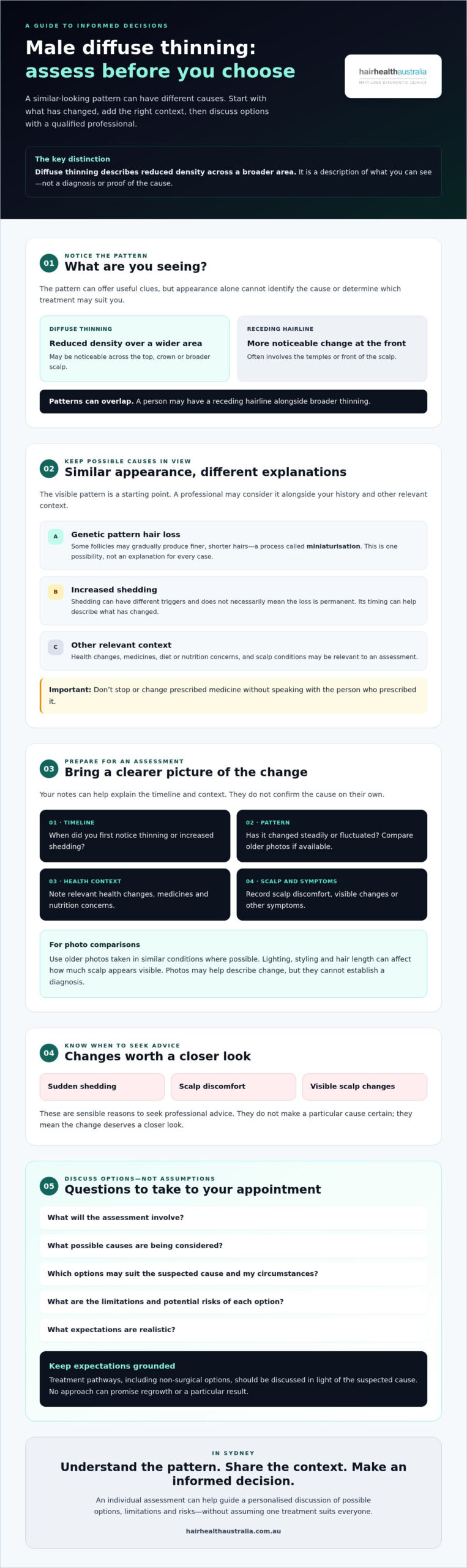
Thinning across the scalp can feel different from watching the hairline recede. You may notice less coverage over a wider area, rather than a clear change at the temples. The pattern can offer useful clues, but appearance alone can’t identify the cause or show which male diffuse thinning treatment may be suitable.
Pattern vs cause
Diffuse thinning describes reduced hair density across a broader scalp area. It’s a way of describing what you can see, not a diagnosis. The underlying cause needs to be considered separately.
How diffuse thinning differs from a receding hairline
A receding hairline usually involves more noticeable change around the temples or front of the scalp. With diffuse thinning, reduced density may be easier to spot across the top or crown, or over a wider area. Individual patterns vary, and the two can overlap: a person may have a receding hairline alongside broader thinning. For background on one common form of patterned loss, see Pattern hair loss. A guide to men’s hair-loss patterns can offer a closer comparison.
What changes should prompt closer attention?
Note when you first noticed the change and whether it has continued steadily or fluctuated. You could also record whether you’ve seen more hair shedding than usual, and when it began. These details help describe what’s happening, but can’t confirm the reason on their own.
Sudden shedding, scalp discomfort or visible changes to the scalp are sensible reasons to seek professional advice. This doesn’t mean a particular cause is certain; it means the change deserves a closer look. A professional can consider the pattern alongside your history and other relevant context before discussing next steps. In Sydney, a hair health check can provide an opportunity to discuss your individual pattern and possible options.
Why male diffuse thinning can have more than one cause
A similar spread of reduced density can develop through different processes. Genetic pattern hair loss may gradually affect follicle growth, while increased shedding can make hair look thinner over a shorter period. Health changes, medicines, nutrition and scalp conditions may also be relevant context for a professional assessment. The visible pattern is a starting point, not enough information to select a treatment.
Appearance alone cannot confirm the cause of diffuse thinning. That distinction matters because a male diffuse thinning treatment should be considered in light of the suspected cause, your health history and individual circumstances, rather than chosen from appearance alone.
Gradual thinning and hair follicle miniaturisation
With genetic pattern hair loss, some follicles can gradually produce finer, shorter hairs. This process is called miniaturisation. As the hairs become less substantial, overall coverage may reduce, sometimes without a clearly defined bald patch. Genetic hair loss is one possibility, not an explanation for every case of diffuse thinning.
Slow changes can be hard to recognise from day to day. Hair length, styling and lighting can also affect how much scalp appears visible. Consistent photos taken in similar conditions may help you describe changes over time, but they can’t establish a diagnosis.
Shedding, health changes and other possible contributors
Increased shedding can have different triggers and doesn’t necessarily mean the loss is permanent. A qualified health professional can consider whether the timing might relate to changes in your health, medicines, diet or scalp, among other factors. Don’t stop or alter prescribed medicine without speaking with the person who prescribed it.
Before an appointment, note when shedding or thinning began and list relevant health changes, medicines and nutrition concerns. Share any scalp symptoms or visible changes, too. These details provide context, but don’t prove a cause. Any specific cause, need for tests or likely recovery timeframe depends on individual assessment and should be discussed with a qualified professional.
If you’re unsure what your pattern may indicate, a hair health check can be a starting point for discussing your concerns and possible next steps. Assessment can help guide a personalised approach, without assuming that one treatment will suit everyone.
How to assess male diffuse thinning before choosing treatment
Choosing a treatment before the cause is reasonably understood can lead to a poor fit. A male diffuse thinning treatment should be considered in context: the pattern, how it has changed, your health history and any scalp symptoms all matter. A professional may review your history and scalp findings, but the assessment process can vary. Ask what each step can and can’t establish.
What information to prepare before an appointment
A few clear notes can make the conversation more useful. Use this framework to organise what you’ve noticed:
- Pattern: Note where density seems reduced, such as across the top, crown or a wider area. Mention whether the hairline has changed as well.
- Timeline: Record when thinning or shedding began and whether it has continued steadily, appeared suddenly or fluctuated. Photos taken in similar conditions may help you compare changes over time.
- Symptoms: Write down any scalp discomfort or visible changes, and when they occur.
- Health context: Bring a current list of medicines and supplements, and note relevant health or nutrition changes. Don’t stop prescribed medicine without advice from the prescriber.
Prepare questions, too: What possible causes fit my pattern? What remains uncertain? Which options may be suitable, and what risks, limitations or follow-up should I understand?
What an individualised assessment should clarify
Ask how your history and observed pattern inform the working explanation, and which findings support it. A scalp image, scan or single test shouldn’t be assumed to identify every possible cause. If the picture is unclear, ask whether further medical advice or assessment is appropriate before deciding on treatment.
Assessment methods differ, so check what a provider uses and what the results can tell you. For more background on one technique, consult a guide to microscopic hair analysis, while keeping in mind that a single method doesn’t replace consideration of your wider history. Specialised services such as rootedscalpclinic.co.uk illustrate how personalised scalp analysis can also be paired with cosmetic solutions to achieve fuller-looking hair.
The aim isn’t to force a quick answer. It’s to understand what is known, what needs further review and why a particular option is being discussed. In Sydney, a hair health check can be a starting point for discussing your individual pattern and possible next steps.
Male diffuse thinning treatment options: compare them by cause and suitability
There isn’t one treatment pathway for every pattern of diffuse thinning. Options depend on the suspected cause, your health circumstances and what an appropriate professional considers suitable. Use this comparison to prepare questions, not to self-diagnose or choose treatment without advice.
| Treatment category | Intended context | Discussion points | Limitations |
|---|---|---|---|
| Clinician-guided treatment for genetic pattern loss | When assessment supports a pattern consistent with genetic hair loss | Ask about suitability, potential side effects, precautions, monitoring and ongoing commitment. | May not address other causes of shedding; response and suitability vary between individuals. |
| Management of an identified health or nutritional contributor | When history or professional assessment suggests a relevant factor to investigate or address | Discuss what evidence supports the suspected contributor and whether medical follow-up is appropriate. | Changing supplements or medicines without advice may be unsuitable; improvement cannot be assumed. |
| Care for a scalp condition | When scalp symptoms or findings need professional review | Ask what the findings suggest and whether a qualified health professional should assess them. | A visible scalp change alone doesn’t confirm a specific condition or treatment. |
| Observation and review | When the cause or pattern remains uncertain and monitoring is recommended | Agree what changes to track and when to seek further advice. | Monitoring doesn’t establish a diagnosis or guarantee that thinning will resolve. |
Questions to ask about clinician-guided options
For any proposed male diffuse thinning treatment, ask why it fits your assessed pattern and what alternatives have been considered. Discuss possible side effects, contraindications, follow-up and ongoing commitment before deciding. Specific medicines, precautions and availability should be checked against current Australian guidance with an appropriate health professional. Don’t self-prescribe or change prescribed treatment based on online advice.
Be cautious of one-size-fits-all promises
An option considered for genetic pattern loss may not address shedding linked to another factor. Be wary of guarantees, dramatic timelines or testimonials presented as evidence of what will happen for you. A more useful conversation explains the reasoning, uncertainties and realistic limits of each option. For broader context, consult a clinical hair-treatment guide or an Australian hair-regrowth reference, and check that information against current professional advice.
Hair Health Australia offers personalised, non-surgical hair-loss treatment programmes in Sydney. To discuss your individual pattern and possible next steps, arrange a hair health check. Assessment can help inform a plan, but no particular result can be promised.
Your next steps for male diffuse thinning treatment in Sydney
If you’re weighing up what to do next, you don’t need to arrive with a diagnosis or a preferred treatment. The useful first step is to understand what the thinning may relate to and what information could guide a suitable discussion. An assessment may be worth considering if the change concerns you, is continuing or is accompanied by symptoms. If you’re unsure, you can still ask what kind of advice is appropriate.
Questions to ask before starting a treatment programme
Use an appointment to understand the reasoning behind any proposed plan, not just its name. These questions can help you make a considered decision:
- What pattern or possible cause is this programme intended to address? Ask how your history and observed changes inform that explanation.
- What information is needed to personalise recommendations? Find out whether you should bring notes about timing, health changes, medicines or supplements.
- What are the limitations and potential risks? Ask what the approach may not address, what concerns to watch for and when to seek further advice.
- How will progress be reviewed? Clarify what follow-up involves, what changes will be considered and who to contact if you have concerns.
You can also ask what remains uncertain. A clear explanation should distinguish between what is known about your situation and what would need further professional input. Take time to consider the answers before committing to a plan.
How to take the next step with Hair Health Australia
Hair Health Australia provides personalised, non-surgical male hair-loss treatment in Sydney. A hair health check can be a starting point to discuss your individual pattern and possible next steps. It’s reasonable to ask what information is needed, what the check can help explore and whether further medical advice may be appropriate. No single approach suits everyone, and a discussion should not be taken as a promise of regrowth or a particular result.
If you’re ready to explore your options, complete a hair health check. It can help open a conversation about whether a personalised male diffuse thinning treatment pathway may be relevant to your circumstances. From there, decisions can be made with realistic expectations, based on your needs rather than a one-size-fits-all claim.
Make your next step an informed one
Diffuse thinning describes a change in hair density, not the reason behind it. Because similar patterns can have different causes, the most useful next step is to discuss your timeline, symptoms and relevant health context with a professional before choosing a male diffuse thinning treatment.
In Sydney, Hair Health Australia offers personalised, non-surgical male hair-loss treatment programmes. A hair health check can help you discuss your individual pattern and explore possible next steps. Ask what an option is intended to address, what its limitations may be and how progress would be reviewed. No treatment can guarantee regrowth or a particular outcome, so clear information and realistic expectations matter.
Ready to start that conversation? Complete a hair health check to discuss your next steps with Hair Health Australia. You can take things one informed decision at a time.
Frequently Asked Questions
What causes diffuse thinning in men?
Diffuse thinning in men can have several possible contributors, including genetic hair loss, increased shedding, health changes, medicines or scalp conditions. The visible pattern alone can’t confirm which explanation applies. A professional can consider when the change began, your health history and scalp findings before discussing options. Bring a current list of medicines and supplements, and don’t start or stop prescribed medicines based only on online information. Ask an appropriate health professional for advice about your circumstances.
Can diffuse thinning in men grow back?
Whether hair density improves depends on the cause, how long the change has been present and how you respond to an appropriate plan. Some shedding may be temporary, while other forms of hair loss may need ongoing management. No treatment can guarantee regrowth for every person. Ask a qualified professional what outcomes are realistic in your case, what limitations to expect and how progress would be reviewed. If the cause is unclear, discuss that before choosing an approach.
Is diffuse thinning the same as male pattern baldness?
No. Diffuse thinning describes reduced density across a broader area, while male pattern hair loss often follows recognisable patterns. However, patterns can overlap, and different causes may look similar. A label or photograph can’t confirm what’s causing your thinning. If the change is new, progressing quickly or accompanied by scalp symptoms, seek professional advice. Describe when you first noticed it and how it has changed, rather than relying on appearance alone to choose a treatment.
How is diffuse thinning diagnosed?
Assessment usually begins with questions about when thinning started, how it has changed, your health history and relevant medicines. A professional may also examine your hair and scalp, and consider further checks if appropriate. The process depends on your circumstances and the provider, so ask what an appointment includes and what its findings can establish. No single visual check should be treated as a guaranteed way to identify every possible cause.
What is the best treatment for male diffuse thinning?
There’s no single best option for everyone. A suitable male diffuse thinning treatment depends on the likely cause, your health context, preferences and potential risks. Ask a qualified professional why an option may suit your situation, what limitations or side effects to consider, and how its suitability will be reviewed. Be cautious of guaranteed results or recommendations made without considering your circumstances. Treatment choices should follow an individual discussion, not a one-size-fits-all claim.
When should I seek professional advice about diffuse thinning?
Consider seeking advice if thinning persists, changes, causes concern or is difficult to explain, particularly if it begins suddenly or occurs with scalp symptoms or other health changes. This doesn’t automatically mean the cause is serious, but a discussion may help clarify what to consider next. In Sydney, Hair Health Australia’s hair health check can help you explore your individual pattern and possible next steps. Ask what the check can clarify and whether further medical advice may be appropriate.