
What if a widening part or thinner-looking hairline isn’t enough to tell you what’s happening? If you’re searching for how to check for hair miniaturization, you’re not alone: subtle changes can be hard to judge in the mirror, and online photos can make normal variation seem worrying. Shedding, breakage and gradual changes in hair thickness can also be difficult to distinguish by sight alone.
A home check can help you record patterns, but it can’t confirm the cause. Hair miniaturisation involves finer, shorter hairs developing over time, while shedding and breakage have different signs. One look at your scalp, or a handful of loose hairs, won’t give you the full picture.
This guide explains what to look for without turning observations into a self-diagnosis. You’ll learn how to compare photos consistently, distinguish possible miniaturisation from shedding and breakage, and decide when a professional assessment may help. The aim is a useful next step, not a reason to scrutinise every strand.
Key Takeaways
- Hair miniaturisation can involve finer, shorter hairs, but differences in hair thickness are a clue, not a diagnosis.
- For how to check for hair miniaturization at home, use consistent lighting and compare the same scalp areas over time rather than relying on one glance.
- Compare possible miniaturisation with shedding and breakage carefully. The signs can overlap, so treat them as observations.
- Record when changes began, which areas are affected and any patterns you notice to make a professional discussion more useful.
- An assessment considers your observations alongside relevant history and examination findings before suitable options are discussed.
What is hair miniaturisation, and what might you notice?
Hair miniaturisation is a gradual change in the hairs a follicle produces, often making them finer and shorter. It’s a visible clue, not a diagnosis. The change can be slow, making it difficult to spot from one day to the next. You might notice that hair looks less substantial in one area, or that more hairs there appear fine compared with nearby strands. These observations can prompt questions, but they can’t confirm why the change is happening.
Hair miniaturisation is associated with androgenetic alopecia, but appearance alone can’t establish that condition or predict what may happen next. Hair thickness naturally varies across the scalp and between people. A pattern of varied hair calibre may be worth discussing in context, rather than treated as proof. This overview of androgenic alopecia and hair miniaturisation provides background on the terminology and its relationship to pattern hair loss.
What changes in a miniaturising hair follicle?
A follicle affected by miniaturisation produces hairs that may become progressively finer and often shorter-growing. In practical terms, some strands in an area can look less robust than neighbouring hairs, even while others remain thicker. The difference may be subtle, particularly if you usually see your hair under changing lighting or styling conditions.
Because the change develops gradually, a single mirror check may tell you little. Hair length, parting, dampness and how your hair sits can all affect how much scalp is visible. An area that seems thinner doesn’t reveal the cause or show whether the pattern will progress. If you’re considering how to check for hair miniaturization, look for changes over time rather than relying on one striking image or comparing your hair with someone else’s.
How can miniaturisation look different from shedding or breakage?
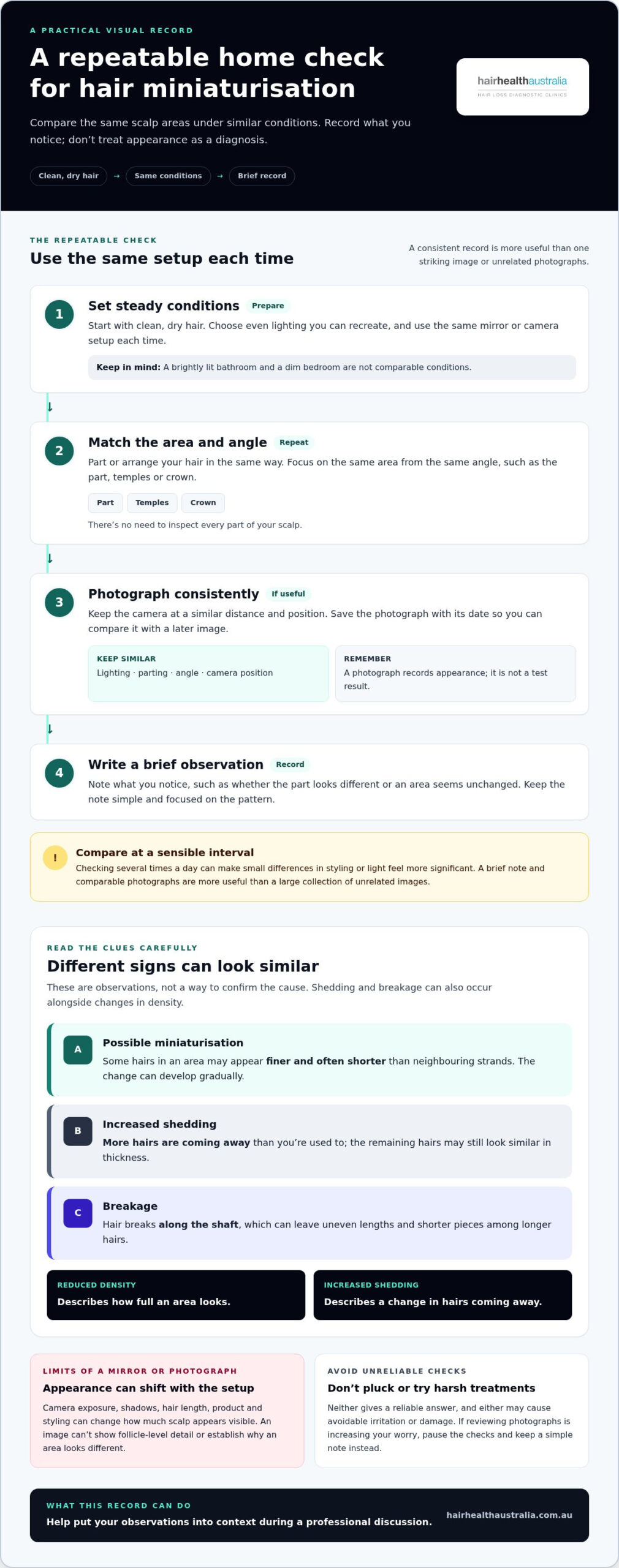
The distinction is useful, but it isn’t always clear by sight. Miniaturisation concerns a change in the thickness and often the length of hairs produced in an area. Increased shedding means more hairs are coming away than you’re used to, while the remaining hairs may still look similar in thickness. Shedding can happen for reasons unrelated to miniaturisation.
Breakage happens along the hair shaft, rather than involving a whole hair being shed from the scalp. It can leave strands at uneven lengths, with shorter pieces among longer hairs. Styling, handling and other factors may contribute, so uneven lengths don’t identify the cause on their own. Shedding and breakage can also occur alongside changes in density, making a visual check uncertain.
In short, reduced density describes how full an area looks; increased shedding describes a change in hairs coming away. Neither observation alone confirms miniaturisation or androgenetic alopecia. A hair health check with Hair Health Australia can help put your observations into context, rather than drawing a conclusion from appearance alone.
How to check for hair miniaturisation at home
A home check is most useful as a consistent record of what you can see, not as a way to diagnose the cause. If you’re wondering how to check for hair miniaturization, compare the same areas under similar conditions. A change that appears in one photograph but not another may reflect the setup, not a change in your hair.
A repeatable visual check: lighting, areas and photographs
Start with clean, dry hair and choose even lighting you can recreate. Avoid comparing a brightly lit bathroom mirror with a dim bedroom photo. Keep your parting consistent and focus on areas relevant to your concern, such as the part, temples or crown. There’s no need to inspect every part of your scalp.
- Choose a place with steady lighting and use the same mirror or camera setup each time.
- Part or arrange your hair in the same way, then inspect the same area from the same angle.
- If you take a photograph, keep the camera at a similar distance and position. Save it with the date.
- Write a brief note about what you notice, such as whether the part looks different or one area seems unchanged.
Compare at a sensible interval rather than checking several times a day. Frequent inspection can make small differences in styling or light feel more significant than they are. A brief note and comparable photographs are more useful than a large collection of unrelated images.
What a mirror or phone photograph cannot tell you
Images have limits. Camera exposure, shadows, hair length, product and styling can all change how much scalp appears visible. A photograph also can’t show follicle-level detail or establish why an area looks different. Treat it as a record of appearance, not a test result, and don’t draw a firm conclusion from a single image.
Don’t pluck hairs to inspect them or try harsh treatments to see whether the appearance changes. Neither gives a reliable answer, and either may cause avoidable irritation or damage. If reviewing photos is increasing your worry, pause the checks and keep a simple note instead. For background on what a formal hair-loss evaluation may involve, see the Mayo Clinic’s information on hair loss diagnosis and treatment.
If your notes or photographs leave you unsure, a hair health check can help put the changes you’ve observed into context. The aim is to discuss the pattern alongside other relevant factors, not to treat a phone photo as a diagnosis.
Miniaturisation, shedding or breakage: compare the clues carefully
Thinning describes a change in how full your hair looks, but doesn’t explain why it’s happening. The clues may relate to finer hairs developing over time, more hairs being shed, damage to the hair shafts, or a combination. Similar visible changes can have different causes, so appearance alone can’t confirm what’s behind them.
Use the comparisons below to organise what you’ve noticed, not to diagnose the cause yourself.
| Pattern | Possible clue | What it may suggest |
|---|---|---|
| Miniaturisation | A mix of finer and thicker hairs in an area, with coverage that may seem to change gradually | Hairs may be changing in calibre over time. This can occur in androgenetic alopecia, but the observation alone doesn’t establish the cause. |
| Shedding | More hairs than usual coming away during washing, brushing or other routine handling | This concerns hair release from the scalp, rather than simply a change in the thickness of hairs that remain. |
| Breakage | Shorter strands of uneven lengths among longer hairs | The hair shaft may be breaking. This appearance doesn’t identify why it’s happening. |
Clues that may point towards finer hair over time
If some hairs in an area seem noticeably finer than others, and the overall coverage appears to change gradually, that’s a useful observation to record. It isn’t proof of miniaturisation: natural variation and other factors can affect how hair looks. There’s no universal visual threshold to apply at home. Focus instead on whether a consistent pattern emerges when you compare the same area under similar conditions.
Clues that may fit shedding or hair-shaft breakage instead
Shedding refers to hairs coming away, while breakage involves damage along the hair shaft. Short, uneven strands could fit breakage, but they don’t confirm it. Shed hairs and changes in density can also be noticed at the same time. The distinction may not be clear from a mirror check, particularly when several changes overlap.
Androgenetic alopecia is one possible context for miniaturisation, not a catch-all explanation for thinning. Other causes may also affect hair density or shedding, and the right interpretation depends on the broader picture. “It looks thinner” is a starting observation, not a diagnosis.
As part of how to check for hair miniaturization, note whether the change seems gradual or sudden, where it appears, and whether you’re also noticing more shedding or uneven short hairs. Seek professional advice if the change is persistent, sudden, worsening or otherwise concerning. A clinician can consider your history and examine the pattern rather than relying on one visible clue.
Track changes and when to seek professional advice
A brief record can make a conversation about hair changes clearer, especially if they’ve been gradual or difficult to describe. It shows what you’ve noticed and when, but it can’t determine the cause. A clinician considers your history and examination findings together, rather than relying on one photograph or home observation alone.
What information is useful to record before an appointment?
Keep notes factual and concise. You don’t need to monitor every strand or decide whether a change is miniaturisation. Record observations that may help explain the pattern:
- When you first noticed a change, and whether it seems stable, gradual or more rapid.
- Which areas appear affected, such as the part, temples or crown, if relevant.
- Whether you’ve noticed more hairs coming away, uneven shorter hairs, or a change in apparent coverage.
- Any recent changes in hair care, medication or general health, or significant health events. Note the timing without assuming these caused the hair change.
- Any photographs you’ve taken consistently, including when they were taken and whether lighting or styling differed.
If a detail is uncertain, mark it as uncertain rather than trying to fill in the gaps. These notes support discussion; they don’t prove a particular diagnosis.
When is a professional opinion more useful than continued self-checking?
Consider seeking an assessment if a change persists, seems to progress, or remains hard to interpret despite keeping a consistent record. A professional can consider the pattern alongside relevant health and hair history, and decide whether further evaluation is appropriate. Independent clinics and healthcare providers, such as meralipharmacyandclinic.co.uk, offer consultations where patients can discuss general health concerns and suitable care with qualified clinicians. Your observations provide context, but don’t replace an assessment.
Seek prompt medical advice if hair loss is sudden, or if you notice scalp symptoms such as persistent irritation, pain or marked redness. New health concerns alongside hair changes are also a reason to speak with a health professional. Don’t delay getting advice to collect more photographs if the change feels sudden or worrying.
For anyone researching how to check for hair miniaturization, the most useful record is a calm, dated account of what changed and when, not repeated close inspections. If you’re in Sydney and would like to discuss your observations, arrange a hair health check with Hair Health Australia. An assessment can help clarify the concern and inform a discussion about suitable next steps.
What happens after a hair miniaturisation concern is assessed?
An assessment makes sense of your concern in context. It doesn’t confirm miniaturisation from one photograph or a single visual clue. The discussion may begin with what you’ve noticed, when it started and whether it has changed. Your hair and health history can help put those observations into perspective.
How findings can shape an individualised discussion
Visible thinning can have different explanations, so an assessment considers the overall pattern rather than assuming one cause. You may be asked about changes in density, shedding or breakage, as well as relevant health events and hair-care habits. Any interpretation depends on your individual observations and history. The aim is to clarify what the concern may involve and whether further medical advice is appropriate, not to draw a conclusion from appearance alone.
Bring your dated notes or consistent photographs if you have them, and explain how they were taken. They provide useful context but aren’t a substitute for discussion and examination. If you’ve been researching how to check for hair miniaturization, this is where your home observations can be considered alongside the bigger picture. You can ask what the findings do and don’t suggest, and what uncertainties remain.
What realistic, non-surgical care can mean
If treatment is a suitable next step, the options should relate to your needs and circumstances. Hair Health Australia provides personalised, non-surgical hair-loss treatment programmes for men and women, including in Sydney. A conversation about care can cover suitability, the process and realistic expectations. No single approach suits everyone, and an assessment isn’t a promise of a particular result.
For women considering care, it may help to understand how individual circumstances inform treatment discussions. The guide to hair loss treatment for women covers that context. Similarly, for men looking to explore clinical advice online, doctor-led telehealth services such as Apollo Health provide dedicated consultations for male pattern thinning and overall health. Whatever your circumstances, ask how a proposed option relates to the concern being assessed, what it involves and how progress would be discussed.
A useful next step doesn’t have to mean committing to treatment. It can simply be a chance to understand your observations and talk through appropriate options. If you’d like to discuss what you’ve noticed, book a hair health check with Hair Health Australia. A considered conversation can help replace guesswork with a clearer understanding of the choices available to you.
Take the next step with clarity
Knowing how to check for hair miniaturization can help you organise what you’ve noticed, but you don’t need to reach a conclusion on your own. Your notes can start a considered conversation about what’s changed and what may be useful to explore next. If the picture still feels uncertain, an assessment is a practical way to move beyond repeated checking.
A hair health check with Hair Health Australia in Sydney gives you an opportunity to discuss your observations in context and consider suitable next steps. Bring your questions and any record you’ve kept. You don’t need to have a diagnosis or treatment decision worked out before starting the conversation.
Book a hair health check to talk through what you’ve noticed with Hair Health Australia.
Frequently Asked Questions
Can you check for hair miniaturisation at home?
Yes, you can monitor visible changes at home, but you can’t confirm miniaturisation or its cause this way. If you’re working out how to check for hair miniaturization, compare the same area under similar conditions and note what changes rather than treating one image as a result. For example, record whether a part appears different across comparable photos. Stop checking if it’s adding to your worry, and seek advice if the change persists.
What does miniaturised hair look like?
It may look finer and sometimes shorter than thicker hairs nearby, with a mix of hair diameters in one area. You might also notice that coverage seems less substantial in a particular region over time. These appearances aren’t unique to miniaturisation. Hair length, styling and lighting can make strands look different, so a visual clue needs to be considered alongside other findings before anyone can draw a conclusion.
Is hair miniaturisation always caused by androgenetic alopecia?
No. Miniaturisation is associated with androgenetic alopecia, but seeing fine hairs doesn’t establish that diagnosis, and thinning can have other explanations. A clinician may consider the distribution of change, your health history and whether shedding or breakage is also present. Avoid choosing a treatment based only on an assumed cause, as options suitable for one type of hair loss may not address another.
Can hair miniaturisation be reversed?
Whether hair changes can improve depends on their cause, your individual circumstances and how the follicles are affected. There isn’t a reliable home method to reverse miniaturisation, and no outcome can be guaranteed. A professional discussion can help clarify what the observed pattern may mean and whether treatment options are appropriate. Be cautious of claims promising certain regrowth or asking you to start treatment without understanding the reason for the change.
How is hair miniaturisation professionally assessed?
A clinician considers your account of the change alongside the pattern seen during an examination. They may ask about timing, health history and hair-care practices, then decide whether further evaluation is relevant. A photograph alone isn’t enough to establish the cause. In Sydney, Hair Health Australia provides personalised hair-loss treatment programmes for men and women, with a non-surgical focus. Suitable options depend on individual circumstances and assessment.
Should I seek advice for sudden hair thinning?
Yes. Arrange prompt medical advice if thinning appears suddenly, particularly if you also have scalp discomfort, redness, irritation or another new health concern. Don’t wait to build a photo record before seeking help. Note when you first noticed the change and any symptoms, then share that information with a health professional. Sudden changes can have different explanations, so timely assessment is more useful than trying to identify the cause by appearance alone.