
Female pattern hair loss treatment in Sydney may involve topical minoxidil at concentrations of 2 to 5%, with oral medicines also considered in some cases. The right approach depends on whether gradual thinning reflects a pattern hair loss condition or another cause; losing about 50 to 100 hairs a day can be normal.
It can be unsettling to notice more scalp or a widening part, especially when everyday shedding makes it difficult to tell what is changing. Female pattern hair loss often causes thinning over the top of the scalp, while some shedding is a normal part of the hair growth cycle. The distinction matters because treatment depends on the cause and pattern of hair loss.
This guide explains how female pattern hair loss differs from normal shedding, outlines medication options such as topical and oral treatments, and describes how diagnosis and follow-up may work. It also covers why treatment may need to continue and why progress is assessed over time, helping you approach the next step with a clearer understanding of care.
Key Takeaways
- About 50 to 100 hairs shed daily can be normal; gradual thinning over the top of the scalp may point to a different pattern.
- Hair-loss assessment considers the pattern and possible causes, since conditions that look similar can require different management.
- Topical minoxidil and selected oral medicines are among the options discussed, with the choice depending on the treatment plan.
- Hair treatments take time to assess, and follow-up helps review response and guide ongoing care.
- Understand the realistic aim of treatment: slowing further loss, with regrowth possible but not an outcome for everyone.
What is female pattern hair loss or female pattern baldness?
Female pattern hair loss, also called female pattern baldness, is a form of non-scarring alopecia. Hair follicles remain intact, but gradual thinning commonly appears across the top of the scalp. Around 40% of women show signs of hair loss by age 50. It can occur at any age, though it becomes more common after menopause. The hairline often remains relatively preserved, unlike some patterns of male hair loss.
Genetics commonly play a role, and inherited susceptibility can come from either or both parents. Some women have no family history of baldness. In affected follicles, sensitivity to androgens can influence hair growth, but this does not necessarily mean there is an underlying hormonal abnormality. An individual assessment considers the distribution and pace of thinning, family history, health changes and any relevant medicines.
Diagnosis is usually clinical. A clinician examines the scalp and hair pattern, including thinning across the crown, part and hairline. Chronic telogen effluvium can resemble female pattern hair loss, although the causes and management differ. Sudden round bald patches can suggest alopecia areata, while scalp inflammation or scarring may point to another condition. These distinctions help guide the assessment rather than assuming every change is pattern hair loss.
Health checks depend on the symptoms and examination. Blood tests may help investigate associated medical conditions, including autoimmune conditions. Routine hormonal testing isn’t required for most women, but signs of androgen excess can make it relevant. A scalp biopsy may be considered if the pattern is atypical or another condition needs to be ruled out. It involves taking a small skin sample for examination under local anaesthetic.
Medicare or private health insurance doesn’t automatically cover every hair-loss consultation or treatment. Any contribution depends on the service and applicable eligibility or policy terms, so diagnosis and treatment costs can vary. This is separate from identifying the cause: a clinical assessment determines which investigations or care are appropriate.
Pregnancy and breastfeeding affect how medication options should be considered. Tell the treating clinician before starting or continuing any hair-loss medicine, so the plan can account for pregnancy or breastfeeding and review each medicine’s suitability.
Personalised planning brings together the pattern of loss, possible triggers, examination results and health history. The aim is to distinguish gradual follicle-related thinning from temporary shedding or conditions that damage follicles. Non-scarring alopecia leaves follicles intact, while scarring alopecia destroys them and can cause permanent loss. If the diagnosis isn’t straightforward, further assessment can help clarify the cause before treatment is chosen.
Hair growth cycle and normal shedding
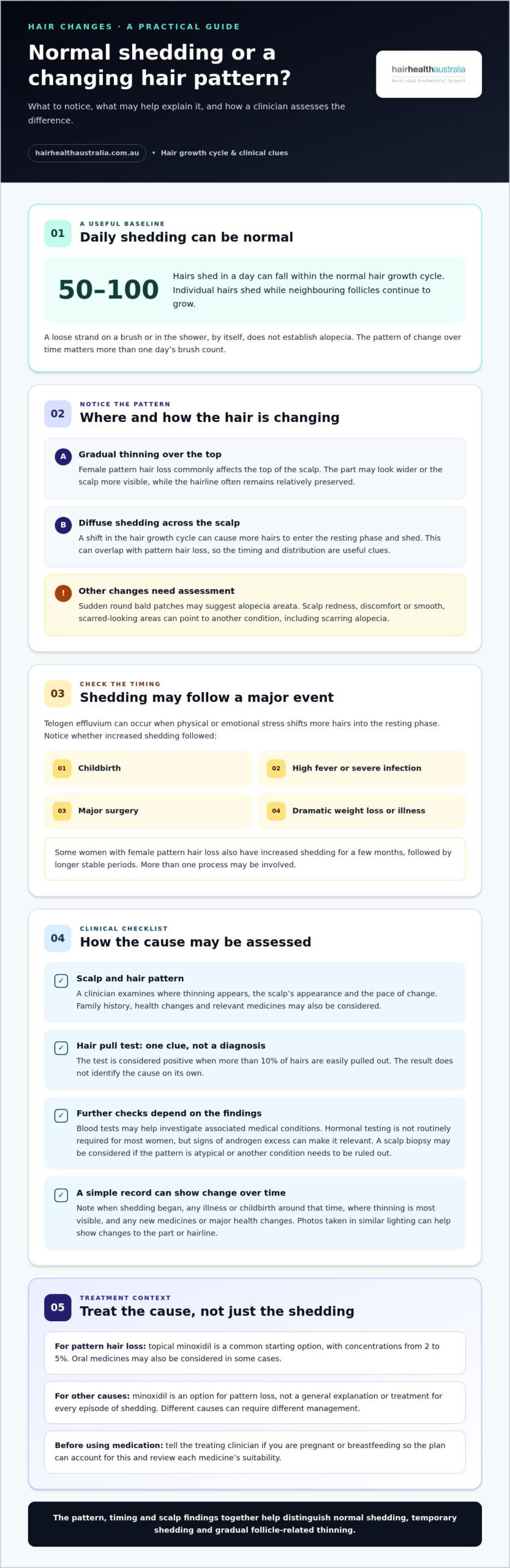
Each scalp hair moves through a repeating cycle of growth, transition and rest before shedding. These phases don’t happen in synchrony, so individual hairs fall while neighbouring follicles continue producing hair. Losing about 50 to 100 hairs daily is normal. A loose strand on a brush or in the shower, by itself, doesn’t establish alopecia. The pattern over time matters more: gradual thinning can make the part look wider or the scalp more visible.
During telogen effluvium, physical or emotional stress can shift more hairs into the resting phase. Shedding may become noticeable after childbirth, a high fever, severe infection, major surgery, dramatic weight loss or an underlying illness. Some women with female pattern hair loss also experience increased shedding for a few months, followed by longer stable periods. These changes can overlap, so the timing of shedding and other health events can help explain what is happening.
Notice where thinning appears and how it changes. Diffuse shedding across the scalp differs from gradual loss concentrated over the crown, while sudden round patches may suggest alopecia areata. Scalp redness, discomfort or smooth, scarred-looking areas also need assessment, because scarring alopecia can destroy hair follicles. Photos taken in similar lighting can help show changes to the part or hairline, rather than relying on a single day’s brush count.
A hair pull test is one clinical clue: it’s considered positive when more than 10% of hairs are easily pulled out. The result doesn’t identify the cause on its own. A clinician considers the shedding pattern, scalp appearance and recent events together. A scalp biopsy may help when the pattern is atypical or another condition needs ruling out. Hormonal assessment depends on accompanying signs, while minoxidil is a treatment option for pattern loss, not a general explanation for every episode of shedding.
Track changes in a simple record: note when shedding began, whether it followed an illness or childbirth, and where thinning is most visible. Include new medicines or major health changes for discussion during an assessment. This helps distinguish a temporary shift in the hair growth cycle from progressive follicle miniaturisation. If you’re unsure how to interpret changes, a hair health check can be a useful next step in understanding your hair and scalp.
Telogen effluvium is temporary hair loss caused by shedding resting hairs after a shock to the system, while new hair continues to grow.
Topical and oral medications
For female pattern hair loss, medication aims to slow thinning or stimulate regrowth. Topical minoxidil is a common starting option, with concentrations from 2 to 5%. It acts on the scalp rather than addressing every possible cause of diffuse shedding. The distinction matters: androgenetic alopecia affects follicles in a characteristic pattern, while temporary shedding can follow illness or other stressors. Treatment choice follows the diagnosis and the person’s health circumstances.
A 2% minoxidil lotion is applied at approximately 1 mL per application. A 5% foam or lotion is used once daily, with response assessed after 6 to 12 months. The 2% solution is less likely than the 5% solution to cause irritation or unwanted hair growth elsewhere on the body. Application technique also matters: the product is directed to the affected scalp area, not the hair shafts. Follow the prescribed directions and discuss persistent irritation during follow-up.
Oral minoxidil is another option. Low-dose oral or sublingual minoxidil is listed at 0.25 to 1 mg for female pattern hair loss. Oral spironolactone, at 25 to 50 mg, may be used as an introductory combination treatment. These medicines work differently, so a treatment plan can weigh the pattern of loss, health history and other medicines. They require clinician oversight rather than self-directed dosing.
Other medicines may be considered for selected patients. Spironolactone and cyproterone acetate are oral options used in some treatment plans. Dutasteride is approved in Australia by the Therapeutic Goods Administration for benign prostatic hyperplasia, not hair loss. Topical finasteride solutions at 0.1 to 0.25% are under investigation for androgenetic alopecia. These distinctions help separate established options from treatments still being studied.
Expect treatment to be assessed over time, not after a few applications. A clinical effect may take 3 to 6 months to become noticeable, and spironolactone may produce noticeable growth after 6 months. Topical or oral treatment generally needs daily continuation because benefits can be lost after stopping. Follow-up can compare scalp coverage and shedding, review tolerability, and inform whether the plan should continue or change. Response varies, and the main aim is often to slow progression, with regrowth possible for some women.
An open-label comparison for hair loss reported increased hair growth in 68% of patients treated with finasteride and 38% treated with saw palmetto.
Dermatologist consultations and follow-up
A dermatologist’s assessment starts by clarifying the pattern, timing and pace of hair loss. They may ask when thinning began, whether it followed illness or childbirth, and whether close relatives have genetic hair loss. The scalp examination looks for the distribution of thinning, follicle changes, inflammation and signs of scarring. These details help distinguish female pattern hair loss from conditions that need different management.
Medical history adds context to the examination. Tell the doctor about health changes, medicines and other symptoms, including signs that may suggest androgen excess. Routine hormonal testing isn’t required for most women with female pattern hair loss, but a doctor may recommend it if other signs point to excess androgens. Blood tests can also help investigate medical conditions associated with hair loss, rather than assuming every change is hormonal.
Further investigation depends on what the scalp examination and medical history show. A scalp biopsy may be considered if the pattern is atypical or another condition needs to be ruled out. It can help distinguish non-scarring loss, where follicles remain intact, from scarring alopecia, where follicles are destroyed. Sudden patches, scalp discomfort or visible scarring may prompt closer assessment. The findings guide whether treatment should target pattern thinning or another cause.
Follow-up gives the doctor a way to review treatment response and tolerability over time. For topical or oral medication, a review can consider whether use has been consistent, whether irritation or other effects have appeared, and whether thinning has stabilised. It can take months to assess a response, so changes over a short period don’t give the full picture. Keeping a consistent record of scalp appearance and shedding can make comparisons more useful.
If there’s no response after 6 months of treatment, referral to a dermatologist should be considered. This review can revisit the original diagnosis, check for another cause and reassess the treatment plan. It also helps separate medical aims, such as slowing progression, from cosmetic goals, such as improving visible coverage. Hair regrowth isn’t the only measure: stabilisation and scalp health also matter.
Prepare for an appointment by noting when changes began, treatments already used and relevant health events. Bring a list of medicines and mention any family history, even if relatives experienced thinning rather than complete baldness. These details help make the assessment more individual. Ask how progress will be reviewed and what findings might lead to a change in care. A clear follow-up plan connects the examination to practical decisions.
Female pattern hair loss treatment options
Clinical treatment aims to slow or halt progression, but regrowth may not occur for everyone. Options depend on the diagnosis, health history and pattern of thinning.
Treatment approaches
Treatment combines an accurate diagnosis with a plan suited to the person’s hair-loss pattern and health. Topical minoxidil is a key option, while oral medicines such as spironolactone may be considered in selected plans. This matters because alopecia areata, scarring loss and female pattern hair loss have different causes, so the same treatment won’t suit every presentation.
For androgenetic alopecia, topical minoxidil may be used on the affected scalp, with oral minoxidil or spironolactone considered where appropriate. The choice depends on factors such as the extent of thinning, existing medicines and health circumstances. Ongoing use is generally needed to maintain benefits. Before starting, discuss each medicine’s purpose, application and review plan.
Some medicines require particular care in how they’re described. Dutasteride is approved in Australia by the Therapeutic Goods Administration for benign prostatic hyperplasia, not hair loss. Topical finasteride solutions or lotions at 0.1 to 0.25% are under investigation for androgenetic alopecia. A receding hairline or thinning crown shouldn’t lead to assuming that medicines used for male pattern loss suit women.
Non-scarring pattern loss differs from conditions that damage follicles. Alopecia areata can cause sudden, round patches, while scarring alopecia can permanently destroy follicles. Identifying these signs affects the treatment pathway. Hair transplantation is also described as an option for some women with female pattern hair loss, but it is surgery and doesn’t suit every pattern. A clinical assessment helps clarify which approach addresses the cause.
Treatment results and timelines
Results vary, and treatment is assessed over months rather than days. A clinical effect may take 3 to 6 months to become noticeable; response to topical 5% minoxidil is assessed after 6 to 12 months. These timeframes matter when judging progress: early shedding or unchanged coverage doesn’t, by itself, show the eventual response.
For spironolactone, noticeable hair growth generally appears after 6 months. The main aim remains slowing progression, although some women experience regrowth. Ongoing treatment is usually needed to maintain benefits, so follow-up considers both visible change and tolerability. If progress is limited, the diagnosis and plan can be reviewed rather than assuming every medication works the same way.
For women considering female pattern hair loss treatment in Sydney, explore a hair health check as a practical starting point for discussing treatment options and next steps.
Hair Health Australia: Male Hair Loss Treatment
Hair Health Australia offers Female Hair Loss Treatment for women seeking support with thinning hair and pattern loss. Its non-surgical regrowth programs use clinically backed methods focused on hair density and scalp health. This may suit you if you’ve learned about medication options and want to explore a treatment program for female hair loss. The approach focuses on addressing thinning without promising a particular outcome. Because hair loss has different causes, treatment choices should match the pattern and individual circumstances. For information about Female Hair Loss Treatment, contact Hair Health Australia or visit hairhealthaustralia.com.au.
Choose a considered next step
The next step is to turn what you’ve noticed into a clear plan. Consider what matters most to you, whether that’s slowing further thinning, supporting visible density or understanding which approach fits your circumstances. For female pattern hair loss treatment in Sydney, a focused conversation can connect your concerns with a suitable treatment pathway, without treating every kind of shedding as the same problem.
Hair Health Australia offers Female Hair Loss Treatment and Male Hair Loss Treatment. If you’re ready to explore support for female hair loss, share your concerns and learn about the options available through its treatment program. Questions about suitability, ongoing care and what to expect are a useful starting point.
Contact Hair Health Australia to discuss your hair health and take a considered step towards understanding your options.
Frequently Asked Questions
What causes female pattern hair loss and how is it diagnosed?
Female pattern hair loss is usually genetic, but a family history isn’t always present. Diagnosis is generally based on the scalp’s appearance and the distribution of thinning. For an assessment, note when the change began, whether it followed an illness or medication change, and whether close relatives have experienced thinning. This timeline can help distinguish a gradual pattern from sudden shedding or patchy loss, which may need a different assessment.
What treatments for female pattern hair loss are available in Sydney?
Options can include topical minoxidil and prescription medicines such as spironolactone, with the approach matched to the diagnosis and health history. For female pattern hair loss treatment in Sydney, Hair Health Australia offers Female Hair Loss Treatment through non-surgical regrowth programs. Treatment discussions can cover the aim of care, how it fits your circumstances and how progress will be reviewed, rather than treating every type of hair loss in the same way.
How effective is topical minoxidil for female pattern hair loss, and how is it used?
Topical minoxidil can help slow thinning and support regrowth, though the response differs between people. For women, a 2% lotion is applied at approximately 1 mL per application; 5% foam or lotion is used once daily. Apply it to the affected scalp area according to its directions. The 2% solution is less likely than the 5% solution to cause irritation or unwanted hair growth elsewhere.
What prescription medicines are used for female pattern hair loss in women in Australia?
Prescription options may include oral spironolactone, cyproterone acetate and low-dose oral minoxidil, selected according to individual circumstances. Topical finasteride solutions are under investigation for androgenetic alopecia. These medicines aren’t interchangeable, so discuss treatment selection and monitoring with the treating clinician.
What are the risks and side effects of hair loss treatments for women?
Topical minoxidil can cause scalp irritation or unwanted hair growth elsewhere on the body; the 2% solution is less likely to cause these effects than the 5% solution. Oral medicines have different considerations, and tolerability depends on the medicine and the person. Before treatment, discuss current medicines, health history and any effects that emerge. This gives the treating clinician useful information for reviewing the plan.
Can women use hair transplants or other procedures for pattern hair loss in Sydney?
Hair transplantation is described as an option for some women, with results potentially more permanent and dramatic than medical treatment. It is surgery, distinct from non-surgical approaches such as medication. Hair Health Australia offers non-surgical Female Hair Loss Treatment, not hair transplant surgery. Discussing the pattern and extent of hair loss can help clarify whether a medical treatment approach addresses your concern and what goals to set.