Could a close-up view of your scalp tell the whole story behind hair loss? Not on its own. If you’re wondering what is a trichoscopy exam, it’s a non-invasive way for a clinician to examine your scalp and hair under magnification. The images can reveal details that are difficult to see with the naked eye, but their meaning depends on the wider pattern and your individual circumstances.
It’s understandable to feel unsure about what happens during a scalp examination or whether magnified images can provide a definite diagnosis. Trichoscopy is generally painless and doesn’t involve cutting or sampling the scalp. However, it has limits: some causes of hair loss may require other investigations, such as blood tests or, in certain cases, a biopsy.
This guide explains what the examination involves, what clinicians may look for and what the findings can and can’t confirm. You’ll also learn how to prepare and what to discuss with a clinician. If you’re considering a hair health check in Sydney, trichoscopy findings may form part of a broader assessment and help inform suitable next steps, rather than being treated as a diagnosis on their own.
Key Takeaways
- Learn what is a trichoscopy exam and how magnified scalp and hair images can support an assessment.
- Understand what may happen during the examination, while recognising that clinic procedures can vary.
- See which visible features imaging may help assess, and why it can’t establish every cause of hair loss on its own.
- Prepare useful details about your symptoms and hair history, and check any preparation instructions with the clinic.
- Know when persistent or changing hair and scalp concerns may warrant a professional discussion, and what to ask about next steps.
What Is a Trichoscopy Exam, and What Does It Examine?
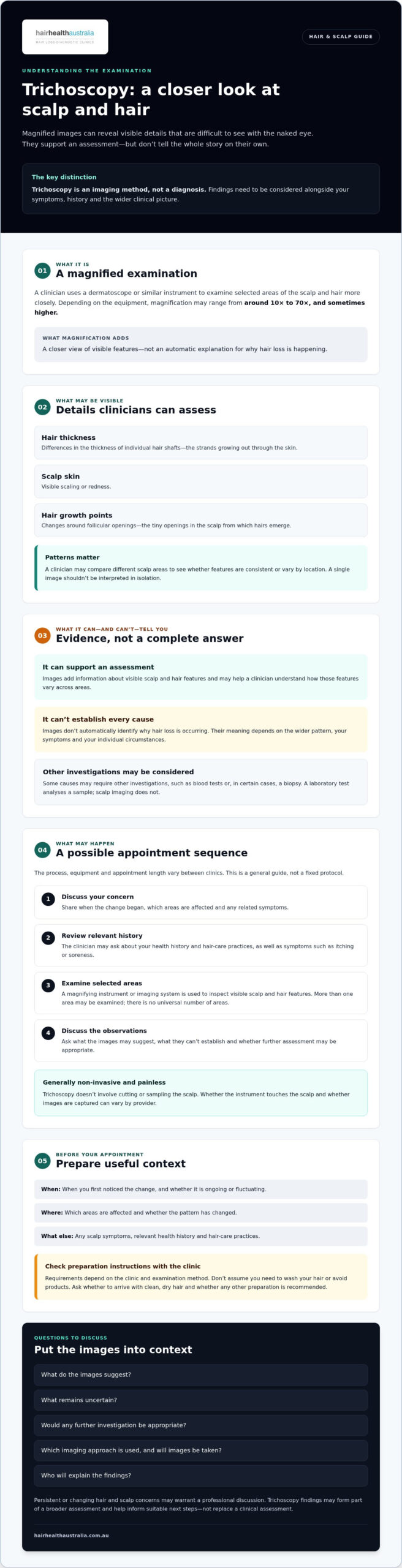
Trichoscopy is a magnified examination of the scalp and hair. A clinician uses a dermatoscope or similar instrument to view details that may be difficult to see with the naked eye. Depending on the equipment, magnification can range from around 10 times to 70 times, and sometimes higher. The images help the clinician assess visible features, but their meaning depends on your symptoms, history and the wider clinical picture.
If you’re asking what is a trichoscopy exam, the key distinction is that it’s an imaging method, not a diagnosis. An ordinary visual check gives an overall view of the scalp and hair, while trichoscopy provides a closer look at selected areas. A laboratory test is different: it analyses a sample, such as blood, and can help investigate issues that scalp images can’t establish. For background on the method, see Trichoscopy.
What features can trichoscopy make easier to see?
Magnified images may show features of the scalp skin and hair shafts, including differences in hair thickness, visible scaling or redness, and changes around hair growth points. A hair shaft is the strand that grows out through the skin. A follicular opening is the tiny opening in the scalp from which a hair emerges. These observations don’t identify every cause of hair loss by themselves.
A clinician may compare images from different scalp areas to see whether features are consistent or vary from one location to another. That pattern can add useful evidence, but a single image shouldn’t be interpreted in isolation.
Is trichoscopy the same as a hair loss diagnosis?
No. Images can support an assessment, but they don’t automatically reveal why hair loss is happening. The clinician may consider how long the concern has been present, whether it’s changing, any scalp symptoms, your health and hair history, and findings from a broader examination. If needed, other investigations may help assess possible causes that imaging can’t confirm.
Think of trichoscopy as one potential part of a clinical assessment, not a substitute for one. Ask the clinician what the images suggest, what remains uncertain and whether further investigation is appropriate. This puts the visual findings into context and can clarify possible next steps.
What Happens During a Trichoscopy Exam?
A trichoscopy appointment usually begins with a conversation, followed by a closer look at selected areas of the scalp and hair. The sequence, equipment and appointment length vary between clinics, so check with the provider about their process. DermNet NZ explains how this examination of the scalp and hair can help clinicians assess visible features more closely.
What may happen before the scalp images are taken?
The clinician may ask when you first noticed a change, whether it’s ongoing or fluctuating, and which areas are affected. They may also ask about symptoms such as itching or soreness, your health history and relevant hair-care practices. These details help put visible findings in context.
Preparation instructions depend on the clinic and examination method. Don’t assume you need to wash your hair or avoid products beforehand. Ask whether to arrive with clean, dry hair and whether any other preparation is recommended.
How are the scalp and hair examined?
A magnifying instrument or imaging system may be used to view selected scalp areas. The clinician might examine more than one area, depending on your concern, but there’s no universal number or fixed protocol. Some providers capture images; others assess features directly. Whether the instrument touches the scalp and how long the examination takes can also vary. Ask what to expect if you’re unsure.
A typical sequence may look like this, but confirm the details with your practitioner:
- Discuss your concern: Share when the change began, where it’s happening and any related symptoms.
- Review relevant history: Answer questions about your health and hair-care routine.
- Examine selected areas: The clinician uses magnification to inspect visible scalp and hair features.
- Discuss observations: Ask what the images may suggest, what they can’t establish and whether further assessment is needed.
The examination is generally non-invasive, but the method and experience aren’t identical at every clinic. Before attending, ask which imaging approach is used, whether images are taken and who will explain the findings.
If you’re in Sydney and seeking a broader discussion about hair concerns, Hair Health Australia’s hair health check may be a relevant next step. Confirm directly whether it includes trichoscopy and which examination methods are used.
What Can a Trichoscopy Exam Show, and What Can It Not Confirm?
Magnified images can reveal visible differences in the scalp and hair, helping a clinician compare patterns across areas. A pattern is evidence to interpret, not proof of a particular condition. In other words, what is a trichoscopy exam can help answer is what features are visible, not necessarily what caused them.
How might trichoscopy contribute to assessing hair loss?
Differences in hair thickness, scalp appearance or follicular openings may contribute to an assessment of conditions such as androgenetic alopecia, alopecia areata or telogen effluvium. These are examples, not conclusions that can be drawn from one feature alone. Signs can overlap, so the clinician considers where they appear and how they fit with your symptoms and history. A review of trichoscopy for diagnosing alopecias describes its role as one source of clinical evidence.
Think of the images as one part of the picture:
| What imaging may show | What it cannot establish alone |
|---|---|
| Visible features of the scalp and hair shafts, including differences between examined areas. | The full cause of hair loss or whether a particular condition is definitely present. |
| Patterns that may support a clinician’s consideration of a hair or scalp condition. | Underlying medical factors, such as a nutritional deficiency or thyroid problem. |
| Changes that may prompt closer clinical discussion or further assessment. | Whether treatment is suitable, or what the outcome of treatment would be. |
When might other tests or assessments be considered?
It depends on the person. A clinician may consider further assessment if your symptoms, history and visible findings don’t provide enough clarity, or if a possible cause can’t be evaluated through scalp images. Blood tests may help investigate certain underlying factors. A scalp biopsy may be considered in some cases where further examination of scalp tissue is needed. Neither is automatically required after trichoscopy.
The appropriate next step depends on clinical judgement, not a fixed pathway. Ask what the images do and don’t suggest, whether other assessment is relevant to your situation, and why. Avoid using online images or a single feature to self-diagnose. Findings need to be interpreted in the context of a broader assessment.
How Should You Prepare for a Trichoscopy Exam and Understand the Findings?
Preparation instructions vary between clinics and examination methods, so check directly rather than changing your hair-care routine based on general advice. Ask whether you should arrive with clean, dry hair and whether to avoid styling products. If you’re unsure what is a trichoscopy exam likely to involve at your clinic, ask what method is used and what to expect before you attend.
What information should you bring to an assessment?
A clear account of what you’ve noticed can help the practitioner understand your concern and interpret any images in context. You don’t need to prepare a formal report. A few notes on your phone may be enough.
- Timeline and pattern: When did the change begin, and which areas are affected? Note whether it seems stable, gradual or changing.
- Symptoms: Record any scalp discomfort, itching or other changes you’ve noticed, and when they occur.
- Relevant background: List medicines, health factors, hair-care practices or previous assessments that may be useful to discuss.
- Your questions: Write down what you want to understand about the examination, the images and possible next steps.
What questions can help you understand the results?
Ask the practitioner to explain their observations in plain language. It’s reasonable to ask what was visible, how it relates to your concern and what the images can’t tell you. If an observation is uncertain, ask what information could help clarify it rather than assuming it confirms a specific cause.
- Which features did you observe, and how do they relate to my symptoms?
- Are these findings conclusive, or are there other possible explanations?
- Would any further assessment be appropriate in my situation, and why?
- What follow-up do you recommend, and when should I seek another clinical opinion?
A good explanation distinguishes what was observed from what remains uncertain. If you leave without understanding the findings or suggested follow-up, ask for clarification. You can also seek another clinical opinion if you remain concerned or feel your questions haven’t been addressed.
If you’re in Sydney and would like to discuss your hair concerns as part of an assessment, explore a hair health check. Confirm with the clinic whether it includes trichoscopy and which examination methods are used.
When Is a Trichoscopy Exam a Useful Next Step for Hair Concerns?
A professional discussion may be helpful if hair loss persists, changes over time or comes with scalp symptoms that concern you. You don’t need to know the cause before asking for an assessment. Understanding what is a trichoscopy exam is only one part of deciding what may help: a clinician can discuss whether magnified imaging is relevant to your concern and what else might be considered.
Trichoscopy is one potential assessment component, not a guaranteed answer, diagnosis or treatment. Its value lies in interpreting visible features alongside your history and symptoms, then explaining what they do and don’t indicate. If a finding is uncertain, ask what could clarify it and whether follow-up is appropriate.
What should you consider when choosing a hair assessment?
Look for clear information about what the assessment involves, its limitations and how findings will be discussed. Before proceeding, ask who conducts the assessment, who interprets any images and what follow-up is available. Check whether the clinic uses trichoscopy as part of its process. Don’t assume every hair assessment includes it.
How does an assessment fit into a treatment discussion?
An assessment can help frame a conversation about possible next steps, but suitable options depend on the individual concern and the information gathered. A treatment recommendation isn’t automatic, and no imaging result can promise regrowth or establish that a particular programme is right for you. Ask how a suggested option relates to your assessment, what its purpose is and what uncertainties remain.
Hair Health Australia is a Sydney-focused clinic offering personalised, non-surgical hair loss treatment programmes for men and women. Its hair health check provides an opportunity to discuss your concerns and possible next steps. Confirm directly which examination methods are used, including whether trichoscopy is part of the assessment. An assessment and a treatment recommendation are distinct steps.
If you’re ready to discuss ongoing or changing hair concerns, book a hair health check and ask what the assessment includes. A clear conversation can help you understand your options without assuming one image or examination will provide every answer.
Take the Next Step with Clearer Information
Trichoscopy gives a clinician a closer view of scalp and hair features, but the images are only one part of a broader assessment. Understanding what is a trichoscopy exam also means knowing its limits: visible patterns may inform a discussion, but they don’t always identify the cause or determine suitable treatment on their own.
If hair or scalp changes are persistent or concerning, discussing them with a clinician can help clarify what to consider next. Ask what an assessment involves, how findings will be interpreted and whether further investigation may be relevant. Hair Health Australia offers personalised, non-surgical hair loss treatment programmes for men and women in Sydney. A hair health check is an opportunity to discuss your concerns and possible next steps. Confirm directly whether it includes trichoscopy.
Arrange a hair health check to start a conversation about your hair concerns. With clear information and an individual assessment, you can take your next step with greater confidence.
Frequently Asked Questions
What is a trichoscopy exam?
A trichoscopy exam is a magnified examination of the scalp and hair using a dermatoscope or similar imaging instrument. If you’re asking what is a trichoscopy exam, think of it as a closer visual assessment, not a test that automatically identifies the cause of hair loss. A clinician may examine selected areas and interpret visible features alongside your symptoms, health and hair history, and any other relevant assessment.
Is a trichoscopy exam painful or invasive?
A trichoscopy exam is generally painless and non-invasive. It involves viewing the scalp and hair under magnification, rather than cutting or taking a sample of the scalp. The exact method can vary between clinics, including whether the instrument touches your scalp or images are captured. If you’re worried about discomfort or unsure what will happen, ask the clinic to explain its examination approach before you attend.
Can trichoscopy diagnose the cause of hair loss?
Trichoscopy can provide useful visual evidence, but it can’t confirm every cause of hair loss on its own. Images may show features that inform a clinician’s assessment, while factors such as your symptoms, health history and examination findings also matter. Blood tests may be considered to investigate some underlying causes, and a biopsy may be relevant in selected cases. Neither is automatically required; further assessment depends on your circumstances.
How long does a trichoscopy exam take?
A trichoscopy examination may take around 5 to 30 minutes, according to the research information for this article. The time can vary depending on the areas examined, the imaging method and whether the appointment includes discussion of your history or findings. Ask the clinic how long to allow for your appointment, as examination processes differ and an assessment may include more than image-taking.
Do I need to prepare my hair before trichoscopy?
Preparation instructions vary, so check directly with the clinic rather than assuming you should wash or leave your hair unwashed. Some guidance recommends avoiding washing for one to two days and not using styling products, but your provider’s instructions should take priority. Ask whether to arrive with clean, dry hair and whether products such as gel or hairspray could affect the examination method used.
Can trichoscopy tell the difference between types of hair loss?
Trichoscopy may help a clinician assess patterns associated with conditions such as androgenetic alopecia, alopecia areata or telogen effluvium. It doesn’t always distinguish them conclusively: visible signs can overlap, and findings need to be considered alongside your symptoms and history. Avoid diagnosing yourself from an image or one feature. Ask the practitioner what the pattern may suggest, what remains uncertain and whether further assessment is appropriate.
What happens after a trichoscopy exam?
After the examination, the practitioner may explain the visible features, how they relate to your concern and whether follow-up is appropriate. Further tests aren’t automatic, and imaging doesn’t guarantee a diagnosis or treatment plan. Ask what the findings can and can’t establish, and what next steps make sense for you. If you’re in Sydney, Hair Health Australia’s hair health check is an opportunity to discuss hair concerns. Confirm directly which examination methods it includes.