What if the most useful hair regrowth story isn’t the one with the most dramatic before-and-after photos? The success stories of non-surgical hair regrowth can offer helpful clues, but only if they explain how progress was assessed, what the person’s hair-loss pattern was and where the limits lie.
It’s understandable to look for evidence that a treatment could work for you. Promotional claims can make it hard to distinguish documented change from an appealing anecdote, and another person’s experience can’t predict your own. The cause of hair loss, the approach used and the time allowed for assessment can all affect what a result looks like. Success may also mean stabilising hair loss rather than visible regrowth.
This article explains what to look for in a credible case example, why outcomes and timelines differ, and how to consider stories without treating them as guarantees. You’ll also find a practical next step: an individual assessment of your hair health, rather than trying to match yourself to someone else’s result.
Key Takeaways
- Use the success stories of non-surgical hair regrowth to prepare informed questions, not to forecast your own outcome.
- Check whether a story explains the starting point, how change was assessed and how long progress was followed.
- Distinguish reported changes such as reduced shedding, visible density and confidence. They describe different experiences.
- Before considering a programme, ask about personal suitability, monitoring, potential benefits, limitations and alternatives.
- A Hair Health Check can help you explore your hair health and whether a tailored non-surgical programme may be suitable.
What success stories of non-surgical hair regrowth can and cannot show
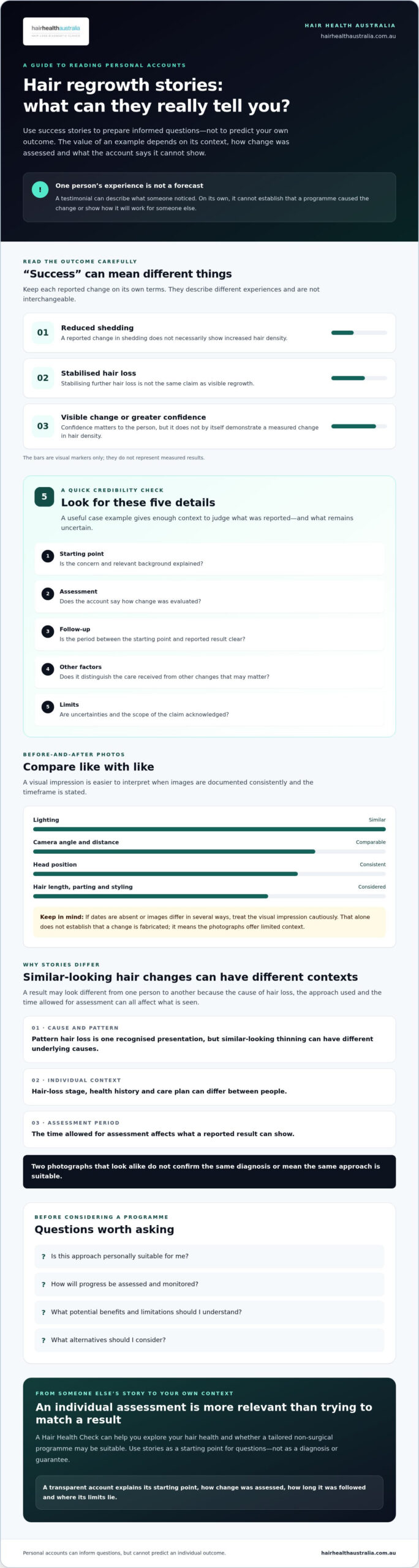
A success story is one person’s account, not proof that someone else will get the same result. The success stories of non-surgical hair regrowth may describe visible changes, less shedding or greater confidence. These are different outcomes: confidence matters to the person, but it doesn’t by itself demonstrate a measured change in hair density.
A testimonial describes an individual experience; clinical evidence is gathered and assessed systematically. A personal account can help you understand what someone noticed, but it can’t establish that a programme caused the change or predict how it will work for you. Look for clear context and evidence, not just a persuasive claim or striking image.
What counts as a meaningful hair regrowth result?
Change is easier to assess when the account includes reliable records or photographs taken consistently, such as from comparable angles and in similar lighting. Ask what was measured, how it was assessed and over what follow-up period. A person’s description of their experience is valuable, but it isn’t automatically a clinical measurement.
Check what “success” means in the story. Stabilising further hair loss and showing visible regrowth are not interchangeable claims. Reduced shedding may be another reported change, but it doesn’t necessarily show increased density. Each outcome should be described on its own terms.
Why one person’s result cannot predict another’s
The cause and pattern of hair loss affect whether an example is relevant. Pattern hair loss is one recognised presentation, but similar-looking thinning can have different underlying causes. The overview of Pattern hair loss can help explain why this pattern may appear differently in men and women. It can’t determine what’s causing your own hair changes.
Hair-loss stage, health history and the care plan can also differ between people. Two photographs that look alike don’t confirm the same diagnosis or mean the same approach is suitable. Treat a story as a starting point for questions, not as a way to diagnose yourself or select a programme.
- Is the starting point described clearly?
- Are photographs or other records consistent and verifiable?
- Is the outcome defined as reduced shedding, stabilisation, visible change or personal experience?
- Are the follow-up period and limitations explained?
A transparent account makes these details easier to judge. Before drawing conclusions, seek an individual assessment of your hair health and discuss whether your circumstances are comparable.
How to assess a non-surgical hair regrowth story
A useful example gives you enough context to judge what was reported, how it was assessed and what remains uncertain. The success stories of non-surgical hair regrowth are more informative when they explain the person’s starting concern and care plan, rather than relying on a dramatic claim alone.
What details should a credible case example include?
Look for a clearly described concern and relevant assessment, while recognising that personal details can be protected. The account should say what care the person received and whether other changes or factors may have contributed. Missing dates, inconsistent records or vague wording limit what you can conclude, but they aren’t, by themselves, proof that a story is false.
- Starting point: Is the concern and relevant background explained?
- Assessment: Does the account say how change was evaluated?
- Follow-up: Is the period between the starting point and reported result clear?
- Other factors: Does it distinguish the care received from other changes that may matter?
- Limits: Are uncertainties and the scope of the claim acknowledged?
These details help separate what the person experienced from what the example can actually demonstrate. For broader context on how hair loss may be assessed and managed, see Mayo Clinic’s overview of Diagnosing and treating hair loss.
How to read before-and-after hair photographs
Before comparing images, check whether they use similar lighting, camera angle, distance and head position. Hair length, parting and styling can also change how much scalp is visible or how dense hair appears. Context makes before-and-after photographs easier to interpret.
A stated timeframe and consistent documentation are more helpful than a single dramatic comparison. If dates are absent or the images differ in several ways, treat the visual impression cautiously. That doesn’t establish that the change is fabricated; it means the photographs offer limited evidence on their own.
A guide titled Clinical Hair Treatment: A Professional Guide to Non-Surgical Restoration can provide broader treatment context, but each example still needs to be judged on its own documentation. If you’d like to consider your circumstances rather than compare yourself with a testimonial, Hair Health Australia’s Hair Health Check is a relevant next step.
Why non-surgical hair regrowth outcomes and timelines vary
A reported result reflects more than the care someone received. The cause and pattern of hair loss, its stage, a person’s health history and their individual care plan can all shape what is observed. For that reason, success stories of non-surgical hair regrowth shouldn’t be read as a universal schedule for visible change. Check any clinical timeframe against reliable evidence and the person’s circumstances before treating it as a guide.
How the cause and pattern of hair loss shape expectations
Androgenetic alopecia, often called pattern hair loss, telogen effluvium and alopecia areata refer to distinct forms or causes of hair loss. A case story or photograph can’t confirm which applies to you. Similar-looking thinning may have different explanations, so don’t infer a diagnosis from someone else’s account. If the cause is unclear or symptoms concern you, speak with a qualified health professional.
What a story’s timeframe can tell you
Check whether an account gives both the date care began and the date the outcome was assessed. These are different reference points. Consistent follow-up helps show whether a reported change was sustained or noticed at just one moment. If a timeframe is missing, treat that as a limit on interpretation. It doesn’t justify assigning a standard regrowth schedule or promising a result.
The table below is a guide to reading claims, not a set of patient outcomes. “Not stated” means the example would need more information before you could assess its timeframe or strength.
| Reported concern | Evidence shown | Timeframe | Limitations to consider |
|---|---|---|---|
| Patterned thinning | Consistent photographs or recorded assessment | Start and review dates stated | Doesn’t establish the cause or predict another person’s response |
| Increased shedding | Personal report, with or without records | Not stated | A reported change in shedding isn’t the same as measured density |
| Patchy hair loss | Images without assessment context | Not stated | A photograph alone can’t determine the underlying cause |
Ongoing assessment may be needed to interpret change and review whether a care plan remains appropriate. No individual outcome should be promised. For a wider overview, consult Best Hair Regrowth Treatment Australia 2026: A Clinical Reference Guide, while checking that treatment details and timelines are supported by current, reliable sources.
Questions to ask before choosing a non-surgical hair-loss programme
A compelling story can prompt useful questions, but your next step should be a discussion about your own hair and health. Rather than trying to copy another person’s programme, ask how a provider will assess your circumstances and explain the options. The success stories of non-surgical hair regrowth are most useful when they help you make an informed, individual decision.
Questions about assessment and personal suitability
Ask how the provider will explore the likely cause and stage of your hair loss, and what the assessment can and can’t establish. If further medical review may be appropriate, ask what kind and why. Share relevant health history and current medicines with your clinician so they can consider these when discussing suitability.
- What factors will you consider when assessing my hair loss?
- Is further review by another health professional appropriate before I decide?
- Which options may suit my circumstances, and why?
- What benefits are realistic to discuss, and what are the limitations, risks and alternatives?
Answers should relate to your needs, not just a testimonial or a standard offer. A tailored plan may differ from someone else’s because their circumstances, assessment and goals may be different. You should have space to consider the information and ask for clarification before proceeding.
Questions about monitoring and expectations
Ask how progress will be recorded and when the plan will be reviewed. Find out what changes the provider will monitor, what might prompt an adjustment and when another clinical assessment may be needed. A clear review process helps you understand how decisions will be made; it doesn’t guarantee a particular outcome or timetable.
- How will progress be documented consistently?
- When will we review the plan, and what will we assess?
- What should I do if my hair loss changes or I have concerns?
- How will we discuss whether to continue, adjust or reconsider the approach?
For broader clinic-evaluation guidance, look for Choosing a Non-Surgical Hair Loss Clinic in Sydney: The 2026 Essential Checklist. Hair Health Australia offers a Hair Health Check as a next step for people considering their hair health and tailored non-surgical care. Arrange a Hair Health Check to discuss your situation rather than trying to match yourself to someone else’s result.
From success stories to your own Hair Health Check
An encouraging example can show what one person says they experienced. It can’t establish that you have the same cause of hair loss or that you’re personally suited to the same approach. An individual discussion is a more useful way to explore your circumstances and what options may be appropriate.
Hair Health Australia is a Sydney-based clinic offering tailored, non-surgical hair-loss programmes for men and women. The right programme, if suitable, depends on the individual. A Hair Health Check is a starting point for discussing your hair health, not a promise of treatment or a particular outcome.
What to prepare for a hair health assessment
A few notes can help you explain what you’ve noticed. Consider writing down when the change began, which areas are affected and whether anything has changed over time. Bring relevant medical history and a list of current medicines, and note the questions you want answered.
- When did you first notice a change?
- Which areas of your scalp or hair are affected?
- What health history or medicines may be relevant?
- What would you like to understand about possible options, limitations or next steps?
The assessment can help inform a discussion about your situation and possible next steps. It doesn’t guarantee that a particular programme will be suitable or that hair will regrow. If the cause of your hair loss needs further medical review, ask what kind of follow-up may be appropriate.
How to take the next step in Sydney
Hair Health Australia’s Hair Health Check is a starting point for an individual conversation with the Sydney-based clinic. You don’t need to decide in advance that someone else’s story applies to you. Use the discussion to understand your circumstances, ask questions and consider whether the available non-surgical options align with your needs.
If you’d like to discuss your own hair health, arrange a Hair Health Check as a considered first step.
Make your next step personal
Success stories of non-surgical hair regrowth can give you useful questions to take into a conversation, but they can’t show whether another person’s outcome is right for you. Look for clear records, a stated timeframe and honest limits, then consider how the cause and pattern of your own hair loss may differ.
A personal assessment can help you explore suitability, options and expectations without assuming a particular result. Hair Health Australia is a Sydney-based clinic offering tailored, non-surgical hair-loss programmes for men and women, with a focus on clinically backed care. A Hair Health Check is a practical starting point for discussing your individual hair health.
Arrange a Hair Health Check to explore your next step with more clarity. You don’t need to have all the answers before you begin.
Frequently Asked Questions
Can non-surgical hair treatments regrow hair?
Some non-surgical hair-loss treatments may support regrowth or help stabilise hair loss, but outcomes depend on the cause and individual circumstances. An improvement in shedding or density isn’t guaranteed, and success may mean slowing further loss rather than visible regrowth. A qualified health professional can help assess what may be contributing to your hair changes and discuss suitable options, their limitations and any alternatives.
How long does non-surgical hair regrowth take?
There’s no single timeline that applies to everyone. Hair changes can take several months to become apparent, but the timeframe depends on factors such as the cause of hair loss, the care plan and how progress is assessed. Ask what review schedule is appropriate for your situation and how change will be recorded. Be cautious of claims that promise a specific result by a fixed date.
Are before-and-after hair regrowth photos reliable?
They can help illustrate reported change, but photographs alone can’t confirm its cause or prove that a treatment produced it. Compare images taken with similar lighting, camera angle, distance, hair length and styling. Ask when each photo was taken and whether the timeframe and care received are explained. If those details are missing or images differ substantially, treat them as limited evidence rather than proof of deception.
What should a hair regrowth success story include?
A useful story describes the starting concern, relevant assessment, care received and the period before the outcome was reviewed. It should clarify whether the reported change was reduced shedding, stabilised loss, visible density or a personal experience such as improved confidence. Look for consistent records or photographs and a candid account of limitations or other possible factors. The success stories of non-surgical hair regrowth should inform questions, not guarantee a similar result.
Can a hair-loss success story tell me which treatment I need?
No. Someone else’s story can help you prepare questions, but it can’t diagnose your hair loss or determine which option is appropriate for you. Similar-looking thinning can have different causes, and personal health history and other factors may affect suitability. Discuss your own symptoms and circumstances with a qualified health professional before deciding on care. Use a testimonial as a conversation starter, not a treatment plan.
Is non-surgical hair regrowth suitable for everyone?
No. A non-surgical approach may not be suitable for every person or every cause of hair loss, and no particular outcome can be assured. Suitability depends on individual assessment, including the nature of the hair changes and relevant health information. Hair Health Australia offers tailored non-surgical hair-loss programmes for men and women through its Sydney clinic. An assessment can help you discuss whether an option may fit your circumstances.
How can I check whether a hair-loss clinic’s success stories are genuine?
Ask whether the clinic has permission to share the story and whether the photographs or other records are consistent and dated. Check that the account explains the starting point, care received, timeframe, assessment method and limits of the reported result. If information is missing, treat that as a reason to ask questions, not automatic proof of dishonesty. In Sydney, Hair Health Australia’s Hair Health Check is a next step for discussing your own hair health.