
What if more checking isn’t bringing you closer to certainty? If you’re trying to work out how to stop worrying about hair falling out, it can be unsettling to notice strands in the shower or on your brush and wonder whether the amount is normal for you.
It’s understandable to look in the mirror, take comparison photos or search online for answers. But repeated checks can keep your attention fixed on every strand without explaining what’s causing a change. Some daily shedding is expected. What matters more is whether you notice a persistent or visible difference.
This guide explains what everyday shedding can mean, which changes may deserve attention and how to ease checking and rumination. It also looks at how stress, health changes and inherited factors may be relevant, and why an individual hair health assessment can help clarify next steps. The aim isn’t to dismiss your concern or jump to conclusions, but to replace guesswork with a calmer, more considered way forward.
Key Takeaways
- Loose hairs alone don’t explain what’s happening. Look for broader patterns and changes over time rather than treating each strand as proof of a problem.
- Frequent checking, comparisons and online searches can keep uncertainty alive without giving you a reliable answer.
- Use a simple, consistent routine to observe changes in coverage, part width or hairline, instead of counting strands or checking throughout the day.
- To practise how to stop worrying about hair falling out, pause, name what you’re unsure about, choose one useful action, then return to your day.
- A structured hair health check may help clarify what you’ve noticed and support individualised next steps, without assuming a diagnosis or outcome.
Why hair falling out can feel alarming, and what everyday shedding means
Finding loose hairs on your pillow, clothes or in the shower can prompt an immediate question: is this more than usual? It can feel especially unsettling if you’ve noticed a change in your appearance or have been thinking about hair loss. But concern is a response to uncertainty, not proof that you have a hair or scalp condition.
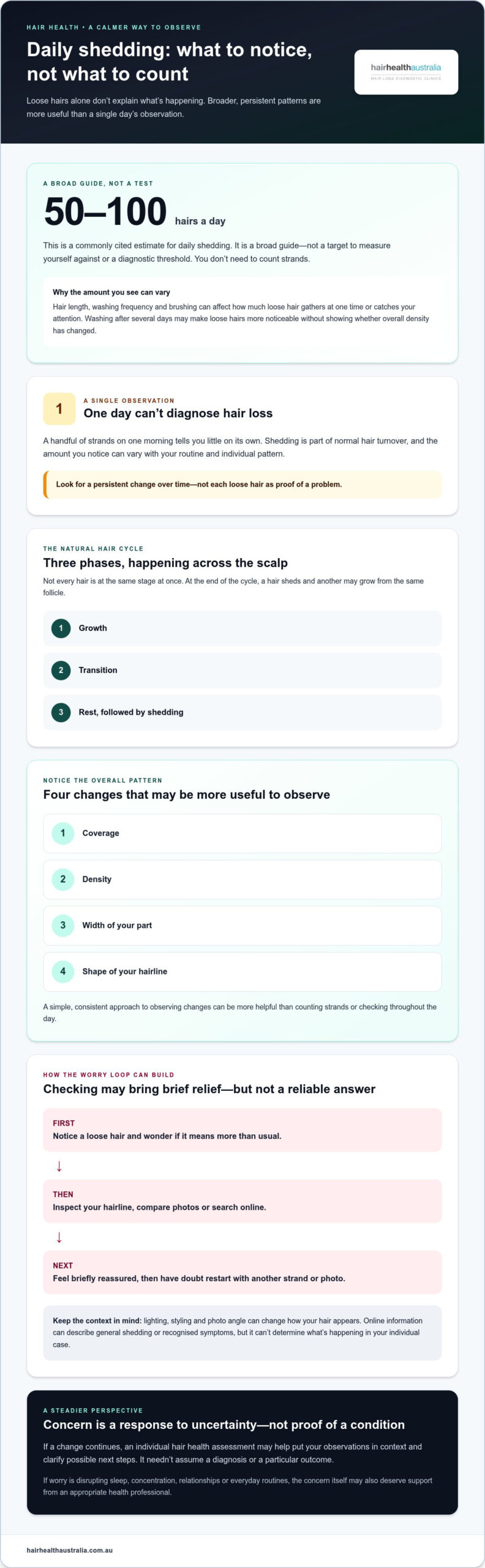
Hair naturally cycles through periods of growth, transition and rest. At the end of this process, a hair sheds and another may grow from the same follicle. This happens across your scalp, but not every hair is at the same stage at once. Shedding is part of normal hair turnover, and the amount you notice can vary with your routine and individual pattern.
Is it normal for hair to fall out every day?
Daily shedding is expected. A commonly cited estimate is around 50 to 100 hairs a day, but this is a broad guide, not a target to measure yourself against or a diagnostic threshold. You don’t need to count strands. Hair length, washing frequency and brushing can affect how much loose hair gathers at one time or catches your attention. For example, washing after several days may make loose hairs more noticeable without showing whether your overall density has changed.
Normal shedding is the routine release of hairs as part of the growth cycle. One day of observation cannot diagnose hair loss. A handful of strands on a particular morning tells you little on its own. It’s more useful to notice a persistent change in coverage, density, the width of your part or the shape of your hairline. These are changes in an overall pattern, not a single moment.
Why does the possibility of hair loss cause so much worry?
Hair can be closely tied to identity, confidence and how someone feels about their appearance. That connection is personal, and there’s no single correct reaction to noticing a change. If hair loss has affected someone in your family, or you’ve recently experienced a major life change, you may find yourself paying closer attention to every shed hair. The broader overview of Hair loss describes different causes and types, but general information can’t establish what’s happening for an individual.
It’s reasonable to want clarity. Worry deserves attention in its own right if it’s disrupting sleep, concentration, social plans or everyday routines, even when the cause of shedding is uncertain. You don’t have to dismiss the concern or decide what it means straight away. Start by distinguishing loose hairs from a change that continues over time. That can help you take a calmer approach to how to stop worrying about hair falling out without ignoring a change that may deserve closer attention.
How uncertainty and repeated checking can keep hair-loss worry going
Uncertainty can make a small observation feel like evidence. You notice a hair on your jumper, wonder if it means you’re losing more than usual, then inspect your hairline or search online for answers. Checking may bring brief relief, but it rarely settles the question for long. Another strand or a different photo can quickly restart the doubt.
This cycle can grow because checking feels like a way to gain control. Yet close-up photos, repeated mirror checks and comparisons with someone else’s hair don’t show the full context. Lighting, styling and the angle of a photo can change how your hair appears. Online information may describe normal hair shedding or recognised symptoms, but it can’t determine what’s happening in your case. Worry alone can’t confirm hair loss or identify its cause.
When does concern become a worry loop?
Notice the effect the concern is having rather than trying to label yourself. Are you checking repeatedly, seeking reassurance or changing plans because you’re worried about how your hair looks? Consider how much time the concern takes and whether it’s interfering with sleep, work, relationships or activities you usually enjoy. If distress is persistent or affecting daily life, discussing it with an appropriate health professional may help.
This doesn’t mean that caring about your hair is unusual or that you have a mental health condition. It’s a practical way to recognise when the worry itself deserves support, regardless of what’s happening with your hair.
Can stress make hair shedding feel more frightening?
Stress can affect how closely you monitor your hair, while a stressful physical or emotional event may also be relevant when considering a change in shedding. These are related but separate possibilities. Timing matters, as do other health changes and personal factors. A difficult period doesn’t automatically explain shedding, and feeling calmer isn’t a guaranteed way to stop it. Avoid blaming yourself for either the worry or the change.
Instead, focus on what can be clarified. If you’ve noticed a continuing change, an individual assessment can help put your observations in context. Hair Health Australia’s hair health check offers a way to seek clearer information and consider possible next steps, without assuming a diagnosis or particular result. For people in Sydney, this provides a more individual starting point than repeating searches that offer general answers but leave your own question unresolved.
Learning how to stop worrying about hair falling out doesn’t mean ignoring what you’ve noticed. It means recognising when checking is adding anxiety rather than useful information, and choosing a more considered way to understand a persistent change.
How to observe hair changes without turning them into a daily test
If you’ve noticed a possible change, the aim isn’t to monitor every strand. It’s to gather a small amount of useful information in a consistent way, then take a break from checking. Repeated inspections can make ordinary differences in lighting, styling or how your hair sits feel like new evidence.
Consistent observations over time are more informative than isolated shed hairs. A simple routine can help you notice a broad trend without turning your hair into a daily test. Choose a regular interval that feels manageable, and use similar lighting, hairstyle and angles each time. A brief note is often enough. You don’t need to photograph your scalp every day or count hairs after washing.
What should you record, and what should you leave alone?
Keep your notes neutral and factual. Record when you first noticed a visible change, where it appears, and whether it seems stable, improving or progressing. If relevant, note major health or life changes around the same period, such as an illness, medication change or particularly stressful event. These details provide context, but they don’t prove what caused the change.
Focus on broad features, such as overall coverage, a part that appears wider or a hairline that seems to have shifted. Try not to compare your hair with someone else’s. Daily photographs, repeated scalp inspections and strand counting can make small variations seem more meaningful than they are. If you want to check again, return to the observation schedule you chose rather than starting a new one.
What changes call for a timely hair health assessment?
A single unusual day of shedding may not tell you much. A persistent or clearly changing pattern is more useful to discuss in an assessment, particularly if you’re concerned or unsure how to interpret it. Sudden patchy changes, scalp symptoms such as irritation, or other new symptoms are reasons to seek timely clinical advice rather than relying on photos or online comparisons. Speaking with a medical doctor—whether consulting a private GP Edinburgh or booking in with your local clinic—can also help identify any underlying nutritional deficiencies or hormonal imbalances contributing to shedding.
An individual assessment can consider the pattern you’ve noticed alongside relevant context. You don’t need to diagnose yourself before seeking help. If you’re trying to understand a continuing change, Hair Health Australia’s hair health check can help replace guesswork with clearer next steps.
For a closer look at possible reasons a change may continue, see Why My Hair Loss Is Persistent: Diagnostic Clues. Use your notes to support a clearer conversation, not as a reason to keep searching for certainty. That’s one practical part of learning how to stop worrying about hair falling out while still taking a persistent change seriously.
How to stop worrying about hair falling out: a practical reset
Worry can make you feel you need to solve the question right now. Instead, use a short reset to separate what you’ve observed from what you fear it means. You’re not trying to talk yourself out of a genuine concern. You’re choosing a proportionate next step rather than repeating checks that don’t provide new information.
What can you do when worry spikes?
Try this four-step reset when you notice yourself checking or searching again:
- Pause. Step away from the mirror, brush or phone for a moment.
- Name the uncertainty. Describe the observation plainly, without adding a conclusion.
- Choose one useful action. Note a continuing change or arrange an assessment if needed.
- Return to your day. Resist the urge to repeat the check for reassurance.
If you feel wound up, take a few slow breaths or focus on a grounding activity, such as noticing what you can see and hear around you. Give yourself time to settle before deciding whether action is needed. This pause doesn’t diagnose or resolve the hair concern. It gives you space to respond thoughtfully.
How can you avoid reassurance-seeking habits?
Set a realistic boundary around mirror checks and online searches, then use the same observation routine each time. For instance, decide not to search for symptoms again after you’ve made a note of a change. Ask someone you trust to listen to how you’re feeling, rather than repeatedly asking them to predict whether you’re losing hair. Reassurance can feel helpful briefly, but it can’t establish the cause.
Support ordinary wellbeing while you seek clarity. Keep up with sleep, regular meals and activities that help you feel steady. Handle your hair gently when washing and brushing, and avoid harsh pulling or unnecessary tension. These habits can support general wellbeing and reduce avoidable strain on your hair, but they can’t prevent every cause of hair loss or guarantee that shedding will stop.
It may help to write down a simple boundary in advance: observe according to your chosen routine, take one useful action if a change persists, then move on to another part of the day. This is a practical way to approach how to stop worrying about hair falling out without dismissing what you’ve noticed. If a persistent change is troubling you, an individual hair health assessment can help put your observations in context and clarify possible next steps.
Anxiety also deserves care in its own right. If worry is regularly disrupting sleep, work, relationships or everyday routines, consider discussing it with an appropriate health professional. Engaging with services like LEAPS Inc. for professional therapy and coaching can provide valuable support for stress and emotional well-being. You don’t need to know what’s causing a hair change before seeking support for how the uncertainty is affecting you.
How a hair health check can replace guesswork with clearer next steps
When you’ve noticed a change, general information can explain what may be possible, but it can’t tell you how your own hair and scalp are changing. An individual hair health check offers a structured way to consider what you’ve observed alongside your timeline and personal circumstances. It can help shift the focus from repeated speculation to a clearer discussion of possible next steps.
A hair health assessment considers your pattern and history, not one loose hair. A single observation rarely explains the bigger picture, while a continuing change may be easier to discuss in context. An assessment can inform suitable next steps, but it shouldn’t be treated as a guarantee of a particular diagnosis or result.
What can a personalised hair assessment help clarify?
A useful starting point is the change you’ve noticed: when it began, whether it appears to be continuing, and where it’s most visible. Your circumstances may also matter. Relevant health or life changes, family history and other factors can help put your observations in context, without proving that any one factor caused them.
Hair Health Australia provides tailored, non-surgical hair-loss care for men and women in Sydney, with an approach centred on hair and scalp assessment and individualised care. A structured assessment can guide discussion about possible next steps. You don’t need to arrive with a diagnosis, and one particular treatment won’t necessarily suit everyone. The aim is clearer information to support an informed decision.
How to take the next step without feeling pressured
Seeking information doesn’t commit you to a treatment programme. You can start by reviewing what a hair health check involves and deciding whether structured guidance feels useful. If you’re not ready to take that step, continue with proportionate observation rather than frequent checking. There’s no need to turn uncertainty into an urgent decision.
If you’d like to understand more about clinical hair treatment options, the guide Clinical Hair Treatment: A Professional Guide to Non-Surgical Restoration can provide further context. Learning about options can help you become better informed, but it doesn’t obligate you to pursue treatment. Any next step should take account of your individual circumstances and what matters to you.
If you’re still wondering how to stop worrying about hair falling out, a structured assessment may help replace online guesswork with a more individual perspective. Hair Health Australia’s tailored approach focuses on understanding your hair and scalp and considering suitable next steps, without promising regrowth or a particular outcome.
If you’re ready to seek clearer, individual guidance, Arrange a hair health check.
Move forward with a clearer plan
You don’t need to solve every question about your hair today. A steadier goal is to decide what would help you feel informed, then take that step without letting repeated checking take over your time. If you’re considering how to stop worrying about hair falling out, remember that seeking clarity is a choice, not a commitment to treatment.
Hair Health Australia provides tailored hair-loss care for men and women, with individualised, non-surgical treatment approaches in Sydney. A hair health check can be a starting point for discussing your concerns and considering what may suit your circumstances. Take time to understand your options and decide what feels right for you.
Arrange a hair health check when you’re ready to explore a more structured next step. You deserve information that helps you move forward with greater confidence, at a pace that feels manageable.
Frequently Asked Questions
Is it normal to lose hair every day?
Yes, some daily hair shedding is a normal part of the hair cycle, and the amount you notice can vary with your routine. A wash day may leave more loose strands visible than a day when you haven’t washed your hair. Rather than treating one day as a test, look for a lasting difference in coverage or pattern. If a change concerns you, an individual assessment can help put it in context.
Can worrying about hair loss make my hair fall out?
Worry by itself can’t confirm that hair loss is happening or explain its cause. Stress may be associated with changes in the hair cycle for some people, but health, family history and other circumstances can also be relevant. Relaxation can support wellbeing, but it isn’t a guaranteed way to stop shedding. If the change continues, note its timing and seek individual guidance rather than assuming anxiety is the explanation.
How can I tell whether my hair is thinning or just shedding?
Loose strands can occur without an obvious change to your overall hair, while a continuing shift in density, part width, hairline or coverage may be worth assessing. One mirror check or wash can’t establish the cause. If you’re unsure, note what looks different and when you first noticed it, then compare under similar conditions at a later point. Avoid using daily photos or strand counts as a substitute for an assessment.
When should I seek help about hair falling out?
Seek timely clinical advice if shedding persists, your hair’s appearance is clearly changing, or you notice sudden patches, scalp symptoms or other new symptoms. These signs don’t prove a particular condition, but they’re useful reasons to discuss what’s happening. An assessment can consider the pattern alongside your circumstances and timeline. Getting guidance is a sensible way to address uncertainty, not evidence that the cause must be serious.
Does stress-related hair shedding grow back?
Whether hair grows back depends on the cause and your individual circumstances, so a general answer can’t predict your outcome. Some temporary shedding may improve after its trigger has passed, while other patterns may call for a different assessment and plan. Avoid relying on a fixed recovery timeline or assuming stress is the only factor. If shedding continues, progresses or worries you, seek an individual evaluation to discuss what may be appropriate.
How do I stop checking my hair all the time?
Choose one manageable time to observe broad changes, and use brief notes instead of repeatedly inspecting your scalp. For example, record whether your part or hairline seems different under consistent conditions, then leave it until your next planned check. If you’re searching for reassurance, pause and identify one useful action before closing the search. If worry is affecting sleep, work or relationships, seek support for the distress too.
Can a hair health check tell me why my hair is falling out?
A hair health check can help consider your concerns and inform possible next steps, but it can’t guarantee a particular diagnosis or result. Before an assessment, it may help to note when you first saw a change and any relevant circumstances, such as a recent health change. If you’re in Sydney and would like structured guidance, explore Hair Health Australia’s hair health check to learn about taking that next step.