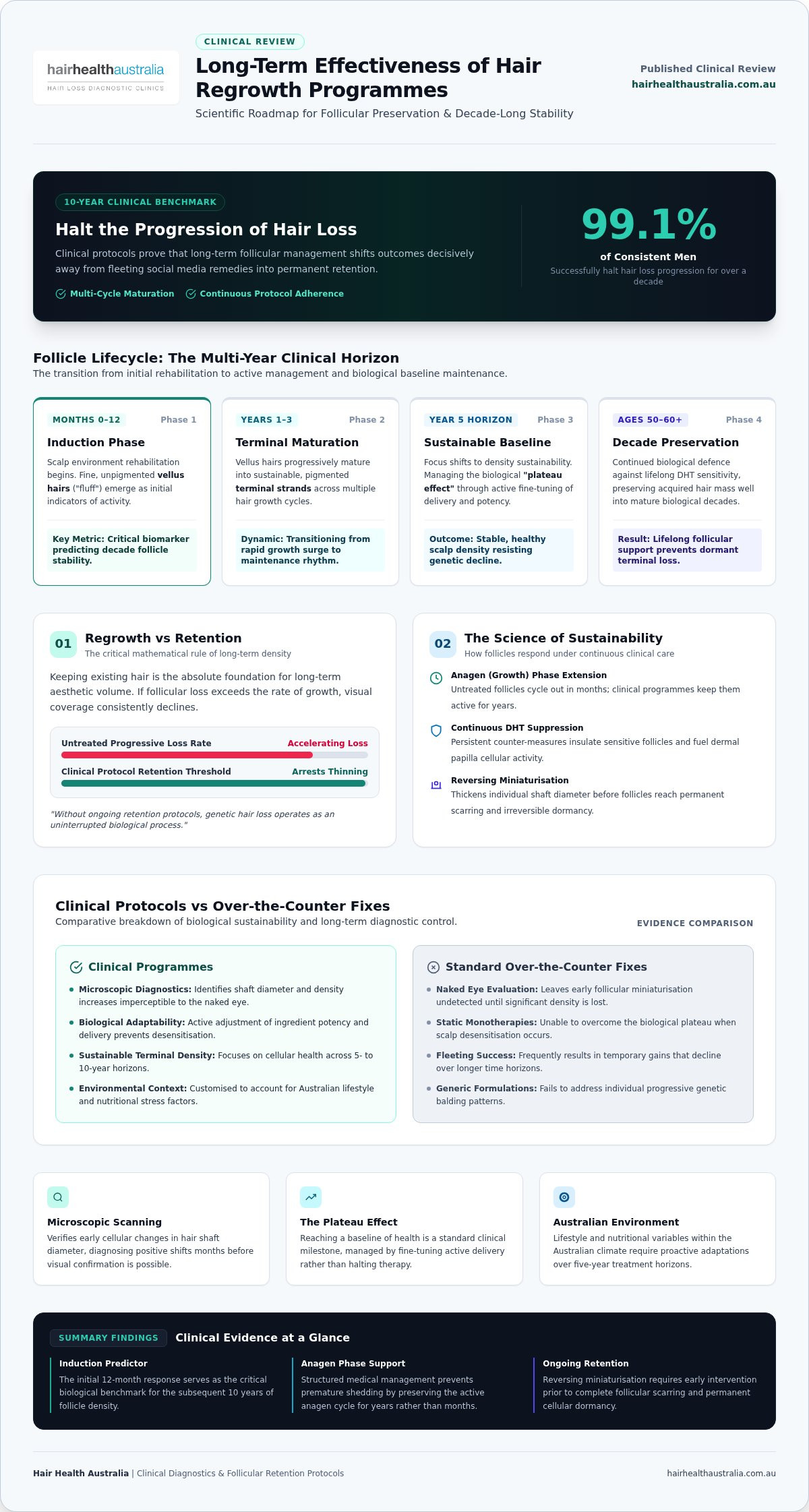
Did you know that 99.1% of men who remain consistent with clinical protocols can successfully halt the progression of hair loss for over a decade? It’s a figure that stands in stark contrast to the fleeting success stories often found on social media. If you’ve spent years worrying that your current routine is just a temporary fix, you aren’t alone. It’s exhausting to invest time and money into a programme while still fearing that progressive balding will eventually win. This 2026 clinical review explores the long-term effectiveness of hair regrowth programs to provide you with a clear, evidence-based roadmap for the years ahead.
You’ll discover why the first twelve months of treatment serve as a critical biomarker for your future results. We’ll also break down the transition from active regrowth to the vital maintenance phase, ensuring you have realistic expectations for your hair density at age 50 and older. By moving beyond simple monotherapies and embracing a customised, non-surgical path, you can replace uncertainty with the confidence that comes from scientific verification. Here is what the latest clinical data says about keeping the hair you have for the long haul.
Key Takeaways
- Understand why the first 12 months of treatment are considered the “induction phase” and how this period predicts your follicle stability for the next decade.
- Compare the long-term effectiveness of hair regrowth programs against standard over-the-counter fixes to identify which strategies offer sustainable density rather than temporary results.
- Learn how clinical protocols extend the anagen growth phase and manage DHT sensitivity to preserve hair health well into your 50s and 60s.
- Discover the specific lifestyle and nutritional factors within the Australian environment that can either support or hinder your results over a five-year horizon.
- Identify why microscopic diagnostics and professional oversight are the most effective ways to adapt your programme as your hair’s needs evolve over time.
Defining Long-Term Success in Hair Restoration
Success in hair restoration is often misunderstood as a rapid, permanent reversal of balding. In reality, the long-term effectiveness of hair regrowth programs depends on two distinct clinical outcomes: the total arrest of thinning and the restoration of terminal hair density. While many people look for a “cure”, the clinical reality is far more methodical. It requires a transition from reactive treatments to proactive, science-based management.
The first 12 months are merely the induction phase. During this time, the scalp environment is being rehabilitated. It’s common to see “fluff”-fine, unpigmented vellus hairs-appearing early on. However, true success involves these hairs maturing into sustainable, pigmented terminal strands. This maturation occurs over multiple growth cycles. Without a long-term perspective, patients often mistake the initial surge for a final result, leading to disappointment when the rapid pace of change naturally plateaus into a maintenance rhythm. Moving from a mindset of “fixing” a problem to a professional clinical management of hair loss strategy is the first step toward lasting results.
The Difference Between Regrowth and Retention
Keeping the hair you currently have is the most critical foundation for long-term density. If the rate of loss exceeds the rate of new growth, the overall aesthetic will continue to decline. Clinical programmes aim to reverse follicular miniaturisation by providing the necessary biological support to follicles before they become dormant. We use microscopic scanning to measure these changes accurately. This diagnostic approach allows us to see increases in hair shaft diameter and density that the naked eye might miss for months. It’s a precise way to verify that your strategy is actually working at a cellular level.
Setting Realistic Expectations for the 5-Year Mark
By the five-year mark, the focus of a successful protocol shifts toward sustainability. You won’t see a perpetual surge of new growth every month. Instead, success looks like a stable, healthy scalp where density is maintained despite the natural, progressive nature of genetic hair loss. Consistency is the single greatest predictor of the long-term effectiveness of hair regrowth programs. Because hair loss is a biological process that doesn’t simply “stop”, the counter-measures must be ongoing. Starting with a comprehensive Hair Health Check ensures your protocol is tailored to your specific rate of loss, allowing for adjustments as your biology changes with age.
The Science of Sustainability: How Follicles Respond Over Time
Sustainable hair density isn’t a one-time achievement; it’s the result of ongoing biological support. Clinically backed protocols work by extending the anagen (growth) phase of the hair cycle. While untreated follicles might spend only months in this phase before shedding, a structured programme keeps them active for years. This persistent support is vital because dihydrotestosterone (DHT) continues to target genetically sensitive follicles throughout a person’s life. The long-term effectiveness of hair regrowth programs depends on this continuous suppression of DHT and the stimulation of cellular activity within the dermal papilla.
Many people notice a period where results seem to stall, often called the plateau effect. This doesn’t mean the treatment has failed. Instead, the follicle has reached a new baseline of health. Clinicians manage this by adjusting the potency or delivery methods of active ingredients to ensure the scalp doesn’t become desensitised. By following the AAD guidance on hair loss diagnosis and treatment, professionals can identify when a protocol needs fine-tuning to overcome these biological hurdles and maintain momentum.
Reversing Follicular Miniaturisation
Follicular miniaturisation is the progressive shrinking of the hair follicle due to androgenetic factors. Success over several growth cycles involves thickening these individual shafts through targeted stimulation. However, there’s a biological limit. Once a follicle has completely miniaturised and scarred over, regrowth is no longer possible. This is why early intervention is the primary predictor of how much density you can reclaim over five or ten years. A personalised Hair Health Check provides the diagnostic data needed to identify these follicles before they reach the point of no return.
The Role of Scalp Health in Programme Longevity
Think of the scalp as the soil for your long-term crop. If the scalp is inflamed or congested with sebum, topicals cannot penetrate effectively. This leads to treatment fatigue where the programme loses its punch because the active ingredients aren’t reaching the follicle bulb. Regular clinical reviews allow us to monitor micro-circulation and scalp health, ensuring the environment remains optimal for growth. Addressing these underlying issues is essential for maintaining the long-term effectiveness of hair regrowth programs and ensuring that cellular health supports the hair for decades, not just months.
Clinical Programmes vs. Over-the-Counter Fixes: A Longevity Comparison
Many Australians begin their journey with a supermarket shelf solution, hoping for a quick fix. While these over-the-counter products might show initial promise, they often fail to deliver after the six-month mark. This failure isn’t always due to the ingredients themselves, but rather the lack of a comprehensive strategy. The long-term effectiveness of hair regrowth programs depends on a multi-modal approach that addresses the multiple pathways of hair loss simultaneously. Single-ingredient “fixes” rarely provide enough biological coverage to combat progressive thinning over several years.
Clinical oversight bridges the “adherence gap” that causes up to 70% of DIY users to quit within the first twelve months. When you’re managing this journey alone, it’s easy to become discouraged by temporary shedding or a perceived lack of progress. A clinical setting provides the diagnostic proof needed to stay the course. From a financial perspective, investing in a series of ineffective, cheap treatments over five years often costs more than a single, high-quality clinical protocol that actually preserves your hair density.
The Danger of the ‘Stop-Start’ Cycle
Stopping treatment abruptly is one of the most common mistakes. Within six to twelve months of cessation, any medically preserved hair is typically lost as the follicles return to their original baseline of miniaturisation. This “stop-start” cycle is physically and emotionally taxing. Clinical programmes avoid this by transitioning patients into low-intensity maintenance modes. These phases are designed to sustain results while reducing the daily burden of treatment, preventing the burnout that leads many to walk away.
Customisation: The Key to Multi-Year Success
A one-size-fits-all dosage rarely stays effective as your biology evolves with age. What worked for you at 30 may not be sufficient at 45. This is where a hair health check becomes indispensable. By using microscopic data rather than guesswork, Sydney-based clinicians can pivot-point your treatment, adjusting concentrations and delivery methods to ensure the long-term effectiveness of hair regrowth programs. This level of customisation is the only way to stay ahead of the progressive nature of hair loss as you grow older.
Factors That Influence Your Results Over 5+ Years
While genetic predisposition defines your baseline rate of loss, it isn’t the only factor determining your success. The long-term effectiveness of hair regrowth programs is heavily influenced by how your body adapts to external stressors over time. Hormonal shifts in your 40s and 50s can alter follicle sensitivity, meaning a protocol that worked in your 30s may require clinical adjustment to remain potent. Understanding these biological transitions allows us to stay ahead of the curve rather than reacting after density has already dropped.
Lifestyle choices also play a significant role. High stress levels and nutritional deficiencies common in fast-paced Australian lives can trigger telogen effluvium, which complicates genetic thinning. Maintaining hair vitality over a five-year horizon requires a holistic approach that supports the follicle from both the inside and outside. We look at your total health profile to ensure your body has the raw materials necessary to sustain a healthy growth cycle.
The Australian Environment and Hair Health
Living in Sydney presents unique challenges for hair restoration. Intense UV exposure doesn’t just damage the skin; it degrades the hair cuticle, making strands brittle and prone to breakage. If you’re frequently in the surf, salt water can lead to mineral buildup and dehydration of the scalp. This environmental tax can undermine your results if not managed correctly. Local water quality also varies, and mineral-heavy water can lead to product buildup that prevents topicals from absorbing. We often recommend specific protective measures to ensure your investment in hair health isn’t stripped away by the elements.
Consistency and Adherence: The ‘Secret’ Ingredient
Clinical data suggests that a significant portion of long-term failure stems from inconsistent application rather than a lack of biochemical efficacy. It’s easy to become complacent once you see initial success. However, the long-term effectiveness of hair regrowth programs relies on building a sustainable daily routine. Missing even a few days a week can allow DHT levels to fluctuate, giving miniaturisation a chance to resume. Regular clinical check-ins are vital here. They provide the accountability and diagnostic proof needed to maintain your motivation for years to come. To ensure your protocol is keeping pace with your changing needs, book a comprehensive Hair Health Check today.
Securing Your Future Growth: The Importance of Clinical Oversight
Achieving a decade of sustained hair density requires moving beyond the trial-and-error phase that characterises many DIY attempts. By 2026, the evolution of non-surgical technology has made it possible to manage hair loss with a level of precision previously reserved for surgical interventions. However, the long-term effectiveness of hair regrowth programs isn’t just about the technology itself; it’s about the clinical oversight that guides its application. Having a dedicated specialist to monitor your progress ensures that your protocol remains aligned with your biological needs as they evolve over time.
Hair Health Australia bridges the gap between complex clinical science and empathetic personal care. We understand that your journey is unique, and our role is to act as your partner in hair retention. By providing a structured framework for your treatment, we replace the anxiety of progressive balding with a clear, evidence-based plan for the future. This professional guidance is what transforms a temporary fix into a lifelong strategy for hair vitality.
The Value of Microscopic Monitoring
One of the most significant advantages of clinical oversight is the ability to detect follicular changes long before they become visible in the mirror. We use advanced microscopic hair analysis to track the exact diameter and density of your hair shafts. This data-driven approach provides objective proof of the long-term effectiveness of hair regrowth programs, allowing us to confirm that your follicles are responding correctly. If the data shows a slowdown, we can intervene early, adjusting your programme to maintain your results without the guesswork that often leads to treatment failure.
Your Personalised Path to Retention
Your biological makeup is as unique as your DNA, which means your path to hair restoration should be equally individualised. Relying on generic dosages often leads to sub-optimal results because it ignores the specific rate of your genetic loss and your scalp’s unique environment. The reassurance of having a Sydney-based specialist manage your journey cannot be overstated. We provide the accountability and expertise needed to navigate the complexities of long-term maintenance. To secure your hair’s future and move forward with confidence, book your comprehensive Hair Health Check today and start your first step toward a decade of better hair.
Securing a Decade of Hair Density
Maintaining hair density for the next ten years is a commitment to biological management rather than a search for a quick fix. We’ve explored how the long-term effectiveness of hair regrowth programs depends on consistent clinical oversight, personalised protocols, and the transition into a sustainable maintenance phase. Relying on superficial supermarket solutions often leads to a cycle of regression, whereas a science-led approach preserves the follicles you still have.
Our expert Sydney-based clinical team uses personalised microscopic diagnostic scans to ensure every adjustment is based on data, not guesswork. These clinically-backed, non-surgical protocols are designed to evolve with your biology, providing the clarity and confidence needed to manage your hair health effectively. You don’t have to navigate progressive thinning alone or settle for temporary results that fail to last.
The first step toward securing your hair’s future is a professional evaluation of your current scalp health. Book Your Comprehensive Hair Health Check today to build a roadmap for the years ahead. It’s time to replace uncertainty with a proven, long-term path to retention.
Frequently Asked Questions
Is the hair regrowth from clinical programmes permanent?
Regrowth achieved through clinical protocols isn’t permanent because androgenetic hair loss is a progressive biological condition. The treatments work by managing the follicle’s environment and suppressing DHT. If you stop the programme, the underlying genetic process resumes, and your hair will eventually return to the state it would have been in without intervention. Sustainable results require ongoing maintenance to keep follicles active and healthy over the long term.
Can I reduce my treatment frequency once I see results?
You can often transition to a maintenance phase once your target density is achieved. This typically involves reducing the frequency of applications or the potency of active ingredients. However, this shift must be managed clinically to ensure the follicles don’t lose the support they’ve grown accustomed to. A specialist will use microscopic data to determine the lowest effective frequency that still protects the long-term effectiveness of hair regrowth programs for your specific scalp.
Why do some people stop seeing results after two years?
Stalled results often occur due to “treatment fatigue” or a shift in your underlying hormonal profile as you age. Your body’s response to a specific dosage can change over time, or the rate of genetic loss may accelerate. This is why a static, one-size-fits-all approach often fails after the initial surge. Regular clinical reviews allow us to pivot your protocol and adjust active ingredients to overcome these biological plateaus and keep follicles stimulated.
How does the Sydney climate affect my hair regrowth programme?
Sydney’s intense UV radiation and high salt water exposure can compromise scalp health and damage the hair cuticle. Intense sun exposure can cause inflammation, while salt water can lead to mineral buildup that prevents topical treatments from absorbing correctly. We recommend using protective scalp care and ensuring thorough cleansing after beach visits. These local environmental factors are critical to manage if you want to maintain the long-term effectiveness of hair regrowth programs in Australia.
Will my hair fall out faster if I stop the programme?
Your hair won’t fall out at an accelerated rate, but you will experience a period of rapid shedding as your follicles return to their genetically predetermined state. Within six to twelve months of stopping, any hair that was medically preserved or regrown will likely be lost. It feels like faster loss because you’re losing years of progress in a short window, returning to the exact baseline of thinning you would have reached without treatment.
Are there long-term side effects to non-surgical hair loss treatments?
Most non-surgical treatments are well-tolerated over decades when managed by a specialist. While individual reactions vary, clinical oversight ensures that any scalp irritation or systemic responses are identified early. By using personalised protocols rather than generic high-dose solutions, we minimise risks. Long-term safety relies on regular check-ins where we can monitor your scalp’s health and adjust the vehicle or concentration of your treatment to suit your body’s changing tolerances.
How often should I have a microscopic hair analysis to track effectiveness?
We recommend a microscopic hair analysis every six to twelve months to track your progress accurately. This diagnostic scan allows us to see changes in hair shaft diameter and follicular unit density that the naked eye simply cannot detect. By reviewing these metrics regularly, we can verify that your programme is working at a cellular level. It provides the objective data needed to make informed adjustments to your protocol before visible thinning recurs.
Can a hair regrowth programme work for total baldness over the long term?
Regrowth programmes are ineffective for areas of the scalp that are totally bald and have been for several years. Once a follicle has completely miniaturised and the scalp has scarred over, it can no longer produce a terminal hair. These programmes are designed to rescue and thicken existing thinning hair. If you’ve lost all follicles in a specific area, non-surgical treatments won’t restore them; their primary value lies in preserving and restoring early-to-moderate thinning.