Did you know that approximately 50% of Australians are impacted by hair loss by the time they reach the age of 50? It’s a confronting reality that often leads to a cycle of frustration, especially when you’ve spent significant money on chemist shelf products that deliver few results. If you feel anxious about social situations or fear that invasive surgery is your only remaining path, you aren’t alone. Finding an effective regrowth treatment for hair should be a clinical process rather than a gamble. We understand the need for a solution that replaces uncertainty with scientific clarity and restores your confidence without the need for a hospital stay.
This clinical guide explores the most effective, non-surgical advancements available in 2026 for restoring hair density. You’ll learn how a systematic diagnostic approach can identify the underlying causes of thinning to ensure your treatment aligns with your specific biological needs. We’ll outline the path toward a sustainable maintenance programme and explain how personalised advice from a specialist can lead to visible results. It’s time to move beyond temporary fixes and embrace a professional strategy built on evidence and long-term follicle health.
Key Takeaways
- Understand the clinical distinction between simple hair growth and the multi-modal process of restoring follicle density.
- Learn why self-diagnosing through social media often leads to wasted investment and how to pivot to evidence-based solutions.
- Compare the latest non-surgical options for 2026 to find the most effective regrowth treatment for hair based on your specific pattern of loss.
- Discover why a microscopic scalp analysis is essential for identifying follicle health before starting any clinical programme.
- Explore how a personalised combination of nutrition, topical applications, and in-clinic therapy can maximise your results.
Defining Clinical Regrowth Treatment for Hair
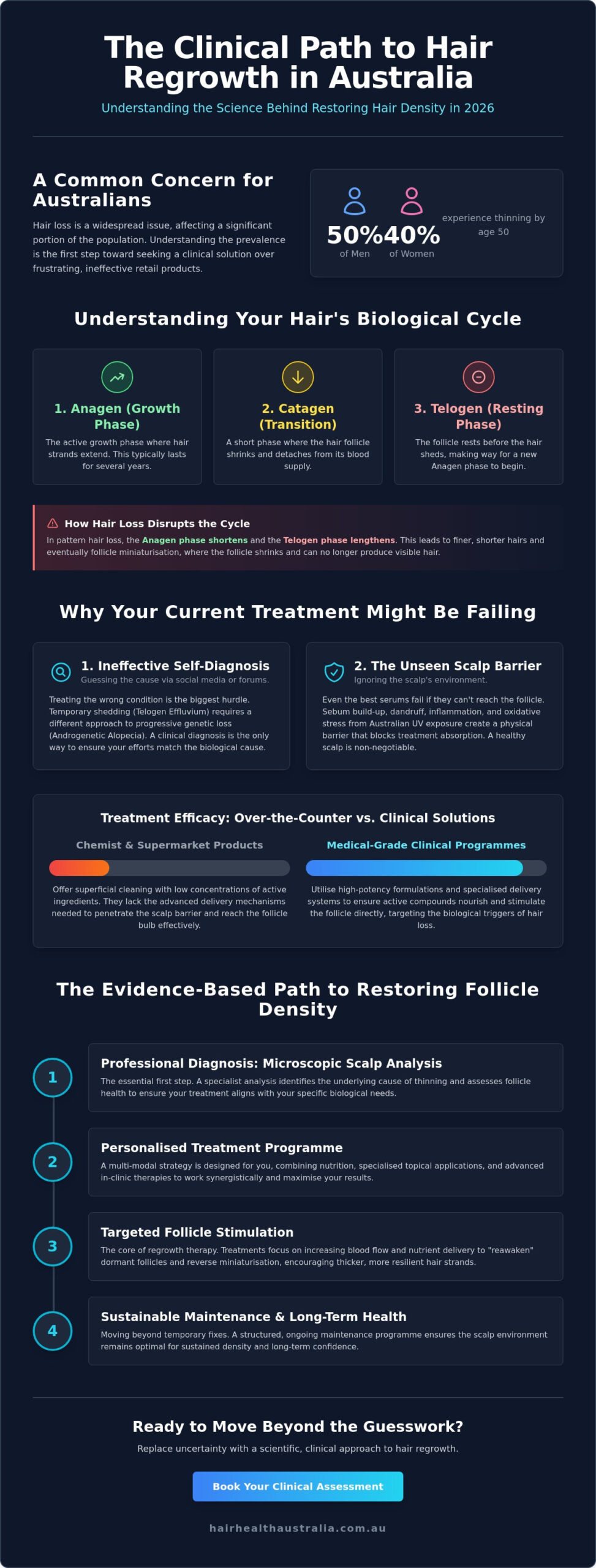
Understanding the difference between hair growth and hair regrowth is the first step toward a successful recovery. While hair growth refers to the simple extension of existing strands, a clinical regrowth treatment for hair focuses on increasing density by addressing the health of the follicle itself. In 2026, we view regrowth as a multi-modal biological process rather than a cosmetic cover-up. This involves shifting follicles from a dormant state back into an active phase to restore the scalp’s natural volume. It’s a systematic approach that prioritises the underlying health of the scalp environment.
The hair on your head follows a specific biological cycle, and disruptions to this rhythm lead to visible thinning. The three primary stages include:
- Anagen: The active growth phase, which typically lasts several years.
- Catagen: A short transitional phase where the hair follicle shrinks and detaches from the blood supply.
- Telogen: The resting phase, which concludes with the hair shedding to make room for new growth.
When someone experiences Pattern hair loss, the Anagen phase shortens while the Telogen phase lengthens. This results in hairs that are finer, shorter, and eventually non-existent. Non-surgical clinical interventions are now the primary first-line defence because they target these biological triggers before permanent loss occurs. With approximately 50% of Australian men and 40% of women experiencing thinning by age 50, catching these cycle changes early is essential for maintaining a full head of hair.
Medical-Grade vs. Over-the-Counter Solutions
Many Australians begin their journey with chemist-bought shampoos, only to find they offer little more than a superficial clean. These retail products often lack the necessary concentration of active ingredients to reach the dermal papilla effectively. Clinical solutions differ because they utilise advanced delivery mechanisms to penetrate the scalp’s barrier. Specialised clinics provide access to higher-potency formulations that aren’t available on retail shelves, ensuring the active compounds actually reach the follicle bulb where they’re needed most.
The Role of Follicle Stimulation in Regrowth
Success relies on precise timing. Dormant follicles can be “reawakened” through targeted stimulation, but this window closes once the follicle undergoes fibrosis, or permanent scarring. Effective regrowth treatment for hair increases blood flow and nutrient delivery to the hair bulb, providing the cellular energy required for repair. Follicle miniaturisation is the primary target of regrowth therapy; it is the process where follicles progressively shrink until they can no longer produce a visible hair. By intercepting this process with a structured programme, we can reverse the shrinking and encourage the production of thicker, more resilient strands.
Why Your Current Hair Treatment Might Not Be Working
Many Australians feel a deep sense of frustration after spending significant time and money at the chemist on products that promise the world but deliver very little. It’s a common story. You’ve likely tried the caffeine shampoos, the supermarket serums, and perhaps even the latest “miracle” oil trending on social media. The reality is that a generic regrowth treatment for hair often fails because it isn’t addressing your specific biological requirements. Self-diagnosing via internet forums or TikTok is a risky strategy that usually leads to wasted investment. Additionally, our local environment plays a significant role. High UV exposure and humidity in Australia can cause oxidative stress on the scalp, creating chronic inflammation that physically blocks your follicles from responding to treatment.
Misdiagnosing the Type of Hair Loss
One of the biggest hurdles to success is treating the wrong condition. There’s a fundamental difference between Telogen Effluvium, which is temporary shedding often triggered by stress or illness, and Androgenetic Alopecia, which is a progressive genetic condition. If your thinning is caused by hormonal shifts, a simple vitamin supplement won’t provide a solution. Obtaining a professional hair loss diagnosis and treatment plan is the only way to ensure your efforts match the biological cause. Without this clarity, you’re essentially guessing, which is why so many people feel that “nothing works” for them. For a deeper understanding of how progressive baldness develops and what clinical options are available, our hair loss baldness treatment guide for 2026 provides a comprehensive evidence-based overview.
The Barrier of Scalp Health
Even the most advanced medical-grade serums can’t work if they can’t reach the target. Excessive sebum build-up, dandruff, and microscopic inflammation create a physical and chemical barrier on the scalp surface. While the “clogged pore” theory is often oversimplified in marketing, clinical follicular occlusion is a real issue that prevents active ingredients from penetrating the skin effectively. A healthy, balanced scalp environment is the non-negotiable foundation for any successful programme. If you’re ready to move past trial and error, a specialised assessment at Hair Health Australia can help identify these hidden barriers. We focus on clearing the path so that your chosen regrowth treatment for hair can actually do its job and reach the follicle bulb.
Comparing Non-Surgical Regrowth Options in Australia
Selecting the right regrowth treatment for hair requires an understanding of how different modalities interact with your unique biology. In 2026, the most successful outcomes are achieved through a multi-therapy approach. Instead of relying on a single product, we combine several targeted interventions to attack hair loss from multiple angles. This strategy addresses several key factors:
- Hormonal triggers that lead to follicle miniaturisation.
- Increasing micro-circulation to ensure consistent nutrient delivery to the hair bulb.
- Providing the necessary cellular stimulation to prolong the Anagen (growth) phase.
By integrating these elements, we can create a synergistic effect that is far more powerful than any standalone solution. This clinical methodology ensures that every aspect of the hair growth cycle is supported, providing a robust foundation for restoring density without the need for invasive surgery.
Topical and Oral Clinical Medications
The evolution of traditional medications like Minoxidil and Finasteride has moved toward a high degree of personalisation. In the Australian market, there is a growing trend toward compounded medications. This allows for customised strengths and combinations, such as a 60ml topical solution featuring varying concentrations of active ingredients tailored to individual scalp sensitivity. Clinical supervision is vital during this process. It helps mitigate potential side effects and ensures that the delivery mechanism, whether oral or topical, is suitable for your daily routine. Compounding often leads to better results because the treatment is designed specifically for your tolerance levels, reducing the likelihood of irritation that often accompanies generic retail products.
Advanced Therapies: PRP and Laser Technology
Advanced clinical therapies have become a cornerstone of modern non-invasive care. Platelet-Rich Plasma (PRP) therapy utilises the growth factors found in your own blood to stimulate dormant follicles. By concentrating these proteins and reintroducing them to the scalp, we can trigger a regenerative response that encourages thicker hair production. Alongside this, Low-Level Laser Therapy (LLLT) uses photo-biomodulation to enhance cellular metabolism. This process provides the hair bulb with the energy required to produce healthier, more resilient strands. LLLT is particularly versatile, with options for both in-clinic sessions and medical-grade home devices that fit into a busy Australian lifestyle.
Patience is a requirement for any clinical programme. While some individuals notice changes in hair texture sooner, most advanced therapies require a consistent commitment over three to six months to see a visible increase in density. This timeline aligns with the natural biological cycles of the scalp. A comprehensive regrowth treatment for hair is not about a quick fix; it is a sustainable, science-led journey toward restoring your natural hair density and confidence.
The Diagnostic Journey: Microscopic Analysis in Sydney
A standard physical examination by a general practitioner is often the first port of call for those noticing thinning, but a visual check alone can’t provide the depth of information required for a successful regrowth treatment for hair. While a GP can identify obvious scalp conditions, they lack the specialised high-definition tools needed to assess the microscopic health of individual follicles. At our Sydney clinic, we’ve established a centre of excellence that replaces subjective “guessing” with precise, data-driven diagnostics. By utilising advanced microscopic scanning, we can look beneath the surface to understand exactly why your hair is thinning and, more importantly, what can be done to stop it.
Why Microscopic Scanning Beats Visual Inspection
Microscopic scanning allows us to view the scalp at a level of detail that’s impossible to achieve with the naked eye. We can accurately measure hair shaft diameter and follicle density across different zones of the scalp. This high-definition perspective is crucial because 50% of hair can be lost before it is visible to the naked eye. By the time you notice thinning in the mirror, the process is already well advanced. We use these initial scans to create a baseline, allowing us to track your progress with absolute certainty. When you return for a follow-up, we don’t just ask if it “feels thicker”; we show you the data-driven proof of your treatment’s efficacy.
Identifying Active vs. Dormant Follicles
The most valuable insight gained from a microscopic scan is the ability to distinguish between an active, a dormant, and a non-viable follicle. This distinction is the difference between a successful regrowth treatment for hair and a wasted investment. If a follicle has undergone complete fibrosis and is no longer viable, no amount of topical serum will bring it back. Identifying these “dead” zones early saves you money and emotional energy by ensuring we only target areas capable of recovery. Our hair specialists interpret these complex scans to determine if a follicle is simply dormant and “reawakenable” or if it has reached a terminal stage. This level of transparency ensures you have realistic expectations from the outset.
If you’re tired of temporary fixes and want a clear, scientific understanding of your scalp health, it’s time to book a professional assessment. You can schedule your microscopic hair analysis at our Sydney centre to begin your journey with clinical precision.
Designing Your Personalised Hair Regrowth Plan
Every scalp is a unique biological ecosystem. Because of this, a “one-size-fits-all” approach to hair loss is almost always destined for limited success. A truly effective regrowth treatment for hair must be built around your specific baseline, taking into account your genetics, lifestyle, and current follicle health. We believe in a multi-modal strategy that integrates nutritional support, medical-grade topicals, and advanced in-clinic therapies—sometimes incorporating holistic wellness practices from the Zhong Centre to address internal health. By addressing the problem from multiple angles simultaneously, we create the optimal environment for your follicles to thrive and produce denser, healthier strands.
Success isn’t accidental. It requires a methodical review of how your scalp responds to initial interventions. As your regrowth treatment for hair progresses, we adjust the potency and frequency of your programme to match the changing needs of your follicles. This ensures that your plan remains sustainable and effective over the long term, preventing the plateaus that often occur with generic retail products. Regular clinical reviews allow us to document your progress with data-driven evidence, giving you confidence that your investment is yielding real-world results.
Tailoring Treatments for Men and Women
The biological drivers of thinning differ significantly between the sexes. For men, the focus is often on managing the hormonal impact of dihydrotestosterone (DHT), which causes the progressive miniaturisation of follicles. Understanding your specific men hair loss pattern is a critical first step, as the location and progression of thinning directly informs which clinical interventions will be most effective. In contrast, female hair thinning frequently involves a complex interplay of iron levels, hormonal shifts, and scalp sensitivity. Because these root causes are so distinct, “unisex” products are rarely the most effective solution. They often lack the specific concentration of active ingredients required to address the primary triggers for either gender. We design targeted programmes that respect these physiological differences, ensuring that every ingredient in your plan serves a specific purpose.
What to Expect During Your First Consultation
Your journey begins with a comprehensive clinical assessment. We start with a thorough history taking to understand your health background and any previous attempts at treatment. This is followed by the microscopic analysis discussed earlier, which provides a high-definition map of your scalp health. We don’t believe in vague promises. Instead, we use this diagnostic data to set realistic expectations and clear milestones for your journey. You’ll leave your first session with a transparent understanding of what can be achieved and a structured path forward.
If you’re ready to stop the guesswork and start a science-backed journey toward better hair density, our team is here to guide you. Taking that first step is often the most difficult part, but it’s the only way to move from anxiety to action. You can Book your clinical hair assessment in Sydney today and discover a personalised strategy designed specifically for your scalp.
Take the First Step Toward Restored Hair Density
Restoring your hair density is a biological journey that requires precision and a commitment to science-led protocols. We’ve explored how moving beyond retail products and embracing a clinical regrowth treatment for hair can replace uncertainty with a clear, actionable path forward. By prioritising advanced microscopic diagnostic technology over visual guesswork, you ensure that your treatment plan is built on a foundation of verifiable data rather than hope.
With over 15 years of clinical experience in Australia, our team specialises in non-surgical, evidence-based regrowth programmes that are tailored to your specific scalp health. You don’t have to navigate the frustration of thinning hair alone or resort to invasive procedures before exploring what modern clinical science can achieve. We invite you to Book Your Personalised Clinical Consultation in Sydney to gain the clarity and expert advice you deserve. It’s time to stop the cycle of trial and error and start a sustainable programme that focuses on long-term results and your personal confidence.
Frequently Asked Questions
How long does it take to see results from a regrowth treatment for hair?
Visible changes in density typically require three to six months of consistent clinical application. This timeline is dictated by the natural hair growth cycle, as it takes time for dormant follicles to re-enter the active Anagen phase. While you may notice a reduction in daily shedding within the first few weeks, a measurable increase in hair volume usually requires at least two full growth cycles to become apparent.
Are non-surgical hair regrowth treatments permanent?
Non-surgical treatments are not permanent and require a sustainable maintenance programme to preserve your results. Because conditions like androgenetic alopecia are progressive, the biological process of follicle miniaturisation will eventually resume if the treatment stimulus is removed. Think of it as a long-term health plan for your scalp that ensures your follicles continue to receive the necessary cellular signals and nutrient supply.
Can I use regrowth treatments if I have a sensitive scalp?
Yes, individuals with sensitive skin can successfully undergo a regrowth treatment for hair by utilising customised, medical-grade formulations. Many standard chemist products contain high concentrations of alcohol or propylene glycol which lead to irritation. Clinical compounding allows us to remove these common irritants and adjust the delivery mechanism to ensure the active ingredients are absorbed without causing scalp inflammation or discomfort.
Is PRP hair treatment more effective than Minoxidil?
These two treatments serve different biological functions and are often used together for a synergistic effect. Minoxidil acts primarily as a vasodilator to improve blood flow to the follicle, while Platelet-Rich Plasma (PRP) introduces concentrated growth factors to stimulate regenerative cellular activity. The most effective choice depends entirely on your specific diagnostic results and whether your follicles require increased circulation, cellular repair, or both.
What is the difference between hair thinning and hair loss?
Hair thinning refers to the process of miniaturisation, where the diameter of the hair shaft decreases over time, making the scalp more visible. Hair loss involves the actual shedding of the hair strand from the follicle or the permanent closure of the follicle itself. Distinguishing between the two is vital, as a regrowth treatment for hair is most successful when thinning is addressed before it progresses to total loss.
Does Medicare cover hair regrowth treatments in Australia?
Medicare and private health insurance providers in Australia generally do not cover hair regrowth treatments, as they are classified as cosmetic rather than medically necessary. This classification applies to most elective aesthetic procedures, including the surgical options provided by specialists like Australia Cosmetic Clinics. However, if your hair loss is triggered by an underlying medical condition, such as a thyroid disorder or severe nutritional deficiency, the diagnostic blood tests ordered by your GP may be eligible for a rebate. It is always advisable to check with your specific fund.
Can stress-related hair loss be reversed with clinical treatment?
Stress-related hair loss, known clinically as Telogen Effluvium, is often reversible with a structured clinical programme. While this type of shedding can sometimes resolve on its own, a professional treatment plan helps “reset” the hair cycle more efficiently. By providing the follicles with targeted stimulation, we can encourage a faster transition from the resting phase back into the active growth phase, minimising the duration of the thinning period.
How do I know if my hair follicles are still alive?
The only accurate way to determine follicle viability is through a microscopic scalp analysis. This technology allows a specialist to identify if a follicle is truly “dead” and scarred over, or if it is simply dormant and producing a fine, microscopic vellus hair. If the follicle is still active at a microscopic level, it remains a candidate for clinical hair loss and baldness treatment therapies designed to restore its original diameter and strength.